
Amazon Flex Canada Review: Can You Really Make $25/Hour?
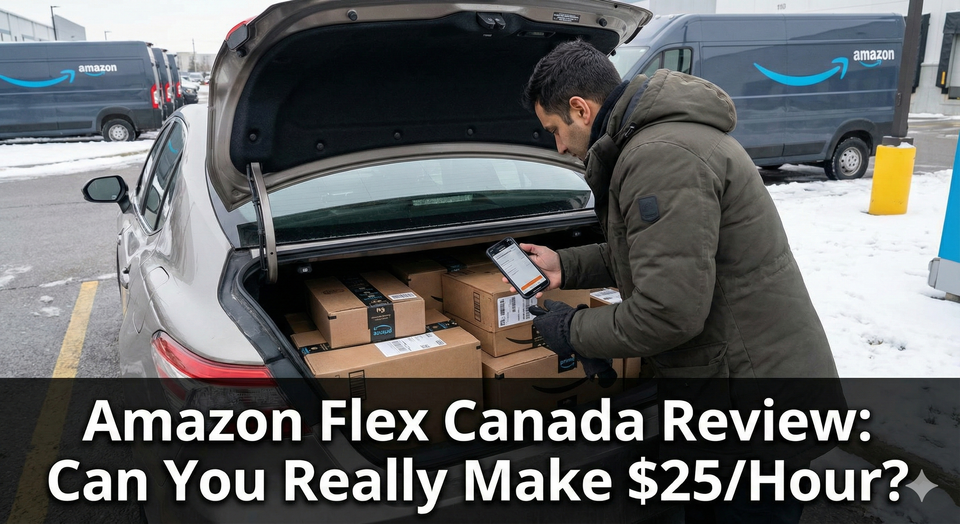
It sounds like the perfect setup: You download an app, pick up a few boxes from a warehouse, drop them off at houses in your city, and get paid $25 to $30 per hour. No boss, no uniform, and no annoying passengers like Uber.
That is the promise of Amazon Flex. In major hubs like Toronto (Scarborough/Etobicoke), Vancouver (Delta/Burnaby), and Calgary, it has become one of the most popular side hustles in Canada.
But if you look at the Reddit forums or talk to drivers in the Tim Hortons parking lot, you hear a different story. You hear about "bot grabbers" stealing shifts, 200-kilometer routes that destroy your suspension, and gas prices eating half your profit.
So, is Amazon Flex actually worth it in 2026? Or are you just borrowing money from your car's future value?
We analyzed the numbers, the "Surge" blocks, and the real driver expenses to give you the definitive Canadian review.
How Amazon Flex Works (The "Block" System)
Unlike Uber Eats or DoorDash, where you can log on and off whenever you want, Amazon Flex works on scheduled shifts called "Blocks."
- The Offer: You open the app and see a list of "Blocks" (e.g., 3.5 Hours - $84.00 - Etobicoke Station DYZ1).
- The Gamble: You accept the block without knowing the route. You only know the pay and the warehouse location. You could be delivering to 40 houses in a nice subdivision, or 10 apartments in downtown traffic.
- The Delivery: You drive to the station, scan your license, load your car (Tetris style), and follow the GPS to drop off every package.
- The Pay: You are paid a flat rate for the block. If you finish early, you still get the full amount. If you finish late, you usually don't get extra (unless you fight support for an adjustment).
The Math: Revenue vs. Reality
Amazon advertises earnings of $22 – $27 per hour. Let's break down a typical 3.5-hour block in a high-cost city like Toronto or Vancouver.
The "Base Pay" Scenario
- Block Offer: $84.00 for 3.5 hours ($24/hour).
- Distance Driven: 100 km (Warehouse to route + route + drive home).
- Gas Cost: approx. $15.00 (at $1.60/L).
- Vehicle Wear & Tear: approx. $10.00 (Tires, brakes, oil, depreciation).
- Real Profit: $84 - $25 = **$59.00**.
- Real Hourly Wage: $16.85 per hour.
- Verdict: AVOID. At base pay, you are barely making minimum wage while destroying your car.
The "Surge Pay" Scenario (The Only Way to Win)
When Amazon is desperate (snowstorms, holidays, or last-minute shifts), the price of the block goes up. This is called a "Surge."
- Block Offer: **$120.00** for 3.5 hours ($34/hour).
- Expenses: Still $25.00.
- Real Profit: $120 - $25 = **$95.00**.
- Real Hourly Wage: $27.14 per hour.
- Verdict: BUY. This is where the money is. The secret to Flex is only taking surged blocks.
Local Proof: The "Station Roulette"
Your experience depends entirely on which station you pick up from.
- Toronto (Etobicoke DYZ1): Notorious for sending drivers to downtown Toronto condos. Avoid this unless you like fighting for parking and climbing stairs.
- Brampton / Mississauga (DYZ2 / DGT5): Usually sends you to residential suburbs or rural areas (Caledon). More driving, but less stopping.
- Vancouver (Delta DVC1): Often sends drivers to Surrey or White Rock. Heavy traffic during rush hour (3 PM - 6 PM blocks are risky).
- Ottawa (DYOW): Known for massive rural routes in winter. You absolutely need snow tires here.
Consensus Verdict: Is Amazon Flex Worth It?
The "Buy" Verdict:
- Do it if: You have a reliable, fuel-efficient "beater" car that you don't care about scratching.
- Do it if: You can work during bad weather. Amazon pays premium rates when it rains or snows because other drivers stay home.
- Do it if: You want zero human interaction. Unlike Uber Eats, you rarely talk to customers. You just drop the box and leave.
The "Avoid" Verdict:
- Don't do it if: You drive a pickup truck or a V8 SUV. The gas cost will wipe out your profit.
- Don't do it if: You have a bad back. You might have to carry cases of water or cat litter up apartment stairs.
- Don't do it if: You need guaranteed full-time hours. Getting blocks is competitive; you cannot rely on this for rent money.
Amazon Flex vs. Amazon DSP (The Blue Vans)
Many people confuse Flex with being a full-time Delivery Service Partner (DSP) driver.
| Feature | Amazon Flex (You) | Amazon DSP (Blue Van) |
| Vehicle | Your Personal Car | Company Provided Van |
| Gas | You Pay | Company Pays |
| Schedule | Flexible (Pick blocks) | Fixed (10-hour shifts) |
| Pay | Per Block ($24-$35/hr) | Hourly ($19-$22/hr) |
| Commitment | Zero (Work when you want) | Full-Time (4 days/week) |
| Best For | Side Hustlers | Job Seekers |
Internal Link: If you prefer the stability of the DSP route, check out our guide on Best Full-Time Jobs That Don't Require Experience.
Practical Questions Answered
"Is it true that bots steal all the shifts?"
Consensus: Yes, unfortunately.
In major markets like Toronto and Vancouver, some drivers use illegal "block grabber" bots to instantly accept high-paying surge blocks before humans can click them. Amazon constantly bans these users, but it is a cat-and-mouse game.
- The Fix: You have to be fast. The best time to swipe for blocks is often 45 minutes before the shift starts, as people forfeit them last minute to avoid penalties.
"Does my regular car insurance cover this?"
NO.
This is the biggest risk. Personal auto insurance policies exclude commercial use. If you get into an accident while delivering a package and you haven't told your insurer, they will deny your claim and cancel your policy.
- The Fix: Amazon Flex Canada provides a free "Commercial Auto Insurance Policy" (usually through Marsh) that covers you while you are on a block. However, you still legally need to tell your personal insurer you are doing rideshare/delivery work, or they can drop you for "material misrepresentation."
"What happens if I can't deliver a package?"
If an apartment buzzer doesn't work or a business is closed, you have to drive the package back to the warehouse at the end of your shift.
- The Pain: You are not paid extra for this return trip. This is why drivers hate downtown routes.
Frequently Asked Questions
How do I sign up for Amazon Flex in Canada?
You must download the Amazon Flex app (not available in the regular App Store/Google Play; you have to download it directly from their website). You need a valid Canadian driver’s license, a smartphone, and a background check. Note: Many cities have a Waitlist that can last 3–6 months.
Can I do Amazon Flex with a G2 license in Ontario?
Yes. Amazon Flex accepts a G2 license in Ontario (or the equivalent "Probationary" license in other provinces). You do not need a full G license, unlike some rideshare requirements for carrying passengers.
When does Amazon release Flex blocks?
There is no set time, but veteran drivers report "drops" happening at specific intervals (e.g., Friday evenings for the weekend schedule). However, the best "Surge" blocks usually appear early in the morning (3:00 AM – 5:00 AM) for same-day shifts or during bad weather.
Does Amazon Flex pay for gas?
No. You are an independent contractor. All vehicle expenses, including gas, parking tickets, and maintenance, are your responsibility. You must track your mileage carefully to claim these as tax deductions at the end of the year.
Is Amazon Flex better than Uber Eats?
It depends on your personality. Flex pays a guaranteed amount—you know exactly how much you will make before you start. Uber Eats is a gamble on tips. Flex is better for those who want stability and hate waiting in restaurants, but it requires more physical labor (heavy boxes).
About the author
Jeff Calixte (MC Yow-Z) is a Canadian career researcher and digital entrepreneur who studies hiring trends, labour market data, and real entry-level opportunities across Canada. He specializes in simplifying the job search for newcomers, students, and workers using practical, up-to-date information.
Sources
- Amazon Flex Canada (Official Requirements): https://flex.amazon.ca/
- Government of Canada (Gig Economy Tax Info): https://www.canada.ca/en/revenue-agency/programs/about-canada-revenue-agency-cra/compliance/platform-economy.html
- Marsh Canada (Amazon Commercial Insurance Policy): https://www.marsh.com/ca/en/home.html
Note:
Job availability, wages, and hiring conditions can vary widely by province, employer, season, and experience level. All salary ranges and job examples in this guide are estimates based on current labour market data. Always confirm details directly with the employer before applying.