
Best Factory & Manufacturing Jobs in Canada (Light Industrial & EV Boom 2026)
For decades, "Factory Work" had a bad reputation. People imagined grease, smoke, and dangerous machinery.
In 2026, that image is dead.
Canada is currently in the middle of a Manufacturing Renaissance, driven by two massive forces: Electric Vehicles (EVs) and Food Security.
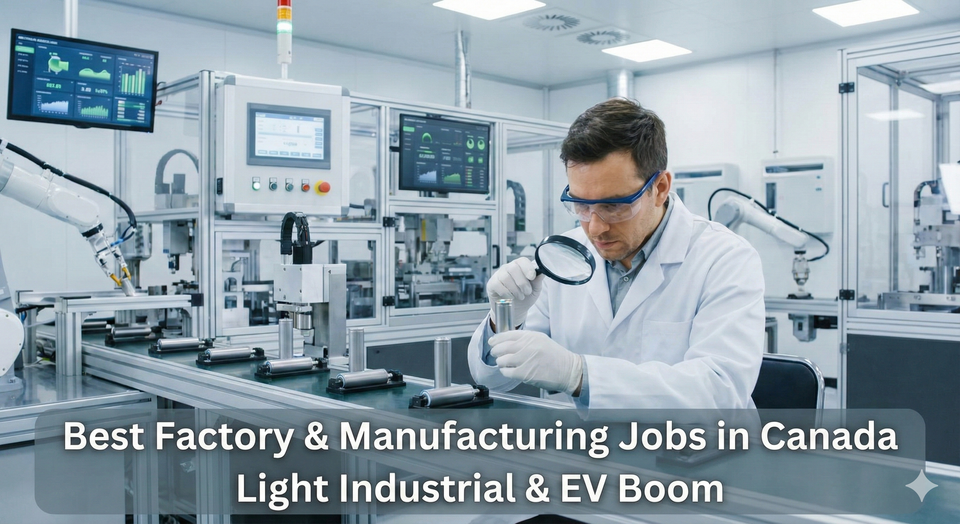
The new factories being built today (like the massive Volkswagen "Gigafactory" in St. Thomas, Ontario) look more like science labs than old-school mills. They are climate-controlled, highly automated, and require workers who can operate touch screens and robots.
Because these plants are receiving billions in government subsidies, they are hiring thousands of people at wages that far exceed the retail or service sectors. A "General Assembler" in an auto plant can earn $26/hr on Day 1 and over $40/hr within a few years.
If you are looking for a career that offers the stability of the past with the technology of the future, here are the best factory and manufacturing jobs in Canada right now.
1. The EV Battery "Gigafactories" (The New Gold Rush)
Status: Hiring Blitz (2026)
Locations: St. Thomas, Windsor, Alliston (Ontario), Bécancour (Quebec).
This is the single biggest opportunity for blue-collar workers in Canada in 20 years.
- Volkswagen PowerCo (St. Thomas): This massive plant is ramping up to hire 3,000+ workers. They need "Cell Assembly Operators" and "Logistics Technicians."
- NextStar Energy (Stellantis/LG in Windsor): Hiring over 2,500 people. They recently shifted focus to energy storage modules, but the jobs remain secure.
- The Pay: Starting wages for production staff are expected to be in the $24.00 – $29.00 per hour range, with skilled trades (millwrights/electricians) earning $45.00+.
- The Vibe: These are "Clean Rooms." You wear anti-static suits. The work is precise. You aren't lifting heavy metal; you are monitoring automated systems that assemble battery cells.
- How to Apply: These companies often use specific recruitment portals (like Knighthunter for London/St. Thomas area) or hold massive local job fairs.
2. Automotive Assembly (Toyota / Honda / Ford)
Status: The "Golden Ticket"
Locations: Cambridge, Woodstock, Alliston, Oakville.
While the battery plants are new, the traditional assembly plants are the kings of stability.
- The Pay:
- Contract Start: ~$23.00 - $25.00/hr.
- Full Rate (After ~4-6 years): $40.00 - $44.00 per hour.
- The Benefits: Once you become a permanent hire, the benefits are legendary. Full pension, family health/dental, and car discount programs (lease a new Honda/Toyota for cheap).
- The Path: Most people start as a "Contract Worker" through an agency. It is a try-out. If you show up every day and work hard for 1-2 years, you get "Rolled Over" to permanent status.
- The Shift: Be prepared for "Rotational Shifts" (2 weeks Days, 2 weeks Afternoons). It can be tough on your sleep schedule, but the pay justifies it.
- Related: This is a prime example of the Jobs With On-the-Job Training model. They teach you everything.
3. Food Processing (The Recession-Proof Sector)
Status: Always Hiring
Major Employers: Maple Leaf Foods, Cargill, Olymel, Saputo.
People always need to eat. When the economy crashes, people stop buying cars, but they keep buying bacon and cheese.
- The Job: operating mixers, packaging sliced meat, or monitoring baking ovens.
- The Pay:
- General Labour: $18.50 – $24.00 per hour.
- Skilled Butcher/Cutter: $26.00 – $32.00 per hour.
- The "Cold" Premium: Many of these plants are refrigerated (4°C). Because of the cold working environment, they often pay a premium over regular factories.
- The Union: Most large food plants (especially Maple Leaf) are unionized (UFCW), meaning you get guaranteed raises and protection from unfair firing.
- Internal Link: Similar to the stability found in Best Warehouse Jobs, food logistics is a safe bet.
4. Pharmaceutical Manufacturing (Light Industrial)
Status: Clean & Quiet
Major Employers: Apotex, Teva, Thermo Fisher.
If you hate grease and noise, this is the sector for you.
- The Job: Packaging pills, watching bottling lines, or weighing ingredients.
- The Environment: Extremely clean (GMP standards). It is quiet, air-conditioned, and smells like rubbing alcohol, not diesel.
- The Pay: $19.00 – $25.00 per hour.
- The Barrier: You need to be detail-oriented. A mistake here means a recalled drug, so they test for literacy and numeracy during the interview.
- Safety: Very high. These are some of the safest industrial workplaces in Canada.
5. Aerospace Assembly (The "Skilled" Assembly)
Status: High Skill, High Pay
Locations: Montreal (Bombardier/Airbus), Winnipeg, Toronto.
This is "Light Industrial" taken to the extreme. You aren't banging metal; you are installing carbon fiber panels or wiring cockpits.
- The Pay: $28.00 – $40.00 per hour.
- The Requirement: Unlike auto assembly (which hires off the street), aerospace often requires a college certificate ("Structural Assembly") or significant experience.
- The Vibe: Slow and steady. Quality matters more than speed. You might spend 4 hours installing one panel perfectly.
6. Consumer Goods Packaging (The "Entry Level")
Status: Easiest to Get
Examples: Cosmetics (Estée Lauder), Plastics, Bottling Plants (Coke/Pepsi).
- The Job: Standing at a conveyor belt and putting bottles into boxes.
- The Pay: $17.00 – $20.00 per hour.
- Why choose it? It is the easiest entry point. Agencies like Randstad or Adecco hire hundreds of people weekly for these roles.
- The Speed: It is fast-paced but physically light (lifting <10lbs).
- Internal Link: This pairs well with our Jobs Hiring Fast guide for immediate placement.
Comparison Table: "Clean Tech" vs. "Heavy Industry"
| Factor | EV / Pharma (Clean) | Auto / Steel (Heavy) | Food Processing |
| Physicality | Low (Dexterity focus) | High (Lifting/Movement) | Medium (Repetitive) |
| Environment | AC / Clean Room | Hot / Loud | Refrigerated / Cold |
| Pay Ceiling | High ($35/hr) | **Very High ($40/hr)** | Medium ($30/hr) |
| Hiring Speed | Slow (Testing) | Medium (Agency) | Fast (Walk-in) |
| Stability | Growing Fast | Cyclical | Recession Proof |
What is a "Continental Shift"? (And why you need to know)
Factory jobs don't usually run 9-to-5. To maximize your earnings, you need to understand the schedule.
- The Schedule: 12-hour shifts. You work 2 days, take 2 days off, work 3 days.
- The Math: You work 7 days every 14 days (50% of the year).
- The Payoff: You get a 3-day weekend every other week.
- The Warning: It switches between Days and Nights every 2-4 weeks. This "Swing Shift" is hard on your body, but it allows you to have days off during the week for appointments or side hustles.
Frequently Asked Questions
Do I need steel-toed boots?
Yes, 100%.
You cannot walk onto a factory floor without CSA-approved (Green Triangle) safety shoes.
- Tip: Some agencies will deduct the cost of boots from your first paycheck if you don't have them. It is cheaper to buy your own at Walmart ($60) before you start.
Is factory work safe?
Yes, in Canada.
Canada has strict Ministry of Labour laws. Machines have "Light Curtains" (sensors that stop the machine if your hand gets too close) and "Lockout/Tagout" procedures.
- Red Flag: If a supervisor asks you to bypass a safety guard to "speed things up," refuse. It is illegal, and you have the "Right to Refuse Unsafe Work" without being fired.
Can I listen to music?
Usually No.
In environments with forklifts (like Auto or Food), headphones are banned for safety reasons. However, in some stationary "Light Packaging" roles, one earbud might be allowed depending on the supervisor.
What math skills do I need?
Basic Arithmetic.
You need to be able to count inventory, read a production schedule (e.g., "Make 500 units"), and understand 24-hour time (military time). You don't need algebra.
About the author
Jeff Calixte (MC Yow-Z) is a Canadian career researcher and digital entrepreneur. He tracks real-time labour market data, government hiring trends, and entry-level opportunities to help newcomers and students navigate the Canadian job market.
Sources
- PowerCo (Volkswagen) Careers: https://www.vw.ca/en/about-volkswagen/careers.html
- Maple Leaf Foods Jobs: https://www.mapleleaffoods.com/careers/
- Unifor (Auto Sector Wages): https://www.unifor.org/
Note:
Job availability, wages, and hiring conditions can vary widely by province, employer, season, and experience level. All salary ranges and job examples in this guide are estimates based on current labour market data. Always confirm details directly with the employer before applying.