
Best Forklift & Heavy Equipment Jobs in Canada (Operator Salary Guide 2026)
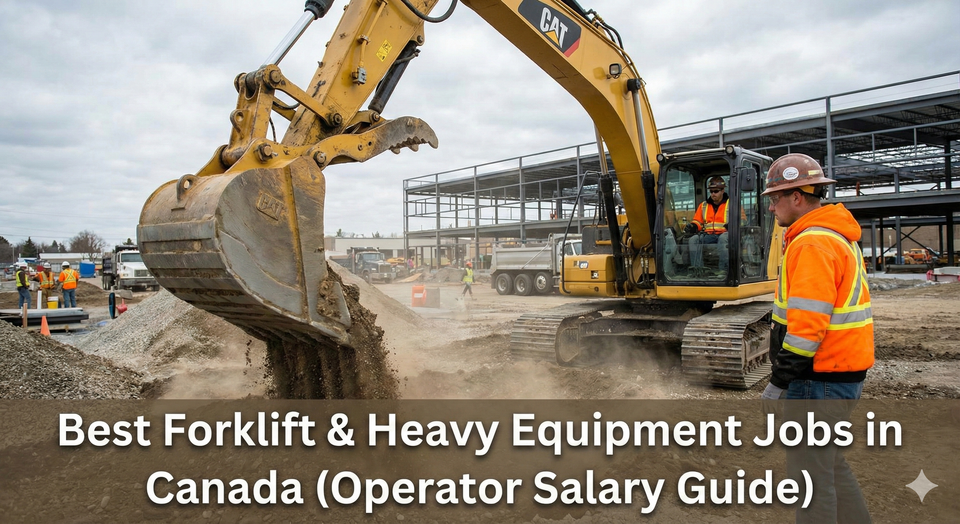
In the blue-collar world, there is a simple rule: "The more expensive the machine, the higher the pay."
If you work in a warehouse lifting boxes by hand, you are "General Labour" earning $18/hr.
If you get a $200 license to drive a Forklift, you are a "Material Handler" earning $24/hr.
If you get certified to operate a 50-ton Excavator or a Tower Crane, you are an "Operating Engineer" earning **$45 to $60 per hour**.
The beauty of this career path is that it saves your body. You aren't destroying your back lifting cement bags; you are using hydraulic power to move mountains while sitting in an air-conditioned cab.
If you are ready to stop trading sweat for money and start trading skill for money, here is the definitive guide to the best heavy equipment jobs in Canada for 2026.
Tier 1: The Warehouse Machines (Entry Level)
These jobs are easy to get, require cheap licenses, and are always hiring.
1. Raymond Reach Operator (The Warehouse King)
- The Machine: A "Reach Truck." It stands tall and extends its forks deep into high racking (30+ feet up).
- The Pay: $22.00 – $28.00 per hour.
- Why it wins:
- The Premium: Reach operators almost always make $2-$4 more per hour than "Counterbalance" drivers because the job requires more skill and nerve.
- The Demand: Every modern distribution center (Amazon, Walmart, Costco) uses high-density racking. They need Reach drivers.
- The License: Cost is ~$250. Takes 1-2 days.
- Internal Link: As mentioned in our Best Warehouse Jobs guide, this is the single best certification for logistics workers.
2. Counterbalance Forklift (The Classic)
- The Machine: The standard "Sit Down" forklift you see at Home Depot.
- The Pay: $20.00 – $25.00 per hour.
- Why it fits: It is the universal license. You can work in a warehouse, a lumber yard, a brewery, or a dock.
- The Environment: Unlike Reach trucks (indoors only), Counterbalance drivers often work outside in lumber yards, which is nice in the summer (but cold in the winter).
- The Catch: It is the most common license, so competition is higher.
3. Order Picker / Cherry Picker
- The Machine: A platform that lifts you up to the shelf so you can hand-pick items.
- The Pay: $21.00 – $26.00 per hour.
- Why it fits: It is less technical than a Reach truck but requires a total lack of fear of heights. If you are comfortable being 30 feet in the air wearing a harness, you will always have work.
Tier 2: The "Yellow Iron" (Construction & Earth Moving)
These roles require more training but pay significantly better. You move dirt, not boxes.
4. Excavator Operator (The Earth Mover)
- The Machine: The "Digger." Used for digging foundations, trenches, and demolition.
- The Pay: $30.00 – $42.00 per hour.
- Why it wins:
- Versatility: An excavator is the first machine on a job site (digging the hole) and the last one to leave (grading the landscape).
- The Union: Operating Engineers (IUOE) make massive wages with pension plans.
- The Entry: You usually start as a "Ground Guy" (shoveling near the machine) and learn by watching, or you go to a heavy equipment school (cost: $5k - $10k).
5. Bulldozer / Loader Operator
- The Machine: Massive machines used to push dirt and level ground.
- The Pay: $28.00 – $38.00 per hour.
- The Vibe: It is all about "Touch." A good dozer operator can level a field to within an inch of accuracy. It is satisfying, solitary work.
- The Season: In Canada, these guys often transition to Snow Removal in the winter (driving giant loaders in mall parking lots), making it a year-round career.
- Internal Link: This pairs well with the "Dirty Jobs" theme in our Best Jobs for Men article.
6. Dump Truck Driver (Rock Truck)
- The Machine: Either a standard dump truck (DZ License) or an off-road "Rock Truck" (massive mining vehicle).
- The Pay:
- City Dump Truck: $24.00 – $30.00 per hour.
- Mining Rock Truck: $35.00 – $45.00 per hour.
- Why it wins: It is the easiest entry into "Heavy" work. Driving a Rock Truck in a mine often requires no license (since it's off-road), just employer training.
- Internal Link: Check our Jobs With Employer Housing guide for mining camp opportunities.
Tier 3: The Sky Kings (Crane Operators)
The highest skill, highest risk, and highest pay.
7. Tower Crane Operator
- The Machine: The giant cranes you see on top of condos.
- The Pay: $45.00 – $60.00+ per hour.
- The Reality:
- The Climb: You climb a 200ft ladder every morning.
- The Bathroom: You pee in a bottle (you don't climb down for lunch).
- The Stress: You are dangling tons of steel over people's heads. One mistake is fatal.
- The License: This is a Red Seal Trade (Hoisting Engineer). It requires a formal apprenticeship (approx. 6,000 hours). You cannot just take a weekend course.
Comparison Table: License Cost vs. Hourly Wage
| Machine | License Cost | Training Time | Pay Range |
| Forklift (CB) | ~$250 | 1-2 Days | $20 - $25 |
| Reach Truck | ~$250 | 1-2 Days | $24 - $28 |
| Excavator | $2k - $10k | 4-8 Weeks | $30 - $42 |
| Mobile Crane | Apprenticeship | 3-4 Years | $45 - $55 |
| Tower Crane | Apprenticeship | 3-4 Years | **$50 - $65** |
How to Get Certified (The Smart Way)
For Forklifts:
- Do NOT wait for an employer.
- Go to a local safety school (e.g., "Industrial Safety Trainers"). Pay the $250. Get the card. Put it on your resume. Employers love hiring people who are "Ready to Go."
For Heavy Equipment:
- Option A (Expensive): Go to a private college (like Transport Training Centres). Cost: $10,000. Pros: You get a certificate. Cons: Employers still want experience.
- Option B (The Hustle): Get hired as a Labourer at a construction company. Work hard. Tell the foreman you want to learn. Ask to sit in the machine during lunch. Eventually, they will train you for free. This is how 80% of operators started.
Practical Questions Answered
"Is it hard to drive a Reach Truck?"
At first, yes.
- The "Backward" Steering: The steering works opposite to a car. It breaks your brain for the first 3 days.
- The Vertigo: Looking up 30 feet to slot a pallet requires good eyesight and a steady hand. If you panic, you will drop the load.
"Do they drug test?"
In Construction: YES.
In Warehousing: Sometimes.
- The Rule: If you operate heavy machinery (Excavator/Crane), almost every reputable company requires a pre-employment drug test. One slip could kill someone. In warehouses, testing usually only happens after an accident.
"Can I wear headphones?"
Absolutely NOT.
- The Danger: You need to hear horns, shouting, and the sound of falling racking. If a safety inspector catches you with Airpods in a forklift, you will be fired on the spot.
Frequently Asked Questions
Do forklift licenses expire?
Yes.
In Canada, you typically need to be "re-evaluated" every 3 years. It is usually a quick refresher test, not the full course.
Can I drive a forklift with a G License?
No.
A driver's license (G) and a forklift license are totally separate. You can have a suspended driver's license (from unpaid tickets) and still legally operate a forklift on private property.
Is Crane Operating dangerous?
Statistically, yes.
While accidents are rare, they are catastrophic. However, wind is the biggest enemy. Crane operators get sent home (with pay) if the wind speed exceeds safety limits (usually 30-50km/h).
About the author
Jeff Calixte (MC Yow-Z) is a Canadian career researcher and digital entrepreneur. He tracks real-time labour market data, government hiring trends, and entry-level opportunities to help newcomers and students navigate the Canadian job market.
Sources
- IUOE Local 793 (Operating Engineers Union): https://iuoelocal793.org/
- WorkSafeBC (Forklift Safety): https://www.worksafebc.com/en/
- Liftow (Forklift Training): https://liftow.com/pages/training
Note:
Job availability, wages, and hiring conditions can vary widely by province, employer, season, and experience level. All salary ranges and job examples in this guide are estimates based on current labour market data. Always confirm details directly with the employer before applying.