
Best Jobs in Ontario (High Demand Regions & Sectors 2026)
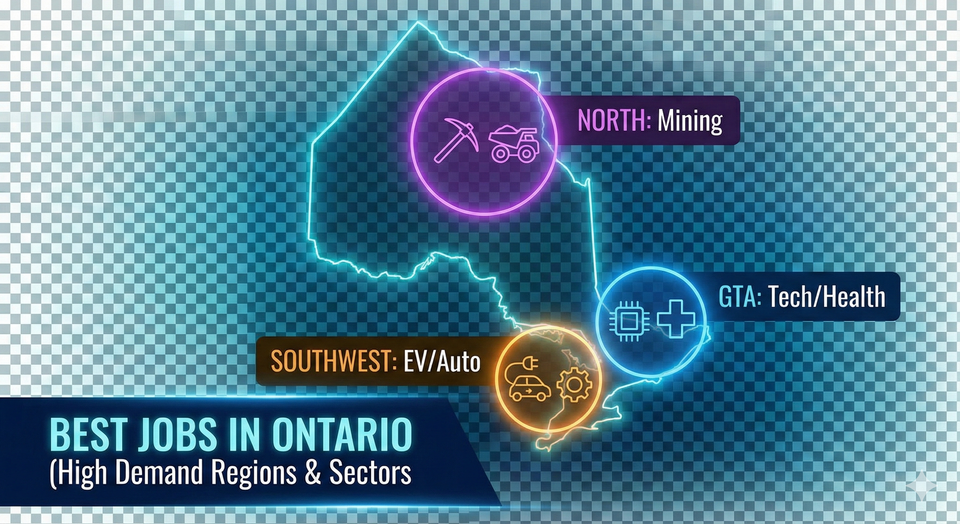
For decades, the advice for job seekers in Ontario was simple: "Move to Toronto."
In 2026, that advice is dead wrong.
While Toronto remains the financial capital, the cost of living (Rent: $2,500+) has made it unlivable for many entry-level workers. Meanwhile, secondary cities are experiencing a historic economic boom driven by Electric Vehicle (EV) Manufacturing and Critical Minerals.
The Ontario government has poured billions into the "EV Battery Belt"—a corridor stretching from Windsor to Ottawa. Factories are being built, supply chains are expanding, and housing is (comparatively) affordable.
If you are willing to look beyond the CN Tower, you can find jobs that pay $30 - $40 per hour with a lower cost of living. Here is where the work is in Ontario right now.
Region 1: The "EV Battery Belt" (Southwest Ontario)
This is the new industrial heartland. Massive factories are hiring thousands.
1. Battery Plant Production (St. Thomas / Windsor)
- The Employers: PowerCo (Volkswagen) in St. Thomas and NextStar Energy (Stellantis) in Windsor.
- The Opportunity: PowerCo is set to be the largest factory in Canada. They are hiring 3,000+ workers for production, logistics, and quality control.
- The Pay: Starting production wages are expected to be $24.00 – $29.00 per hour, with skilled trades earning $45+.
- Why move here? St. Thomas and Windsor are significantly cheaper than the GTA. You can actually buy a house here on a factory wage.
- Related: We covered the specifics of these roles in our Factory Jobs Guide.
2. Automotive Supply Chain (Alliston / Cambridge)
- The Employers: Honda (Alliston) and Toyota (Cambridge/Woodstock).
- The Shift: Both companies are retooling for Hybrid and EV production. This has created a "ripple effect" for suppliers (Magna, Linamar, Martinrea) who need thousands of parts manufacturers.
- The Job: CNC Operators, Welders, and General Assemblers.
- The Pay: $22.00 – $28.00 per hour (Non-Union) to $40.00+ (Union/Direct).
Region 2: The "Critical Minerals" Ring (Northern Ontario)
The world needs nickel and lithium for batteries. Ontario has it.
3. Underground Miner (Sudbury / Timmins)
- The Employers: Vale, Glencore, Newmont.
- The Job: Extracting nickel, copper, and gold. Modern mining is high-tech; you are often operating remote-controlled machinery from the surface or driving air-conditioned rock trucks.
- The Pay: **$40.00 – $55.00 per hour** ($100k+ annually with overtime).
- The Shortage: The workforce is aging out. Mines are desperate for young workers.
- The Incentive: Many companies offer "Fly-In, Fly-Out" (FIFO) rotations if you don't want to move permanently, or massive relocation bonuses ($10k+).
- Related: Check our Jobs With Employer Housing guide for camp details.
4. Indigenous Liaison / Environmental Monitor
- The Context: Mining projects like the Ring of Fire require strict environmental compliance and partnership with Indigenous communities.
- The Job: Monitoring water quality, wildlife impact, or managing community relations.
- The Pay: $60,000 – $90,000 per year.
- Why it wins: It connects traditional knowledge with modern industry. It is a high-respect, high-impact role.
Region 3: The "Service Hub" (GTA & Ottawa)
Where the people are, the service jobs follow.
5. Healthcare Support (GTA Hospitals)
- The Crisis: Toronto and Peel Region have the highest population density and the longest ER wait times.
- The Jobs: PSWs, Registered Practical Nurses (RPNs), and Medical Device Reprocessing.
- The Pay: $25.00 – $35.00 per hour (Unionized).
- The "Super Agency" Trend: Many nurses are quitting hospitals to work for "Agencies" that pay $50 - $70 per hour to fill shifts at the exact same hospitals. It is a controversial but lucrative path.
- Related: See our Healthcare Support Guide for non-medical entry points.
6. Construction & Trades (Transit Expansion)
- The Projects: The Ontario Line (Subway), Eglinton Crosstown West, and Highway 413.
- The Demand: These are multi-billion dollar government projects guaranteed to run for the next 10 years. They need everything from Labourers to Electricians.
- The Pay: Unionized construction workers in Toronto (LiUNA, IBEW) earn $40.00 – $60.00 per hour + Pension.
- How to Start: Join a union apprenticeship program. They are actively recruiting women and minorities to fill the gap.
7. Film & TV Production (Toronto / Hamilton)
- The Status: "Hollywood North."
- The Jobs: Grip, Lighting Tech, Carpenter (Set Building), Hair/Makeup.
- The Pay: $30.00 – $45.00 per hour (Union rates - IATSE).
- The Boom: With the writers' strike over, production has surged back. Netflix and Amazon utilize vast studio spaces in the Port Lands and Etobicoke.
- Related: We touched on this in our Fun Jobs Guide regarding background actors, but the real money is behind the camera.
Government Help: "Better Jobs Ontario"
If you want these jobs but lack skills, the government will pay you to learn.
What is it?
A grant (not a loan) of up to $28,000 to pay for tuition, books, and living expenses while you train for a "high-demand" job.
Who qualifies?
- You have been laid off.
- You are unemployed for 6+ months.
- You are from a low-income household.
What does it cover?
- Truck Driving (AZ License).
- HVAC / Welding / Plumbing pre-apprenticeships.
- Personal Support Worker (PSW) college programs.
- IT / Cyber Security bootcamps.
Strategy: Do NOT pay for a private career college out of pocket. Go to an "Employment Ontario" center first and ask about the Better Jobs Ontario grant.
Comparison Table: Region vs. Lifestyle
| Region | Primary Industry | Cost of Living | Income Potential | Best For |
| GTA (Toronto) | Tech / Health / Film | Very High | High ($80k+) | Career Climbers |
| Southwest (Windsor) | EV Battery / Auto | Medium | High ($70k+) | Families / Homeowners |
| North (Sudbury) | Mining | Low | Very High ($100k+) | Savers / Adventurers |
| East (Ottawa) | Gov / Tech | High | Medium (Stable) | Bilingual Workers |
Practical Questions Answered
"Is moving to Sudbury crazy?"
No, it's smart.
- The Math: You can buy a detached house in Sudbury for $400,000. In Toronto, a condo is $700,000.
- The Wage: A miner in Sudbury makes more than a marketing manager in Toronto. Your disposable income will skyrocket.
- The Trade-off: Winters are cold. Really cold. And the social scene is smaller.
"Are the EV plant jobs guaranteed?"
Pretty much.
- The Subsidies: The federal and provincial governments have invested billions into Volkswagen and Stellantis. They cannot afford to let these plants fail. These jobs are as secure as government work for the next decade.
"Do I need a car in Ontario?"
Outside Toronto? YES.
- The Reality: Transit in St. Thomas, Windsor, or Northern Ontario is limited. To work a shift at the VW plant or a mine, you absolutely need a reliable vehicle. Budget $5,000 for a used car if you move there.
Frequently Asked Questions
What is the minimum wage in Ontario?
Currently $17.20/hr (Adjusts annually in October).
However, living in any Ontario city on minimum wage is extremely difficult. You should target the "Living Wage," which is closer to $25/hr in most regions.
Is French required in Ontario?
Only in Ottawa and parts of Northern Ontario.
In Ottawa (federal government town), bilingualism is key. In Sudbury/Timmins, there is a large Franco-Ontarian population, so French is an asset but not usually mandatory for mining/trades. In Toronto/Windsor, it is rarely needed.
Can I apply for Better Jobs Ontario if I quit my job?
Generally No.
It is designed for people who were laid off or are unemployed. If you quit, you must prove "Just Cause" (e.g., medical reasons or harassment) to be eligible. Consult an Employment Ontario counselor before quitting.
About the author
Jeff Calixte (MC Yow-Z) is a Canadian career researcher and digital entrepreneur. He tracks real-time labour market data, government hiring trends, and entry-level opportunities to help newcomers and students navigate the Canadian job market.
Sources
- Better Jobs Ontario: https://www.ontario.ca/page/better-jobs-ontario
- Invest Ontario (EV Sector): https://www.investontario.ca/electric-vehicles
- Job Bank (Ontario Regional Outlooks): https://www.jobbank.gc.ca/trend-analysis/job-market-reports/ontario
Note:
Job availability, wages, and hiring conditions can vary widely by province, employer, season, and experience level. All salary ranges and job examples in this guide are estimates based on current labour market data. Always confirm details directly with the employer before applying.