
Bin Rental Driver: Is Roll-Off Easier Than Dump Truck? (2026 Guide)
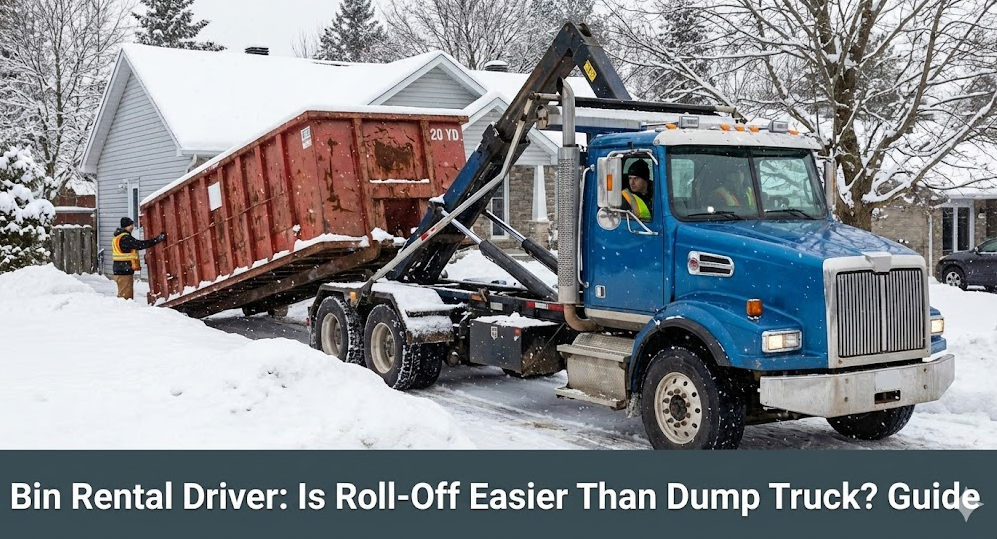
If you have your Class 3 or Class D license, you are usually choosing between two paths: Dump Truck or Roll-Off (Bin Rental).
On paper, they look the same. You drive a big truck, you haul heavy stuff, you dump it.
But in reality, the lifestyle is completely different.
Dump Truck drivers are part of a paving crew. You chase the paver. You wait in line. You work 14 hours a day in summer and get laid off in winter.
Roll-Off drivers are solo operators. You drop a bin at a house, leave, and come back 3 days later to pick it up.
In 2026, the Roll-Off sector is booming because home renovations and demolition never stop—even in winter.
The pay is consistent ($26 - $32 per hour), but the job comes with a unique set of headaches: frozen loads, overloaded concrete bins, and customers who expect you to fit a 20-foot bin into a 10-foot spot.
This guide compares the two jobs head-to-head, explains the "Cable vs. Hook" lift systems, and reveals why "shoveling off the top" is the worst part of your day.
Need your license first? Check out How to Upgrade to a Class 3 / D License or see the pay for Septic Tank Pumpers if you want higher rates.
The Pay: Hourly vs. "Per Load"
Who pays more? The answer depends on the season.
1. Dump Truck (Asphalt/Aggregates)
- The Rate: $28.00 - $35.00/hour.
- The Season: April to November.
- The Reality: You make a fortune in the summer ($80k in 6 months) because you work 70 hours a week. But in winter, you are on EI (Unemployment).
2. Roll-Off (Waste/Scrap Metal)
- The Rate: $26.00 - $30.00/hour.
- The Season: Year-round. Garbage doesn't stop in January.
- The Reality: The hourly rate is slightly lower, but your annual income is stable. You get 40-50 hours a week, every week.
- Tips: Unlike dump truck drivers, Roll-Off drivers often get Cash Tips ($20-$50) from homeowners for placing the bin carefully without scratching the driveway.
The Job Description: "Drop and Hook"
The main difference is autonomy.
Dump Truck: "Hurry Up and Wait"
- You drive to the pit. Wait 20 minutes to get loaded. Drive to the site. Wait 40 minutes to dump into the paver.
- Stress: High. If you are late, the asphalt cools and the foreman screams at you.
Roll-Off: "The Solo Mission"
- You get a dispatch ticket: "Drop 14-yard bin at 123 Maple St."
- You drive there. You figure out how to back into the driveway. You place wood planks (to protect the asphalt). You slide the bin off.
- Stress: Medium. The stress comes from Tight Spaces.
- Scenario: Backing a massive truck down a downtown Toronto alleyway with only 2 inches of clearance on each side mirrors.
Deep Dive: Cable Hoist vs. Hook Lift
Not all roll-off trucks are the same. You need to know what you are driving.
1. Cable Hoist (The Old School)
- How it works: You pull a heavy steel cable manually, hook it to the bin, and winch it up.
- Pros: Can pull bins from weird angles.
- Cons: Dangerous. If the cable snaps, it cuts people in half. It is also physically harder (dragging the cable through mud).
2. Hook Lift (The Modern Way)
- How it works: A giant hydraulic hook grabs a bar on the bin and lifts it.
- Pros: You barely leave the cab. It is faster and safer.
- Cons: You must line up the truck perfectly straight with the bin. If you are 2 degrees off, the hook misses.
Practical Questions Answered
Waste Management to find the gritty truth.
"What happens if the customer overloads the bin?"
This is your nightmare.
- The Law: You cannot drive if the debris is above the "Water Line" (top of the bin). It is a $500 fine and points on your license.
- The Reality: You arrive and see a mountain of drywall sticking up 3 feet.
- The Fix: You have to climb up and throw it off onto their lawn. Or you refuse the pickup (Charge a "Dry Run" fee of $150). The customer will scream at you. You must have a thick skin.
"Is tarping hard?"
Yes.
- Auto-Tarps: Most modern trucks have a button to roll a tarp over the bin.
- The Problem: If the load is uneven (a 2x4 sticking up), the tarp rips.
- Manual Tarping: On scrap metal bins, you often have to throw a heavy mesh tarp by hand and bungee it down. In the wind, this is a battle.
"Do bins freeze?"
Yes.
- In January, wet garbage freezes to the metal floor of the bin.
- The "Bang": When you go to the dump, the load won't slide out. You have to slam the brakes (Bang!) to shake it loose. This destroys the truck over time.
- The Shovel: Sometimes, you have to climb inside the tilted bin and shovel the frozen muck out. It is dangerous and gross.
The "Rocket Launcher" (Trailer)
If you want to make the big money ($32+/hr), you drive a Truck and Pup or a Rocket Launcher.
- What is it? You carry one bin on the truck and a second bin on a trailer.
- The Skill: You have to drop the trailer, empty the truck bin, put the trailer bin onto the truck, empty that, and then reassemble everything.
- Why do it: It requires high skill (backing up a short trailer is incredibly hard). Companies pay a premium for drivers who can do this without jackknifing.
Advanced Tactics & The "Scrap" Bonus
1. The "Overweight" Nightmare (And How to Avoid $1,000 Fines)
- The #1 fear of a roll-off driver isn't crashing; it's the MTO/DOT Scale.
- The Problem: A 20-yard bin filled with concrete weighs 15 tons. Your truck is rated for 10 tons.
- The Fine: In Ontario and BC, The Fine: In Ontario and BC, fines can exceed $1,100 and put points on your Commercial License (Class D).
- The Hack: Learn to read your Air Suspension Gauge.
- If your PSI gauge spikes past 60 PSI when you lift the bin, PUT IT DOWN.
- Call dispatch. Tell them: "It's overweight. I need a second truck or the customer needs to offload." Never drive an unsafe load just to be "nice."
2. The Scrap Metal "Scavenger" Bonus
- While garbage bins are gross, Scrap Metal Bins are liquid gold.
- The Perk: Some smaller scrap yards have a "Driver Incentive."
- How it works: If you bring in high-grade copper or aluminum (instead of just shredded steel), the yard owner might slip you $20 - $50 cash.
- The "Clean Out": Occasionally, customers throw valuable items (batteries, copper wire) into general waste. If you spot it, and your company allows "salvage rights," that's tax-free cash in your pocket.
- Comparison: This is similar to the "Cash Tips" mentioned in our Garbage Truck Runner guide, but it requires a sharper eye.
3. The "Stinger" Tail Hack (Fitting Big Bins in Small Spots)
- You will often hear drivers argue about "Fixed Rail" vs. "Stinger Tail."
- What is a Stinger? A hydraulic extension on the back of the truck that slides out.
- The Advantage: It allows you to create a shallower angle when loading. This is critical for Low Clearance garages or keeping the bin from smashing into a customer's overhang.
- The Skill: If you master the "Stinger Slide," you can drop a 20-foot bin into a 22-foot driveway. This skill alone makes you unfireable.
4. Winter "Chain-Up" Laws (BC & Northern Ontario)
- Driving a roll-off truck in the city is fine. Driving one to the landfill in a snowstorm is terrifying.
- The Law: In BC (Coquihalla) and Northern Ontario, you MUST carry chains from October to April.
- The Fine: Bypassing a chain-up area in BC carries a $598 Fine.
- The Reality: Throwing chains on a muddy dual-axle truck at -20°C is brutal work.
- Link: If you hate winter driving, consider a fly-in camp job like Fort McMurray where you take a bus to work instead of driving.
5. Owner-Operator Math (Can You Make $200k?)
- Many drivers dream of buying their own truck.
- The Cost: A decent used Kenworth Roll-Off costs $80,000 - $120,000.
- The Insurance: This is the killer. Commercial insurance for a new venture can be $15,000/year.
- The Rates: You can charge $120/hour to the customer.
- The Verdict: Only do this if you have secured contracts with construction companies before you buy the truck. Competing with giants like Waste Management on "one-off" residential bins is a losing battle.
- Related Link: This business model is very similar to the Septic Tank Pumper owner-operator route.
6. Dispatch Apps: No More Paper Tickets
- The days of paper carbon copies are gone.
- The Tech: Most companies use apps like Trux, Dispatcher.com, or Truckbase.
- The Job: You get a ping on your iPad. You take a photo of the empty driveway (proof of delivery). You take a photo of the full bin (proof of overload).
- The Benefit: No math. The app calculates the weight ticket and billing automatically.
- The Downside: The dispatcher tracks your GPS. If you stop at Tim Hortons for 20 minutes, they know.
7. "Bin Juice" & Odour Control
- Unlike a sealed septic truck, a roll-off bin is open.
- The Rain: If it rains on a garbage bin, it creates "Bin Juice" (Leachate).
- The Leak: When you lift the bin, that juice rushes to the back door. If the seal is bad, it pours onto the client's driveway.
- The Fix: Always carry Spill Kits (absorbent clay). If you leave a puddle of toxic juice, the Ministry of Environment can fine you.
- Smell: It’s bad, but wind disperses it. It is generally better than the confined smell of a Septic Tank.
8. The "Deadlift" (Cable Trucks Only)
- If you drive an older Cable truck, you might have to "Deadlift."
- What is it? Dragging a bin that has sunk into the mud.
- The Danger: The cable tension is incredibly high. If the bin is frozen to the ground, the cable can snap.
- The Protocol: Never stand near the cable. Use "shakers" (vibrating the truck) to break the suction before pulling full power.
9. "Do Not Block" (Alleyway Wars)
- In downtown cores (Toronto, Montreal), you often block the alley to load a bin.
- The Stress: Drivers will honk, scream, and throw things at you.
- The Attitude: You are in a 30,000lb truck. They are in a Civic. Do not rush. Rushing leads to hitting a brick wall.
- The Tip: Put out cones before you start backing up. It stops cars from entering the alley behind you.
Frequently Asked Questions
Do I need a Z Endorsement?
YES.
- Just like Septic Pumpers, almost all roll-off trucks have Air Brakes.
- You cannot get hired without your Z endorsement.
Can I damage driveways?
Yes.
- Steel wheels on a 5-ton bin will crack asphalt instantly on a hot day.
- The Protocol: You must place 2x8 Wood Planks under the wheels.
- If you forget the wood and crack the driveway, the company pays for it, but you might get fired.
Is it dirty?
Cleaner than garbage running.
- You are in the cab 90% of the time.
- You rarely touch the garbage unless you are fixing a tarp or closing a door.
- Smell: The bin smells, but it is behind you.
Summary: The Thinking Man's Trucking
- Choose Roll-Off if you want year-round pay and enjoy solving puzzles (fitting big bins in small spots).
- Choose Dump Truck if you want to make max cash in summer and sleep all winter.
- Watch the Overload: Never take an unsafe load. Your license is worth more than their garbage.
- Carry Wood: Keep spare 2x4s in your toolbox. They save driveways and save your job.
About the author
Jeff Calixte (MC Yow-Z) is a Canadian career researcher and digital entrepreneur who studies hiring trends, labour market data, and real entry-level opportunities across Canada. He specializes in simplifying the job search for newcomers, students, and workers using practical, up-to-date information.
Sources
- Waste Management (WM): Driver job descriptions and safety protocols. https://www.wm.com/
- GFL Environmental: Roll-off driver requirements. https://gflenv.com/
- Ontario Ministry of Transportation: Load security regulations. https://www.ontario.ca/page/commercial-vehicle-safety-requirements
Note
Job availability, wages, and hiring conditions can vary widely by province, employer, season, and experience level. All salary ranges and job examples in this guide are estimates based on current labour market data. Always confirm details directly with the employer before applying.