
Best Jobs for Creative People in Canada (No Degree Needed 2026)
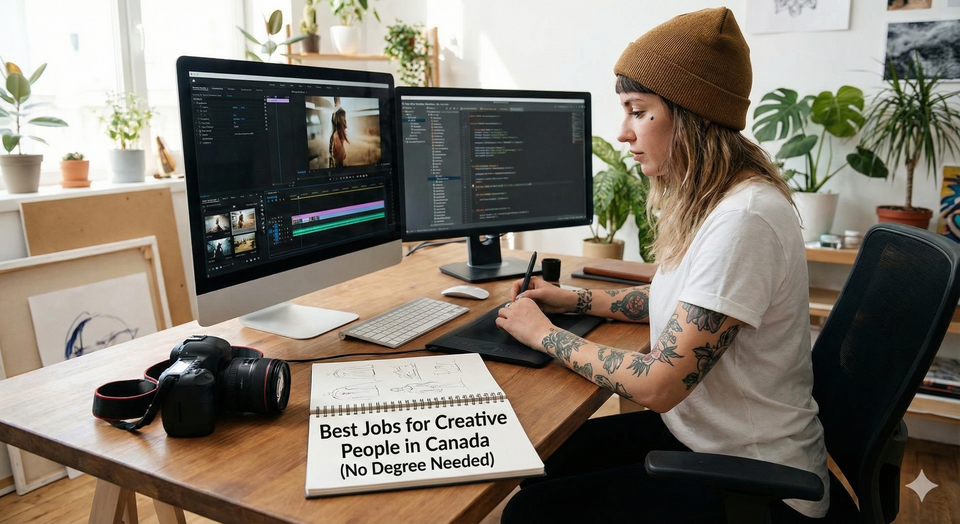
For decades, creative people in Canada were told the same lie: "Art is just a hobby. If you want a job, go to business school."
In 2026, that advice is dead..
We are living in the Content Era. Every business—from the local coffee shop to the massive bank—is now a media company. They need videos for TikTok, graphics for Instagram, copy for websites, and designs for packaging. They are desperate for people who can make things look good and sound good.
The best part? They do not care about your degree.
Creative fields are unique because they run on a "Show Me" basis. A marketing director will hire a dropout with an incredible portfolio over a university graduate with a boring one, 100% of the time.
If you have a creative mind and the hustle to build a portfolio, here are the best high-paying careers in Canada where your talent pays the bills.
1. Social Media Manager (The "Voice" of the Brand)
- Average Salary: $50,000 – $75,000 (Freelance: $30–$60/hr)
- The Role: You are not just "posting on Facebook." You are the digital voice of a company. You create the strategy, film the content (Reels/TikToks), write the captions, and engage with the community.
- Why No Degree? University marketing textbooks are outdated before they are even printed. A degree can't teach you how the TikTok algorithm changed last Tuesday. Employers want to see that you can grow an account now.
- How to Start:
- Pick a Niche: Don't just say "I do social media." Say "I help Real Estate Agents in Toronto grow on Instagram."
- Build a Portfolio: Start a niche page (e.g., "Best Food in Vancouver") and grow it to 1,000 followers. Use this as your resume.
- Pitch: Email small businesses and offer to run their socials for a month at a discount in exchange for a testimonial.
2. Video Editor (The "High Demand" Skill)
- Average Salary: $55,000 – $85,000 (Freelance: $300–$800 per video)
- The Role: Taking raw footage and turning it into a compelling story. This ranges from editing 60-second vertical videos for influencers to cutting corporate training videos or wedding films.
- Why No Degree? Film school is expensive ($40k+). You can learn Adobe Premiere Pro or DaVinci Resolve on YouTube for free in 3 months.
- The Market: Every YouTuber, Coach, and Business owner needs video. There is a massive shortage of editors who understand "pacing" and "retention."
- Day in the Life: You receive 2 hours of footage via Dropbox. You spend the morning organizing clips ("logging"). You spend the afternoon cutting the story and adding music. You send the draft by 5:00 PM.
- Related: This is a perfect fit for Remote Jobs since you can edit from anywhere.
3. Home Stager (The "Real Estate" Artist)
- Average Salary: $200 – $500 per consultation (or $40k–$70k salary)
- The Role: Making empty houses look expensive so they sell faster. You bring in furniture, art, and decor to transform a cold room into a cozy home.
- Why No Degree? Interior Design degrees focus on architecture and code. Staging is purely aesthetic. If you have a good eye for trends (Modern Farmhouse, Minimalist), you can stage.
- How to Start:
- Volunteer: Offer to stage a friend's home when they sell. Take "Before and After" photos. These photos are your gold.
- Connect: Reach out to local Real Estate Agents. They are your clients, not the homeowners.
- The Physical Reality: This is hard work. You are moving sofas and carrying lamps. It is "Creative Moving."
4. UX/UI Designer (The "Tech" Creative)
- Average Salary: $70,000 – $100,000+
- The Role: Designing how an app or website feels (UX) and looks (UI). You decide where the "Buy Now" button goes and what color it should be to make people click it.
- Why No Degree? While you don't need a University Degree, you usually need a Bootcamp Certificate (3-6 months). Tech companies value your portfolio of case studies above all else.
- The Path:
- Google UX Design Certificate: A cheap, recognized way to learn the basics.
- Build Case Studies: Redesign a popular app (like Spotify) and write a blog post explaining why you made your changes. This proves your logic to employers.
5. Makeup Artist (MUA)
- Average Salary: $40,000 – $90,000 (Highly variable based on niche)
- The Role: Applying makeup for brides, TV actors, or fashion shoots.
- Why No Degree? You need a certificate from a beauty school (for hygiene/sanitation), but you do not need a college degree.
- The Money:
- Bridal: The most lucrative. A bride pays $300–$500 for trial and wedding day. If you do a bridal party of 5 people on a Saturday, you can make $1,000 in one morning.
- Retail: Working at Sephora or MAC ($18–$24/hr). Good for stability, bad for creativity.
- Related: Looking for weekend gigs? Check out our Gig Economy Guide.
6. Freelance Photographer (Commercial)
- Average Salary: $50,000 – $80,000
- The Role: Taking photos for businesses. Not just "Weddings"—think Product Photography (taking photos of soap for a website), Real Estate Photography, or Corporate Headshots.
- Why No Degree? A degree in photography often focuses on "Art." Businesses want "Sales." If your photo makes their burger look delicious, they will hire you.
- Gear: You do need to invest in gear ($3k–$5k), but you can start by renting equipment for specific jobs until you can afford to buy.
7. Digital Copywriter
- Average Salary: $55,000 – $85,000
- The Role: Writing the words on websites, emails, and ads that persuade people to buy.
- Why No Degree? English Literature degrees teach you how to analyze Shakespeare. Copywriting is about psychology and sales.
- How to Start:
- Read “Cashvertising” or “The Boron Letters” to learn the psychology of selling.
- Rewrite bad ads you see on Facebook and put them in your portfolio as "Spec Work" (Speculative work).
Comparison Table: Barrier to Entry vs. Pay Potential
| Job Title | Initial Cost (Gear/Training) | Learning Curve | Income Potential |
| UX/UI Designer | Medium ($500 course) | High (6 months) | **Very High ($100k)** |
| Social Media Mgr | Low (Smartphone) | Low (1 month) | Medium ($60k) |
| Video Editor | Medium (PC + Software) | Medium (3 months) | High ($85k) |
| Makeup Artist | High (Kit + School) | Medium (6 months) | High (Bridal) |
| Home Stager | High (Furniture inventory) | Low (Natural talent) | Medium |
The "Portfolio" Strategy: Your New Resume
In the creative world, your Resume (CV) is boring. Your Portfolio is everything. Here is how to build one if you have zero experience.
Step 1: Do "Spec" Work
Speculative work means creating a project for a fake client (or a real client who didn't hire you).
- Example: Redesign the menu for your favorite pizza place.
- Example: Film a 30-second commercial for Nike using your iPhone.
- Label it clearly: "Concept Project." Employers love this because it shows passion.
Step 2: Use a Free Portfolio Site
Do not send a Google Drive folder of images. It looks unprofessional. Use:
- Behance: (Best for Designers/Photographers).
- Carrd.co: (Best for Copywriters/Social Media).
- Vimeo: (Best for Video Editors).
Step 3: The "Process" Matters
Don't just show the final image. Show how you got there.
- Include sketches.
- Explain the problem: "The client needed a logo that looked modern but trustworthy."
- Explain your solution: "I chose blue because it represents trust..."
Practical Questions Answered
"Is AI going to replace these jobs?"
It will replace bad creatives.
- The Reality: AI (like ChatGPT and Midjourney) can write generic emails and make generic logos.
- The Pivot: You must become the Editor of AI. Instead of just writing copy, you are the "AI Content Strategist." Instead of just drawing, you are the "Creative Director" using AI tools. If you learn to use AI, you become faster and more valuable. If you ignore it, you risk being left behind.
"Is freelance unstable?"
Yes.
- The Fix: The "Feast or Famine" cycle is real. You might make $5,000 in January and $0 in February.
- Strategy: Never quit your day job until you have 3 months of emergency savings. Start these creative careers as a Side Hustle first. Once your side income matches your job income, then you quit.
"Do I need to live in Toronto/Vancouver?"
For Film/TV Makeup: Yes.
For Digital Jobs (Design, Video, Writing): No.
- Most creative agencies are fully remote now. You can be a Video Editor living in rural Saskatchewan working for a client in New York.
Frequently Asked Questions
Can I get a creative job with a criminal record?
Generally, Yes.
Unlike Finance or Healthcare, creative industries rarely do background checks. Clients care about the work, not your past. However, if you work with children (e.g., School Photographer), a check is mandatory.
What is the difference between Graphic Design and UX Design?
- Graphic Design: Static images (Logos, Flyers, Posters).
- UX Design: Interactive experiences (How an app works, user flow).
- Money Tip: UX Design generally pays 30-40% more than Graphic Design because it is tied directly to tech product sales.
Is "Influencer" a real job?
Yes, but it takes time.
"Content Creator" is the professional term. If you can build an audience, brands will pay you. However, it usually takes 1-2 years of working for free (building the audience) before you see a penny. It is a long-term business, not a quick job.
About the author
Jeff Calixte (MC Yow-Z) is a Canadian career researcher and digital entrepreneur who studies hiring trends, labour market data, and real entry-level opportunities across Canada. He specializes in simplifying the job search for newcomers, students, and workers using practical, up-to-date information.
Sources
- RGD (Association of Registered Graphic Designers): https://www.rgd.ca/
- Interactive Advertising Bureau of Canada (Salaries): https://iabcanada.com/
- Google UX Design Certificate: https://grow.google/certificates/ux-design/
- Job Bank (Graphic Designer Trends): https://www.jobbank.gc.ca/marketreport/outlook-occupation/22564/ca
Note:
Job availability, wages, and hiring conditions can vary widely by province, employer, season, and experience level. All salary ranges and job examples in this guide are estimates based on current labour market data. Always confirm details directly with the employer before applying.