
Crime Scene Cleaner Pay Canada: Dealing with Biohazards (2026 Guide)
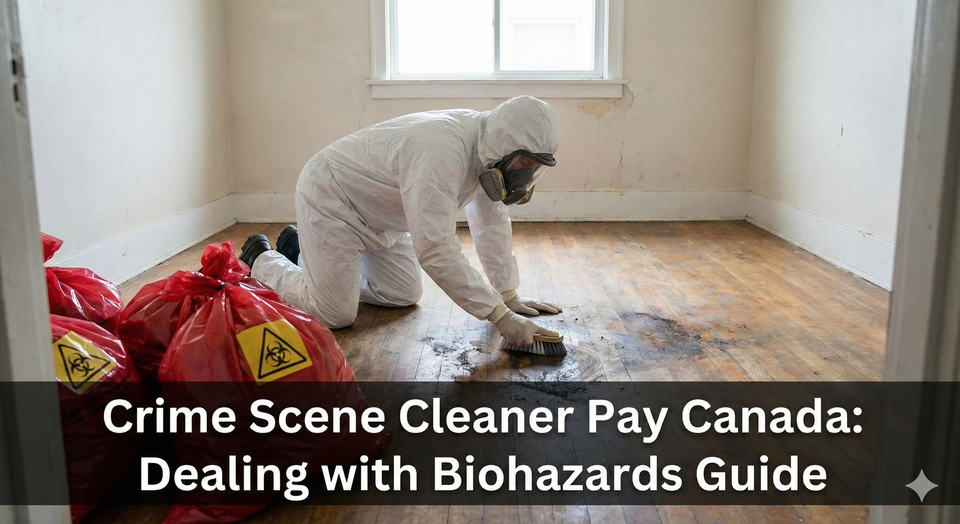
When people hear "Crime Scene Cleaner," they picture a scene from CSI or Dexter. They imagine working for the police, driving a cool van, and solving mysteries while scrubbing.
The Reality:
You are not a detective. You are a Janitor for the Dead.
The police do not hire you. The grieving family or the landlord hires you.
And the job isn't just "cleaning up blood." It is scrubbing decomposition fluids out of floorboards, clearing out 5-foot piles of garbage from a hoarder's house, and dealing with the smell of death that no mask can fully block.
But in 2026, it is also one of the few entry-level jobs in Canada that can pay $35.00 to $50.00 per hour without a university degree.
This guide explores the dark but lucrative world of CTS (Crime and Trauma Scene) Decontamination. We break down the exact certifications you need (and the fake ones to avoid), the mental toll of the job, and how to get hired by the private companies that dominate this industry.
If this sounds too intense, consider a physically demanding but less traumatic job like Worm Picking or Cash Daily Labour.
The Pay: Is It Worth the Trauma?
Let’s get straight to the numbers.
This is not a minimum wage job. It is "Hazard Pay."
Entry-Level Technician
- Rate: $22.00 - $28.00/hour.
- The Role: You are the "helper." You carry the bags, wipe down walls, and do the heavy lifting in hoarding situations. You are supervised by a Senior Tech.
Senior / Lead Technician
- Rate: $30.00 - $45.00/hour.
- The Role: You assess the scene, determine the chemicals needed, manage the biohazard disposal, and deal with the client (who is often crying or angry).
Independent Contractor / Owner
- Rate: $200.00 - $500.00 per hour (Billed to Client).
- The Reality: Specialized cleaning companies bill insurance companies massive amounts. A single suicide cleanup can cost $3,000 to $10,000.
- The Catch: You have to pay for the expensive chemicals, the van, the insurance, and the disposal fees (which are astronomical).
Who Actually Hires You? (It's Not the Cops)
This is the biggest myth.
The Police DO NOT clean the crime scene.
Once the police finish their investigation, they remove the yellow tape and leave. They leave the blood, the fingerprint dust, and the mess behind.
The Responsibility falls to:
- The Homeowner: If a tragedy happens in your home, you have to clean it (or hire someone).
- The Landlord: If a tenant dies and isn't found for weeks (Unattended Death), the landlord hires a CTS crew.
- Insurance Companies: Home insurance policies often cover "Trauma Cleanup."
Major Employers in Canada:
- ServiceMaster Restore: A massive franchise that handles fire, water, and trauma.
- FirstOnSite: Another restoration giant.
- Crime & Trauma Scene Cleaning (CTS) Specialists: Smaller, niche local companies (e.g., "BioSweet" or "Trauma Care").
The Job Description: The "Big 3" Tasks
You aren't just cleaning up crime scenes. That is actually rare.
1. Unattended Death (Decomposition)
- This is 60% of the job.
- Scenario: An elderly person dies alone. Nobody finds them for 2 weeks.
- The Reality: The body releases fluids that soak into the mattress, the carpet, and the subfloor.
- Your Job: You must cut out the carpet, cut out the floorboards, and seal the structure to remove the smell. It is construction work in a Hazmat suit.
2. Hoarding Cleanup (Distress)
- This is 30% of the job.
- Scenario: A "Level 5" hoarder house filled with trash, feces, and rats.
- Your Job: Shoveling garbage for 8 hours a day. It is physically exhausting.
3. Violent Trauma (Suicide/Homicide)
- This is only 10% of the job.
- Your Job: Cleaning biological matter from walls and ceilings. You must be extremely meticulous because if you miss one drop, the smell will return in summer.
Internal Link: You will need Standard First Aid before applying to any of these roles.
Practical Questions Answered
Cleaning jobs to find the grit.
"Can I handle the smell?"
Probably not at first.
- The Consensus: "Vicks VapoRub under the nose doesn't work. The smell of decomp sticks to your hair and skin. You smell it for days after."
- The Gear: You wear a Full-Face Respirator with organic vapour cartridges. It helps, but it’s hot and claustrophobic.
"Do I need a degree in Forensics?"
NO.
- Employers do not care about your Criminology degree. They care about:
- Can you wear a Hazmat suit for 4 hours without fainting?
- Are you vaccinated for Hepatitis B?
- Do you have a valid driver's license?
"Is it emotionally scarring?"
Yes.
- You see the worst day of people's lives. You see photos of the deceased on the wall while you are scrubbing their blood off the floor. Burnout is high. Most techs last less than 2 years.
Certifications & The "ABRA" Standard
Unlike Security Guards, there is no government "License" to be a crime scene cleaner in Canada.
However, you cannot just show up with a mop.
1. Mandatory Requirements
- Hepatitis B Vaccination: You are working with blood. You must be immune to Hep B.
- WHMIS 2015: You are using industrial-grade biocides. (See our Free WHMIS Guide).
- Bloodborne Pathogens Course: An online course (OSHA standard) that teaches you how diseases spread.
2. The "Gold Standard" (To Get Hired)
- ABRA (American Bio Recovery Association): While American, this is the standard recognized in Canada. Being a "Certified Bio Recovery Technician" makes you instantly hireable.
- IICRC (Institute of Inspection Cleaning and Restoration Certification): Look for the "Trauma and Crime Scene Technician (TCST)" certification.
- Cost: ~$400 - $600 for a 3-day course.
- Value: Essential. It teaches you the legal way to transport biohazard waste (you can't just throw it in a dumpster).
Frequently Asked Questions
Is this job recession-proof?
Yes.
People die, tragic accidents happen, and hoarding exists regardless of the economy. In fact, during economic downturns, mental health crises (and hoarding) often increase.
Can I start my own business?
It's hard.
- Insurance: "Pollution Liability" insurance is incredibly expensive.
- Disposal: You need a contract with a medical waste incinerator.
- Marketing: You can't put flyers on telephone poles. You need relationships with Funeral Homes and Property Managers.
Do I work 9-to-5?
No.
You are On-Call. Death happens at 3:00 AM on a Tuesday. If you don't answer the phone, the client calls the next company.
Deep Dive: "Tear Gas" Cleanup & The Reality of Fingerprint Dust
1. The "Tear Gas" Nightmare
- One of the hardest jobs isn't blood; it's CS Gas (Tear Gas).
- Scenario: Police SWAT team fires tear gas canisters into a house to flush out a suspect.
- The Mess: The gas is actually a fine, oily powder. It coats everything—walls, HVAC ducts, clothes, dishes.
- The Cleanup: You cannot just wipe it. You often have to sand down the drywall and encapsulate it. If you miss a spot, the homeowners will start crying (literally) when they turn on the heat in winter.
- The Pay: These jobs pay massive overtime because they are technically difficult and require full Hazmat gear.
2. Fingerprint Dust (Graphite)
- Scenario: Forensics dusts the entire house for prints.
- The Problem: Fingerprint dust is usually graphite (black powder) or aluminum (grey powder). It is designed to stick to everything and never come off.
- The Cleanup: If you use water, it turns into permanent ink. You need specialized "Dry Sponges" (soot sponges) and HEPA vacuums. It is tedious, detailed work.
3. The "Biohazard Bin" Logistics
- You cannot throw a bloody mattress in the garbage. It is illegal.
- The Red Box: You must cut the mattress into small pieces, place them in red "Biohazard" bags, and then into a rigid cardboard box.
- The Cost: Disposal companies charge by the pound. A single truckload of biohazard waste can cost $1,500 to incinerate.
- The Paperwork: You need a "Waste Manifest" to prove where it went. If you dump it illegally, the Ministry of Environment will fine you $50,000.
4. "Industrial Accidents" Niche
- Factories hire CTS cleaners too.
- Scenario: A worker gets their arm caught in a conveyor belt.
- The Job: You have to clean the machine so it can be turned back on.
- The Pressure: The factory loses $10,000 for every minute the machine is off. They scream at you to hurry. You must be fast, thorough, and safe (Lockout/Tagout procedures are vital here).
5. Mental Health: The "Dark Humour" Coping Mechanism
- Crews often joke on the job.
- Why: It’s a defense mechanism. If you internalize the tragedy of a 20-year-old’s suicide, you will quit in a month.
- The Rule: Zero tolerance for disrespect. You can joke in the van, but never on the site. If a neighbour hears you laughing, you will be fired instantly.
6. Needle Sweeps (Sharps Recovery)
- A common entry-level task.
- Scenario: A homeless encampment in a park or a stairwell in a parking garage.
- The Job: Scanning for used hypodermic needles.
- The Tool: You use puncture-resistant Kevlar gloves and "Grabbers" (tongs).
- The Risk: A "needlestick injury" is the biggest fear. If you get poked, you need immediate antiviral drugs (PEP) at the hospital.
7. Fentanyl Cleanup (Level A Hazmat)
- In 2026, Fentanyl is a major risk.
- The Danger: If you disturb Fentanyl powder and inhale it, you can overdose and die on the job.
- The Gear: Fentanyl labs require Level A or B suits (fully encapsulated with SCBA air tanks), similar to what firefighters wear.
- The Pay: Extremely high due to the lethal risk.
8. The "Ozone" Machine Myth
- The Myth: "Just run an Ozone machine to kill the smell."
- The Truth: Ozone removes the airborne smell, but if the source (fluid in the floor) is still there, the smell returns.
- The Process: Source Removal First -> Cleaning Second -> Ozone Third.
- Warning: Ozone is dangerous to lungs. You must seal the house and ensure no pets or people are inside.
9. How to Get "The Call"
- If you work for a company, you are on a rotation.
- The App: Most use apps like "ServiceTitan." You get a ping: "New Job: Unattended Death - Scarborough. Arrival required in 60 mins."
- The Speed: Speed to lead is everything. The first company to answer the phone gets the $5,000 contract.
10. "Compassion Fatigue"
- It’s real. After 6 months, you might start feeling numb to death.
- Self-Care: Successful cleaners have hobbies that are the opposite of death (gardening, sports, bright colours). You need to separate "Work" from "Life" aggressively.
Summary: A Job for the Strong
- Stomach of Steel: If you vomit easily, do not apply.
- Certification: Get your Bloodborne Pathogens and WHMIS tickets first.
- Driver's License: Mandatory. You drive unmarked vans to discreet locations.
- Empathy: You are part therapist. Being kind to the family is as important as the cleaning.
About the author
Jeff Calixte (MC Yow-Z) is a Canadian career researcher and digital entrepreneur who studies hiring trends, labour market data, and real entry-level opportunities across Canada. He specializes in simplifying the job search for newcomers, students, and workers using practical, up-to-date information.
Sources
- IICRC: Trauma and Crime Scene Technician certification. https://iicrc.org/tcst/
- Canadian Centre for Occupational Health and Safety (CCOHS): Routine practices for bloodborne pathogens. https://www.ccohs.ca/
- FirstOnSite: Restoration career information. https://firstonsite.ca/careers/
Note
Job availability, wages, and hiring conditions can vary widely by province, employer, season, and experience level. All salary ranges and job examples in this guide are estimates based on current labour market data. Always confirm details directly with the employer before applying.