
Deckhand Jobs on Fishing Boats: East Coast vs. West Coast Pay
It is the most romanticized—and dangerous—job in Canada. You watch Deadliest Catch, you see the piles of cash, and you think: "I can do that."
But commercial fishing in Canada is not a single industry. It is a tale of two coasts.
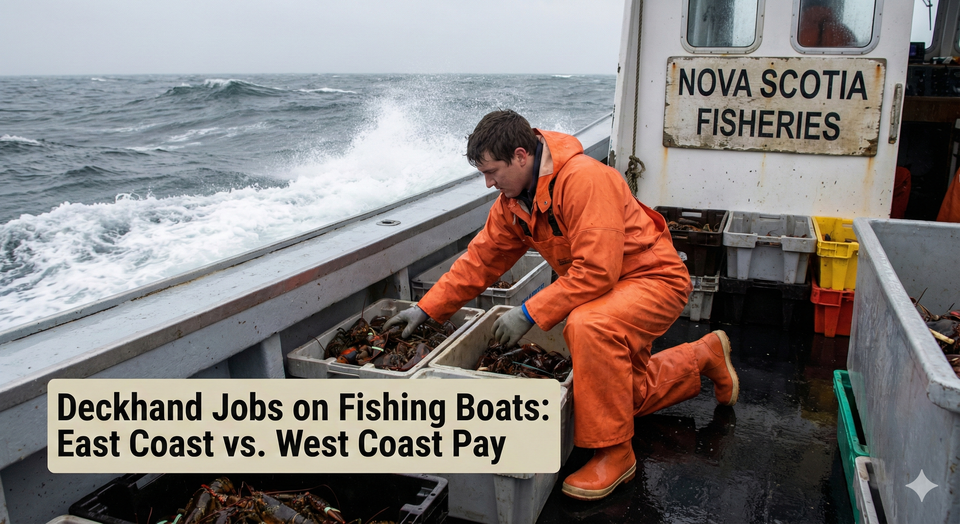
On the East Coast (Nova Scotia/PEI), it is a war of attrition. You are battling freezing spray in the dead of winter to haul thousands of lobster traps. The season is short, intense, and pays massive cash if the price is right.
On the West Coast (BC), it is a game of endurance. You might be at sea for weeks chasing Tuna or Spot Prawns. The weather is milder, but the trips are longer.
For a no-experience job seeker, the barrier to entry is high. You can't just walk onto a wharf and get hired anymore. You need certificates, gear, and a thick skin.
Here is the "Greenhorn’s Guide" to making money at sea in 2026.
1. The Pay: "Crew Shares" vs. Flat Rate
Fishing is rarely an hourly job. You are paid based on what the boat catches. This is called a Crew Share.
How the Math Works (The Greenhorn Rate)
- The Deal: The boat pays for fuel, bait, and food ("Grub"). The remaining profit is the "Net Stock."
- Your Cut: As a beginner (Greenhorn), you typically get 5% to 8% of the Net Stock.
- The Gamble: If the boat catches nothing, you make nothing. If the boat hits the "Motherlode" (e.g., $100,000 catch), you walk away with **$5,000 – $8,000 for one trip**.
East Coast (LFA 34 Lobster)
- The "Dumping Day" Bonus: In Southwest Nova Scotia (Yarmouth/Digby), the season starts in late November.
- Pay Potential: A good deckhand can make $30,000 – $50,000 in a 6-month season.
- Flat Rate Option: Some captains pay greenhorns a flat $200 – $300 per day until they prove they aren't seasick. Take this deal if it's offered. It protects you from bad fishing days.
West Coast (BC Prawns & Tuna)
- Spot Prawns (May/June): The "Gold Rush" of BC. It only lasts ~40 days. Deckhands can make $10,000+ in a month.
- Tuna: Long trips (2–3 weeks) offshore. High pay, but mentally draining.
2. The Certifications: You Can't Legally Work Without Them
In the old days, you just jumped on. Now, Transport Canada will fine the captain if you don't have these tickets.
1. MED A1 or A3 (Marine Emergency Duties)
- MED A3: For small vessels (Lobster boats close to shore). Takes 1 day. Cost: ~$250.
- MED A1: For offshore vessels (Tuna/Crab). Takes 3–4 days. Cost: ~$1,000.
- What you learn: How to put on a survival suit in 60 seconds, how to fight fires, and how not to die in freezing water.
2. ROC-M (Radio Operator)
- What it is: A license to use the VHF radio.
- Cost: ~$100 (Often included in maritime courses).
3. Fisher's Registration Card
- Cost: $30 – $50 per year (depending on province).
- Where: Department of Fisheries and Oceans (DFO) or Professional Fish Harvesters Certification Board.
3. East vs. West: Which Coast Fits You?
The Atlantic Reality (Nova Scotia / PEI)
- The Grind: It is Day Fishing. You leave at 3:00 AM, haul 300 traps, and return at 5:00 PM. You sleep in your own bed (mostly).
- The Danger: Winter. You fish in December and January. Ice builds up on the boat. Falling overboard means hypothermia in minutes.
- Best For: People who want to live on land but work at sea.
The Pacific Reality (Vancouver Island / Prince Rupert)
- The Grind: It is Trip Fishing. You live on the boat for 10–20 days. You sleep in a bunk ("fo'c'sle").
- The Danger: Fatigue. You might work 18 hours a day when the fish are biting. Sleep deprivation is the enemy.
- Best For: Tree planters or seasonal workers who want to disappear and stack cash.
4. How to Get Hired (The Wharf Walk)
Indeed is useless here. Captains hire face-to-face.
- Go to the Wharf: Go to Digby, NS or Steveston, BC in the weeks before the season opens.
- Look for Activity: Find boats where guys are painting, fixing traps, or loading gear.
- The Pitch: "I have my MED A3, my own rubber gear, and I'm not addicted to drugs. do you need a hand prepping the boat?"
- The "Wharf Rat" Strategy: Offer to wax the boat or paint buoys for free/cheap. If they see you working hard, they will offer you a deck spot.
Comparison Table: East vs. West Coast Fishing
| Feature | East Coast (Lobster) | West Coast (Prawn/Tuna) |
| Pay Structure | High % Share (Volatile) | High % Share (Volatile) |
| Trip Length | Daily (Home nightly) | Weeks (Live on boat) |
| Weather | Extreme Cold / Ice | Rain / Big Swells |
| Season | Winter (Nov - May) | Summer/Fall |
| Barrier to Entry | High (Family ties help) | Medium (Walk-ons common) |
Practical Questions Answered
"Will I get seasick?"
Consensus: YES.
Everyone gets sick their first time in 10-foot swells.
- The Rule: You do not stop working. If you have to vomit, you do it over the side (leeward side!) and keep hauling traps. If you go lie down in the bunk, you will be fired when you hit the dock.
- The Fix: Take non-drowsy Gravol (Ginger) starting 24 hours before you leave the dock.
"What is 'Mug Up'?"
East Coast Slang.
It means a coffee break. On a boat, "Mug Up" is the only time you sit down. It usually happens between hauling strings of traps. Do not sit down until the Captain says "Mug Up."
"Is it safe for women?"
Consensus: Getting better.
Historically, it was a "Boys Club." Today, many women work as deckhands, especially in BC.
- The Challenge: Bathroom privacy on small boats is non-existent (often a bucket). You need to be comfortable with zero privacy.
Frequently Asked Questions
How much does a greenhorn make on a lobster boat?
A first-year deckhand (Greenhorn) in a lucrative area like LFA 34 (Yarmouth) can earn between $25,000 and $45,000 for a 6-month season. However, this depends entirely on the catch rate and market price of lobster. In poorer fishing areas, you might only make $15,000.
What gear do I need to buy?
You cannot wear standard rain gear; it will rip in 5 minutes. You need Commercial PVC Gear (Orange or Yellow).
- Brands: Helly Hansen Workwear or Grundéns.
- Boots: Dunlop or Xtratuf rubber boots.
- Gloves: You will go through 20 pairs of rubber "atlas" gloves. Buy them in bulk.
Do I need a passport?
Only for Tuna.
Some West Coast tuna boats chase fish into US waters (Albacore Treaty). If the boat lands in Oregon or Washington to sell fish, you need a valid passport to clear US Customs. For local lobster/crab fishing, you do not need one.
Is fishing considered a trade in Canada?
No. Deckhands are not considered "Apprentices" in a Red Seal trade. However, the hours you work can count towards your "Sea Time" if you want to eventually become a Captain or Marine Engineer. You must ask the captain to sign a "Testimonial of Sea Service" form at the end of the season.
About the author
Jeff Calixte (MC Yow-Z) is a Canadian career researcher and digital entrepreneur who studies hiring trends, labour market data, and real entry-level opportunities across Canada. He specializes in simplifying the job search for newcomers, students, and workers using practical, up-to-date information.
Sources
- Transport Canada (Marine Emergency Duties): https://tc.canada.ca/sites/default/files/migrated/tp4957e.pdf
- Fish Safe BC (Safety Training): https://www.fishsafebc.com/
- Nova Scotia Fisheries Sector Council (Job Board): https://www.nsfsc.ca/
Note:
Job availability, wages, and hiring conditions can vary widely by province, employer, season, and experience level. All salary ranges and job examples in this guide are estimates based on current labour market data. Always confirm details directly with the employer before applying.