
Dietary Aide in Long Term Care: Is it Just Serving Food? (2026 Guide)
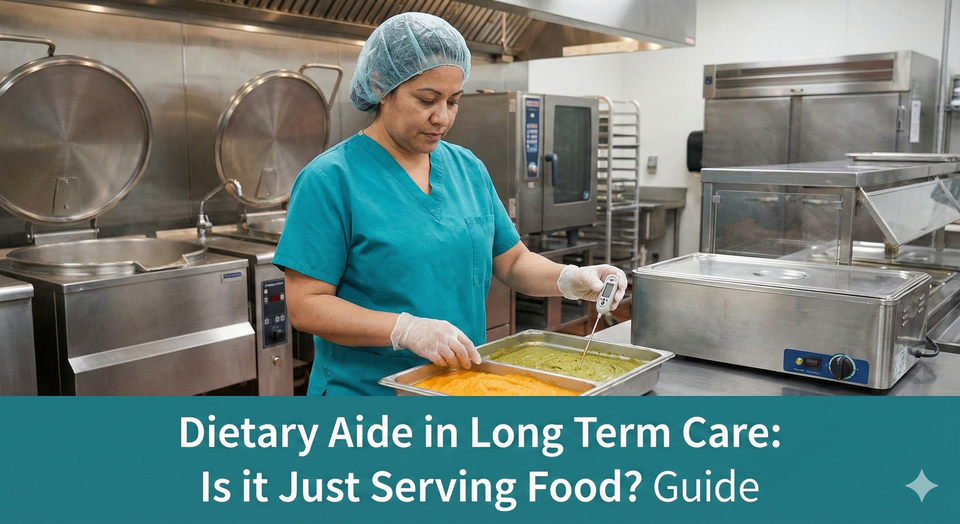
If you look at job postings for "Dietary Aide" or "Food Service Worker" in Long Term Care (LTC), you might think it is a glorified cafeteria job.
You imagine standing behind a buffet line, scooping mac and cheese onto plates for sweet old ladies.
This is the biggest misconception in entry-level healthcare.
In 2026, a Dietary Aide is not a "Lunch Lady." You are a Clinical Support Worker.
You are the last line of defense against aspiration pneumonia and choking. If a resident is prescribed a "Minced & Moist" diet and you accidentally give them a "Soft & Bite-Sized" piece of chicken, that resident could choke and die on your shift.
Because the stakes are so high, the pay is significantly better than fast food.
While a line cook at Tim Hortons makes $17.20/hour, a Dietary Aide in a unionized Ontario nursing home often starts at **$22.00 - $25.00/hour** plus a pension.
This guide will tear down the myths of the Dietary Aide role. We will explain the complex IDDSI Texture Framework you need to memorize, the reality of dealing with dementia patients in the dining room, and how to use this job as a stepping stone to become a Nurse or Occupational Therapist.
Looking for other ways to make money without a degree? Check out our list of Best "Cash Daily" Agencies or grab our No Experience Resume Template.
The Pay: Why It Beats Fast Food
The number one reason to become a Dietary Aide is the Union Premium.
Most Long Term Care homes in Canada are unionized (represented by CUPE, SEIU, or CLAC).
1. Long Term Care (LTC) Pay Rates
- Non-Union / Private Retirement Homes: $17.50 - $19.00/hour.
- These are easier jobs (serving active seniors), but the pay is lower.
- Unionized LTC Homes: $21.50 - $26.00/hour.
- Example: A municipal home in Toronto or Peel Region often pays part-time staff in lieu of benefits, bumping the rate to ~$28/hour.
2. Hospital Pay Rates
- The "Holy Grail": Working in a hospital kitchen (e.g., UHN, Sunnybrook, Vancouver General).
- Rate: $25.00 - $31.00/hour.
- Competition: Extremely high. You usually need 1-2 years of LTC experience to get hired here.
3. The "Shift Premium"
- Unlike restaurants, healthcare runs 365 days a year.
- Weekends: Often +$1.00/hour.
- Evenings: Often +$0.75/hour.
- Stat Holidays: Double time and a half (2.5x pay). Working Christmas Day as a Dietary Aide can earn you $600 for one shift.
The Job Description: It’s Not "Cooking"
Do you need to know how to cook? No.
The cook does the cooking. Your job is Assembly, Modification, and Delivery.
1. The "Belt" (Assembly Line)
- In large homes, you stand at a conveyor belt.
- One person puts the plate. One puts the meat. One puts the veg. One puts the dome lid.
- Speed: You have 4 seconds per tray. You must check the "Ticket" (Diet Card) instantly.
- Ticket says: "No Salt, Pureed Carrots, Thickened Water."
- You must grab the correct scoop before the tray moves past you.
2. The Dining Room (The Front Line)
- You push a heavy heated cart ("The Steam Table") to the unit.
- You serve 30 residents in 20 minutes.
- The Challenge: You are dealing with residents who may be confused, angry, or sleeping. You have to coax them to eat ("Hi Mrs. Smith, look at this lovely soup!") while ensuring they don't steal their neighbour's food.
3. The "Dish Pit"
- After the meal, you are the dishwasher.
- Healthcare dishwashers are industrial beasts. You handle thousands of dishes per shift. It is hot, wet, and physically exhausting work.
The IDDSI Framework (Your New Bible)
In 2019, the world switched to IDDSI (International Dysphagia Diet Standardisation Initiative).
Before you interview, you must know what this is.
If you say "I know about Minced diets," the manager will think you are old school.
If you say "I am familiar with the IDDSI Levels 4, 5, and 6," you are hired.
Why It Matters
Many seniors have Dysphagia (difficulty swallowing). If they drink thin water, it goes into their lungs (aspiration), causing pneumonia and death.
You must thicken their water with powder until it reaches a specific consistency.
The Cheat Sheet (Memorize This)
- Level 7 (Regular): Normal food.
- Level 6 (Soft & Bite-Sized): Pieces no bigger than 1.5cm (size of a thumbnail). Can be cut with a fork.
- Level 5 (Minced & Moist): Looks like ground meat. No separate thin liquid. 4mm lumps max.
- Level 4 (Pureed): Smooth like pudding. No lumps. Holds its shape on a spoon.
- Level 3 (Liquidised): Drips slowly through a fork.
The "Fork Drip Test"
- How do you know if the puree is thick enough?
- The Test: You scoop it with a fork. It should sit in a mound. It should not drip through the prongs. If it drips, it is too thin, and it could kill a patient. You must send it back to the cook.
- Interview Tip: Mention the "Fork Drip Test" in your interview. It proves you know safety protocols.
Practical Questions Answered
Personal Finance Canada to find the gritty truth about this job.
"Is it gross?"
Sometimes.
- The Reality: You are working in a home where people live and die. You will see people drooling. You will smell urine in the hallways. You might see someone take out their dentures and put them in the mashed potatoes.
- The Verdict: You need a strong stomach. If you gag easily, this is not for you.
"Is it hard physical work?"
YES.
- You are on your feet for 8 hours on concrete floors.
- The "Cart Push": Pushing a heated food cart (which weighs 300lbs fully loaded) down a carpeted hallway requires serious core strength. Back injuries are common.
- Internal Link: If you want physical work without the smells, try FedEx Jumper.
"Can men do this job?"
Absolutely.
- While it is female-dominated (80%), homes love hiring men.
- Why: Because the carts are heavy, and the garbage bags are heavy. Also, some male residents respond better to male staff.
Requirements: What You Need to Apply
You cannot just walk in with a resume. Healthcare is regulated.
1. Food Handler Certificate (Mandatory)
- Cost: $40 - $90.
- Time: 1 Day course (or online).
- Validity: 5 years.
- Where to get it: Your local Public Health unit (e.g., Toronto Public Health) or a private provider like TrainCan or Probe It.
- Do not apply without this. It is an automatic rejection.
2. TB Test (Tuberculosis)
- You need a 2-Step Mantoux Test.
- Process: Go to a doctor -> Get injected -> Go back 48 hours later to read it. Repeat 2 weeks later.
- Cost: Often $40-$60 (not covered by OHIP for employment purposes).
3. Vulnerable Sector Check (Police Record)
- This is stricter than a standard criminal check.
- It checks if you have any pardoned offenses related to vulnerable people.
- Time: Can take 2-6 weeks in big cities. Apply early.
4. Uniforms (Scrubs)
- You usually wear Scrubs (just like nurses).
- Colour: Every home has a specific colour for Dietary (e.g., Teal, Lime Green, or Black) to distinguish you from the Nurses (Blue) and Housekeeping (Navy). Wait until you are hired to buy them.
- Shoes: Non-slip, closed-toe shoes are mandatory. Sketchers "Work" line is the industry standard.
Deep Dive: The "Code White" & Behavioral Management
This is the part nobody talks about in the job description.
You are working with residents who have Dementia and Alzheimer's.
The Scenario
You are collecting a tray from a resident. Suddenly, he grabs your wrist and tries to punch you because he thinks you are stealing his food.
- This is a "Code White" (Violent Person).
Your Role
- Do Not Fight Back: You can never strike a resident, even in self-defense. You must "Disengage and Retreat."
- GPA Training: Many homes will pay for you to take Gentle Persuasive Approaches (GPA) training. It teaches you how to block a punch without hurting the senior.
- The Mental Toll: Being yelled at or spit on is part of the job. You have to have the emotional maturity to realize it's the disease, not the person. If you take it personally, you will burn out in a month.
Career Path: The "Stepping Stone" Strategy
Dietary Aide is rarely a forever job. It is the perfect "Pre-Health" job.
1. The "Nursing Student" Route
- If you are in nursing school (RPN or RN), being a Dietary Aide is better than working at Starbucks.
- Networking: You are in the building. You talk to the Director of Care (DOC). You talk to the Charge Nurses.
- The Hire: When you graduate, you are already an "Internal Applicant." You skip the line for nursing jobs at that facility.
2. The "Food Service Supervisor" (CSNM) Route
- If you enjoy the food side, you can take a 1-year college certificate to become a Food Service Supervisor.
- Pay: $55,000 - $65,000 salary.
- Role: You manage the kitchen, do the ordering, and handle the scheduling. You stop washing dishes and start managing the budget.
3. The "Recreation Aide" Pivot
- Dietary Aides often switch to Recreation (running Bingo, music therapy).
- Why: It’s cleaner and more fun.
- Pay: Similar, but no dishwashing.
Frequently Asked Questions
Do I need to speak English perfectly?
Yes.
You are reading medical diet cards ("No Concentrated Sweets", "Renal Diet"). If you misread "Allegra" (allergy) as something else, it is dangerous. Communication with residents is also key.
Is it a "Union" job right away?
Yes.
Even part-timers pay union dues.
- Pros: Job security. It is very hard to get fired once you pass probation.
- Cons: Seniority rules. You pick your vacation based on seniority. As the new guy, you will be working Christmas, New Year's, and every Friday night for the first 2 years.
Can I eat the food?
Strictly NO.
- It is considered "Theft of Resident Property."
- If you eat a leftover cookie from a tray, you can be fired for cause. Most homes provide a staff meal for $2-$5, or you bring your own lunch.
What is a "Texture Modification" Audit?
- The Ministry of Health does surprise inspections.
- They will walk into the kitchen, point at a bowl of puree, and ask you: "Is this Level 4? Prove it."
- You must perform the "Spoon Tilt Test" in front of the inspector. If you fail, the home gets cited.
Summary: A Noble Grind
- Get Certified: Food Handler Certificate is step one.
- Learn IDDSI: Memorize the levels (4, 5, 6) before the interview.
- Expect Fluids: You will deal with spit, spilled soup, and potentially other fluids. It is healthcare.
- Join the Union: Enjoy the $24/hour pay and the pension, even if the work is hard.
About the author
Jeff Calixte (MC Yow-Z) is a Canadian career researcher and digital entrepreneur who studies hiring trends, labour market data, and real entry-level opportunities across Canada. He specializes in simplifying the job search for newcomers, students, and workers using practical, up-to-date information.
Sources
- IDDSI Framework: Official testing methods and descriptors. https://iddsi.org/
- Canadian Union of Public Employees (CUPE): Long Term Care collective agreements. https://cupe.ca/
- ZipRecruiter: Dietary Aide Salary Data Ontario 2026. https://www.ziprecruiter.com/
Note
Job availability, wages, and hiring conditions can vary widely by province, employer, season, and experience level. All salary ranges and job examples in this guide are estimates based on current labour market data. Always confirm details directly with the employer before applying.