
Drywall Taper Salary: Piecework vs. Hourly Rates (2026 Guide)
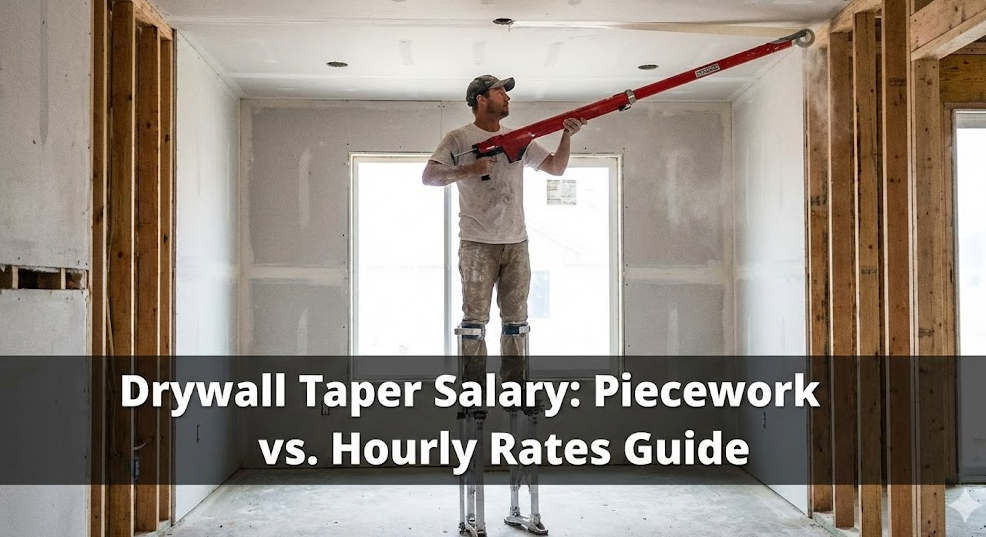
In the world of construction, Drywall Tapers (or "Mud Men") are the rock stars of finishing.
While electricians and plumbers make high hourly wages, a skilled Taper on Piecework can out-earn almost everyone on the job site—if they are fast.
But it is a brutal trade. It destroys your shoulders, fills your lungs with dust, and requires an upfront investment of $5,000+ in tools if you want to be a pro.
In 2026, the housing boom in Alberta and Ontario has pushed rates higher.
- Hourly Tapers earn a safe $30 - $45/hour.
- Piecework Tapers can earn $60 - $80/hour... or $15/hour if they are slow.
This guide compares the Union (IUPAT) vs. Non-Union rates, breaks down the math of "Board Feet," and explains why buying a Bazooka (Automatic Taper) is the only way to survive past age 40.
Not interested in construction? Check out Night Shift Warehouse Premiums for indoor work or School Bus Driving for part-time income.
Piecework Rates: The "Board Foot" Math
Most residential tapers are paid by the square foot of drywall installed (Board Foot).
2026 Piecework Rates (Taping Only)
- Standard Height (8ft): $0.40 - $0.60 per sq. ft.
- High Ceilings / Detail Work: $0.70 - $1.00 per sq. ft.
- The Math:
- A standard 2,000 sq. ft. house has approx 7,000 sq. ft. of drywall surface.
- At $0.50/sq. ft. = **$3,500 for the job.**
- If you finish it in 5 days = $700/day.
- If you finish it in 10 days = $350/day.
- Speed is everything.
The "Extras" List
Never tape for free. You must charge extra for:
- Corner Beads: $2.00 per foot (requires more mud).
- Bulkheads: $3.00 per linear foot.
- Vaulted Ceilings: +25% premium (scaffolding risk).
Hourly Wages: Union vs. Non-Union
If you want safety and a pension, you go Hourly.
1. Union (IUPAT - International Union of Painters and Allied Trades)
- Rate: $38.00 - $48.00/hour (Total package including benefits often exceeds $60/hr).
- Pension: Yes.
- Benefits: Full medical/dental.
- The Job: Commercial work (Condos, Hospitals, Offices). Less physical speed, more "Level 5" quality finish.
2. Non-Union (Residential Reno)
- Rate: $28.00 - $35.00/hour.
- The Job: Small renovations, basements.
- The Risk: No overtime pay, no benefits. You are often a "Subcontractor" responsible for your own taxes.
Winner: Piecework for young, hungry workers who want cash fast. Union for career longevity.
The Tool Investment: "The Bazooka"
You cannot be a pieceworker with just a hawk and trowel. You need Automatic Taping Tools.
The Basic Kit ($500)
- Pan, Knife (6", 10", 12"), Mixing Drill.
- Result: You are slow. You will make $25/hour.
The Automatic Set ($5,000+)
- The Bazooka (Automatic Taper): Applies tape and mud simultaneously.
- Cost: ~$2,000.
- Flat Boxes: Applies the second coat automatically.
- Cost: ~$1,500.
- The Pump: Fills the tools with mud.
- Result: You are 4x faster. You can tape a whole house in a day.
- ROI: The set pays for itself in 3 houses.
The "Reddit Defense": Practical Questions Answered
We scanned r/Drywall and r/Construction to find the dust-covered truth.
"Will I destroy my body?"
Yes, if you don't stretch.
- Rotator Cuff: The constant overhead motion kills shoulders.
- Dust Lung: Drywall dust (gypsum/silica) is terrible.
- Fix: Never sand without a mask (N95 minimum) or a dustless sander (Festool).
"Can I start as an apprentice?"
Yes.
- The Union Path: Join IUPAT as an apprentice.
- Start Pay: 50% of Journeyman rate (~$20/hr).
- Training: They teach you the trade for free.
- The Helper Path: Find a pieceworker and ask to be his "Sander" or "Mixer."
- Start Pay: $20 cash/hour. It sucks, but you learn by watching.
"Is Level 5 finish hard?"
Yes.
- Level 4: Standard house. Some imperfections allowed.
- Level 5: Skim coat entire wall. Must be like glass. Used in high-end condos with bright lights.
- Charge double for Level 5.
Deep Dive: The "Fire Taping" Niche
The easiest money in taping is Fire Taping (Level 1).
- What is it? Taping garages or mechanical rooms. No sanding required. Just seal the joint for fire code.
- The Pay: Fast and ugly.
- The Strategy: Many tapers only bid on commercial warehouse jobs doing Fire Taping. You can run thousands of feet a day with a Bazooka and never sand a single spot.
The Underground Economy & Repair Hustles
1. The "Cash Job" Reality (The Weekend Hustle)
- While the Union pays the bills, the "Cash Job" buys the toys.
- The Hustle: Every taper knows that Saturday is for "Private Work."
- The Market: Homeowners on Kijiji or Facebook Marketplace looking to finish a basement or fix a ceiling leak. They don't want to pay a big company + HST. They want you.
- The Rate: You can charge $50 - $60/hour cash for these small jobs.
- The Link: If you need cash even faster than a weekend reno, check out our guide on Cash Daily Agencies for immediate payout options.
2. The "Dustless" Revolution (Festool vs. Mirka)
- The #1 complaint from clients is dust.
- The Upgrade: If you buy a Festool Planex or Mirka Leros sander ($1,500) with a HEPA vacuum extractor, you capture 99% of the dust.
- The Upsell: You can charge a 20% Premium for "Dustless Sanding."
- Why it sells: Rich clients with nice furniture will happily pay an extra $500 to not have their house covered in white powder. It also saves your lungs from long-term damage.
3. The "California Patch" Side Hustle
- You don't need to tape a whole house to make money.
- The Niche: Fixing doorknob holes, water damage spots, or electrician cut-outs.
- The Technique: The "California Patch" (or Hot Patch) uses the paper from the drywall itself to create a seamless repair in 20 minutes using "Hot Mud" (Quick Set).
- The Pay: Minimum charge $150 - $200 per visit.
- The Math: You drive there, mix a cup of 20-minute mud, patch it, skim it, and leave. $150 for 1 hour of work. It is the highest hourly rate in the trade.
4. "Butt Joints" vs. "Factory Edge" (The Rookie Killer)
- This is the technical skill that separates the $25/hr guys from the $45/hr pros.
- Factory Edge: The long side of the drywall sheet has a recess. Easy to hide tape.
- Butt Joint: The short end (cut end). No recess. Creates a "hump" on the wall.
- The Secret: Experienced tapers "float" the butt joint out 12-18 inches wide to create an optical illusion of flatness.
- The Warning: If you mess this up, the homeowner will see a "hump" every time they turn on the hallway light. You will have to sand it down for free.
5. Drywall vs. Plastering (The Stucco Pivot)
- Taping is indoor work. What about summer?
- The Pivot: Many tapers switch to Stucco (Exterior Plastering) in the summer.
- The Skill Transfer: It uses similar tools (trowels/hawks) but heavier material (cement based).
- The Pay: Stucco pays huge money because it is harder work and weather-dependent.
- Comparison: Unlike the Night Shift Warehouse where the environment is controlled, Stucco requires you to work in the blistering sun.
6. The "Holdback" Scam
- In residential piecework, builders often try to keep a "10% Holdback."
- The Excuse: "We hold 10% until the painters finish to ensure no deficiencies."
- The Scam: They never call you back, and they keep your 10%.
- The Fix: Never agree to a holdback for taping unless it is a massive commercial contract. For houses, demand "Paid on Completion of Sanding." If they refuse, walk away.
7. "Women in Drywall" (The Untapped Market)
- Drywall is 98% male, but women are entering the trade fast.
- The Advantage: Female tapers are often preferred for Renovations in Occupied Homes.
- Why: Homeowners (especially elderly women or stay-at-home moms) often feel safer and find female tradespeople cleaner and more respectful of their furniture.
- Marketing: If you are a woman, market yourself as "Clean, Detail-Oriented, & Trustworthy." You can charge a premium for the peace of mind.
8. "Sheet Count" vs. "Square Footage"
- Sometimes builders try to pay by the "Sheet" instead of the square foot.
- The Trap: A 4x8 sheet is 32 sq ft. A 4x12 sheet is 48 sq ft.
- The Math: If they offer "$15 per sheet," make sure you know if they are using 8-footers or 12-footers.
- Heavy Lifting: Hanging 12-foot sheets (weighing 80lbs) is brutal. If you are also doing the "Boarding" (Installing), negotiate a "Heavy Board Premium."
9. Level 5 Finish (The "Skim Coat" Upsell)
- We mentioned Level 5 briefly, but here is how to sell it.
- The Pitch: "If you are painting these walls with eggshell or semi-gloss paint, or if you have pot lights close to the wall, you WILL see texture differences. I recommend a Level 5 Skim Coat to make it look like glass."
- The Profit: It takes 1 extra day but doubles the price of the job.
- The Alternative: If you want a job where "perfection" matters less and "safety" matters more, look into upgrading to a Class 3 / D License where the machine does the work.
Frequently Asked Questions
Do I need a vehicle?
Yes.
You cannot take 10-foot stilts and buckets of mud on the bus. You need a Van or Pickup Truck.
Is winter slow?
Yes.
- Drywall mud needs heat to dry.
- In unheated new builds, you have to use Propane Heaters. If the mud freezes, it cracks, and you have to redo it for free.
- Tip: Charge a "Winter Surcharge" for heater rentals.
Stilts vs. Ladders?
Learn Stilts.
- Ladders are slow (up, down, move).
- Stilts allow you to walk the ceiling continuously.
- Safety: Illegal on some commercial sites (Union), but standard in residential.
Summary: A Young Person's Game
- Invest Early: Buy the Bazooka as soon as you can afford it.
- Protect Your Lungs: Wear a mask every single day.
- Charge for Extras: Don't let builders bully you into doing bulkheads for free.
- Join IUPAT: If you want to retire with knees that work.
About the author
Jeff Calixte (MC Yow-Z) is a Canadian career researcher and digital entrepreneur who studies hiring trends, labour market data, and real entry-level opportunities across Canada. He specializes in simplifying the job search for newcomers, students, and workers using practical, up-to-date information.
Sources
- IUPAT (Painters & Allied Trades): Union wage rates and benefits. https://iupat.on.ca/
- Ames Taping Tools: Automatic tool pricing. https://amestools.com/
- WorkSafeBC: Drywall safety regulations. https://www.worksafebc.com/
Note
Job availability, wages, and hiring conditions can vary widely by province, employer, season, and experience level. All salary ranges and job examples in this guide are estimates based on current labour market data. Always confirm details directly with the employer before applying.