
EI Application Guide 2026: Step-by-Step Screenshots
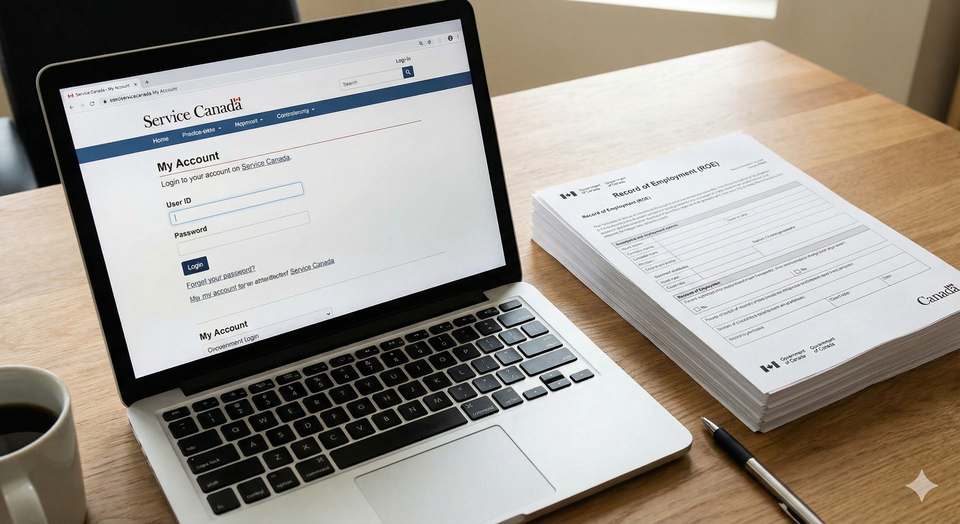
Applying for Employment Insurance (EI) in Canada feels like a test you didn't study for.
The Service Canada website is full of government jargon like "Insurable Hours" and "Benefit Rate."
One wrong click—like choosing "Quit" instead of "Shortage of Work"—can disqualify you from receiving $695 per week for months.
In 2026, the rules have shifted slightly due to new Temporary Economic Measures introduced in March 2025 (extending into April 2026). If you are applying right now, you might be eligible for a Waiting Period Waiver or extra weeks of benefits.
This guide is your cheat sheet. We will walk you through the application step-by-step, translate the ROE codes that determine your fate, and explain exactly how to report your earnings if you find a part-time job.
Laid off but not sure what to do next? Update your Resume immediately and calculate your outstanding Vacation Pay.
2026 Update: The New "Temporary Measures"
Before you apply, check if you qualify for these special rules active until April 11, 2026:
- Waiting Period Waived: For many claims starting in 2026, the standard 1-week unpaid waiting period is waived. You might get paid starting Week 1 instead of Week 2.
- Separation Pay Suspension: Usually, if you get a severance package, EI pauses until that money "runs out." Under the new pilot, you might be able to receive EI and your severance cheque simultaneously without delay.
- Maximum Benefit: The maximum weekly payout for 2025/2026 is approx $695 (based on $65,700 MIE).
Step 1: Gather Your Documents (The "Must-Haves")
Do not start the application until you have these. The portal times out after 20 minutes of inactivity.
- SIN (Social Insurance Number): If it starts with a '9', you need your work permit expiry date.
- The Mother's Maiden Name: Used for security verification.
- Banking Info: Transit (5 digits), Institution (3 digits), Account (7-12 digits). Do not wait for a cheque in the mail; it takes weeks.
- ROE (Record of Employment):
- Digital: Most employers submit this directly to Service Canada. You don't need a paper copy.
- Paper: If they gave you a paper copy, you must mail it to Service Canada or drop it at a Service Canada Centre.
Step 2: The ROE Code Decoder
Your eligibility depends entirely on Block 16 of your ROE.
If your employer put the wrong code, you will be rejected.
| Code | Meaning | EI Eligibility | Note |
| A | Shortage of Work | YES | Layoffs, end of contract, seasonal. The "Golden Ticket." |
| D | Illness / Injury | Sickness Benefits Only | Requires a doctor's note eventually. |
| E | Quit | NO (Usually) | Unless you can prove "Just Cause" (abuse, safety). |
| F | Maternity | YES | For birth mothers only. |
| M | Dismissal | NO (Usually) | Fired for misconduct. You can fight this if it wasn't your fault. |
| N | Leave of Absence | NO | You chose to take unpaid leave. |
The Trap: If you quit because your boss was abusive, but they mark Code E (Quit), you must call Service Canada to explain your side. Do not just accept the rejection.
Step 3: The Online Application (Tricky Questions)
Go to Canada.ca -> Benefits -> EI -> Regular Benefits -> Apply.
Q: "Are you ready, willing, and capable of working each day?"
- Answer: YES.
- Why: If you say "No" (e.g., because you are sick or in school full-time), you are ineligible for Regular benefits. You must be looking for work.
Q: "Did you receive any other monies?"
- Answer: Be honest. List "Vacation Pay" or "Severance."
- Note: Even if you haven't received the cash yet, list it if it's owed.
Q: "Do you want to pay tax now?"
- Answer: YES.
- Why: EI is taxable income. If you don't deduct tax now, you will owe the CRA thousands of dollars next April.
Step 4: The "Bi-Weekly Report" (How to Get Paid)
Applying is just the start. To get money, you must file a report every 2 weeks.
The "Working While on Claim" Rule:
In 2026, you CAN work part-time while on EI.
- The Rule: You keep 50 cents of your EI benefits for every dollar you earn (up to 90% of your previous earnings).
- The Math:
- EI Benefit: $500/week.
- Part-time Job: You earn $200.
- Deduction: $100 (50% of $200).
- Total Pay: $400 (EI) + $200 (Job) = **$600**.
- Result: You are always better off working.
Practical Questions Answered
The real problems people face.
"My employer hasn't submitted my ROE yet. Can I apply?"
YES. Apply IMMEDIATELY.
- Do not wait. If you wait more than 4 weeks after your last day, you might lose benefits.
- Apply now. Service Canada will chase your employer for the ROE later.
"I was fired for 'performance'. Can I get EI?"
Usually YES.
- Misconduct vs. Performance: "Misconduct" (Code M) means you stole, hit someone, or skipped shifts. "Performance" means you tried but weren't good at the job.
- The Rule: You CAN get EI if you were fired for being bad at the job. You CANNOT get EI if you were fired for breaking the rules.
"I'm a student. Can I get EI?"
It depends.
- If you are in school full-time, Service Canada usually says you aren't "Available for Work."
- Exception: If your classes are evenings/weekends, or if you have a history of working full-time while in school, you can argue your case.
Deep Dive: How to Fix a "Code E" (Quit) Situation
If you quit, you have to prove "Just Cause" to get paid.
1. The "Reasonable Alternative" Test
Service Canada will ask: "Did you have any other choice but to quit?"
- Bad Answer: "I didn't like the vibe."
- Good Answer: "I raised the safety issue with my manager on [Date] in writing. Nothing changed. I felt unsafe, so I left."
2. Proof You Need
- Emails to your boss complaining about the issue.
- Doctor's note (if quitting for medical reasons).
- Log of harassment incidents.
- Internal Link: If you quit due to safety, read our Resignation Letter Guide to see how to document it properly.
3. The Interview
- A Service Canada agent will call you.
- Tip: Be calm, factual, and refer to your notes. Do not rant. Focus on the steps you took to save your job before quitting.
Frequently Asked Questions
How much will I get?
55% of your earnings.
- It is calculated on your "Best Weeks" in the last year.
- Max: ~$695/week (2026).
- Min: Depends on your income.
How long does it last?
14 to 45 weeks.
- It depends on the unemployment rate in your city (Toronto gets fewer weeks than rural Newfoundland) and how many hours you worked in the last year.
What if I travel?
You don't get paid.
- If you leave Canada for a vacation, you must report "Not Available." You won't get paid for those days. (Exception: You can sometimes get paid while looking for work in the USA if you are authorized to work there, but it's complex).
Summary: Don't Panic, Just Report
- Apply Day 1: Even without the ROE.
- Check Block 16: Ensure it says Code A if you were laid off.
- Report Earnings: If you work a side gig (like TaskRabbit), report the gross income.
- Keep Searching: Keep a log of jobs you apply to. They audit people randomly.
About the author
Jeff Calixte (MC Yow-Z) is a Canadian career researcher and digital entrepreneur who studies hiring trends, labour market data, and real entry-level opportunities across Canada. He specializes in simplifying the job search for newcomers, students, and workers using practical, up-to-date information.
Sources
- Service Canada: EI Regular Benefits eligibility. https://www.canada.ca/en/services/benefits/ei/ei-regular-benefit.html
- Government of Canada: ROE Code Guide for Applicants. https://www.canada.ca/en/employment-social-development/programs/ei/ei-list/reports/roe-guide.html
- CRA: Tax implications of EI. https://www.canada.ca/en/revenue-agency.html
Note
Job availability, wages, and hiring conditions can vary widely by province, employer, season, and experience level. All salary ranges and job examples in this guide are estimates based on current labour market data. Always confirm details directly with the employer before applying.