
Food Handler Certificate Ontario: Test Answers & Cheat Sheet
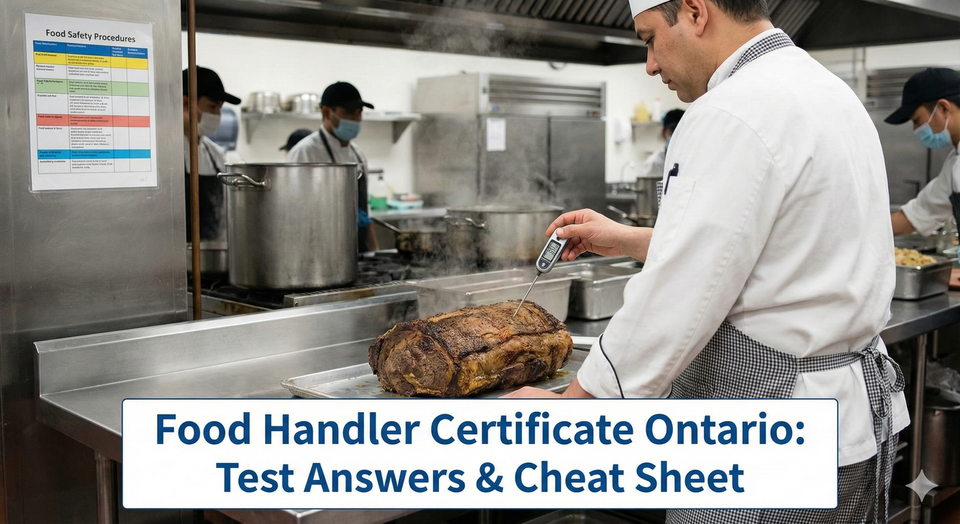
In Ontario, if you want to work in a kitchen, serving food, or even at a hot dog stand, you need to know about food safety.
While not every single server is legally required to have the certificate (the law requires at least one certified person on shift at all times), having it on your resume puts you ahead of 90% of applicants. Employers love it because it means they don't have to train you on the basics of handwashing and temperature checks.
But the test can be tricky. It involves memorizing specific temperatures (in Celsius) and knowing exactly how to mix sanitizer.
This guide will break down the cheapest ways to get certified in 2026, provide a "Cheat Sheet" for the hardest questions, and explain the proctoring rules.
Looking for a job in food service? Check out our Ultimate Canadian Job Directory or see who is hiring in our Tim Hortons Hiring Guide.
Do I Really Need It?
Legally: Ontario Regulation 493/17 states that every food premise must have at least one certified food handler present during every hour of operation.
Practically: Yes. If you apply to McDonald's, Subway, or a fancy restaurant in downtown Toronto, having "Food Handler Certified" on your resume proves you are serious. It is often a condition of employment for line cooks and prep cooks.
Top 3 Ways to Get Certified (2026)
1. Local Public Health Unit (Cheapest & Best)
- Provider: Toronto Public Health, Peel Public Health, Ottawa Public Health, etc.
- Cost: ~$40 - $60 (varies by city).
- Format: In-person class + exam OR Self-study + in-person exam.
- Why: This is the most "official" route and usually the cheapest.
2. In Good Hands (Online)
- Provider: Thunder Bay District Health Unit (recognized province-wide).
- Cost: ~$35 - $50.
- Format: Fully online course + webcam proctored exam.
- Why: It is government-run but fully digital. Very popular.
3. Private Providers (Fastest)
- Examples: Probe It, TrainCan, CIFS.
- Cost: $50 - $80.
- Format: 100% Online, instant scheduling.
- Why: If you need the certificate tonight for a job starting tomorrow, these private companies are faster (but more expensive).
Internal Link: If you are looking for student jobs that don't require certifications, check out our Student Jobs Canada guide.
The "Cheat Sheet": Answers to the Hardest Questions
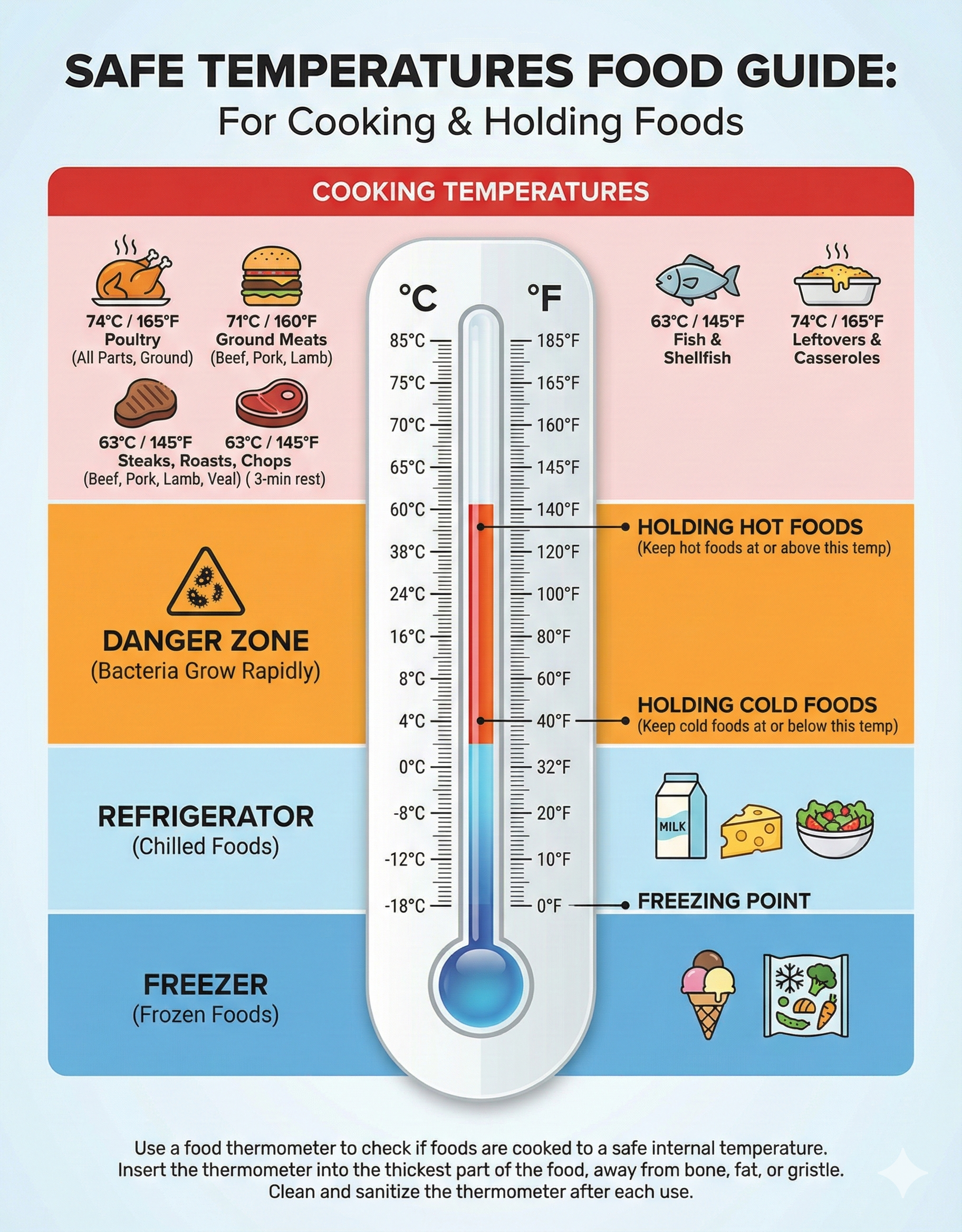
The exam usually consists of 50 multiple-choice questions. You need 70% to pass. Here are the facts you must memorize.
1. The "Danger Zone"
- Question: What is the Temperature Danger Zone?
- Answer: 4°C to 60°C (40°F to 140°F).
- Rule: Bacteria grow fastest in this range. Keep hot food above 60°C and cold food below 4°C.
2. Internal Cooking Temperatures (Memorize These!)
- Whole Poultry (Chicken/Turkey): 82°C (180°F).
- Poultry Pieces / Ground Poultry: 74°C (165°F).
- Food Mixtures (Soups/Stews): 74°C (165°F).
- Pork / Ground Meat (Beef): 71°C (160°F).
- Fish: 70°C (158°F).
- Whole Cuts of Beef/Lamb: 71°C (Medium).
3. The "2-Hour / 4-Hour" Rule
- Question: How long can food stay in the Danger Zone?
- Answer: 2 Hours. If food is left out at room temperature for more than 2 hours, it must be discarded.
4. Sanitizer Ratios
- Chlorine (Bleach): 100 PPM (Parts Per Million).
- Recipe: ~1 tsp of bleach per litre of water.
- Quats (Quaternary Ammonium): 200 PPM.
- Iodine: 25 PPM.
5. Washing Hands
- Question: How long must you lather soap?
- Answer: 20 Seconds (Happy Birthday twice).
Practical Questions Answered
We scanned r/KitchenConfidential and r/askTO to see what actual workers say about the test.
"Is the online exam proctored?"
YES.
- Just like Smart Serve, if you take the online version (e.g., In Good Hands or Probe It), you need a webcam. A proctor will watch you. You cannot use notes or Google.
"Can I fail?"
Yes, but it's hard.
- The failure rate is low if you read the manual. Most people fail because they confuse 71°C (Ground Beef) with 74°C (Chicken). If you memorize the temperature chart, you will pass.
"Does it expire?"
YES.
- The certificate is valid for 5 years in Ontario. After that, you must retake the exam (recertification is usually cheaper).
Deep Dive: How to Pass the Proctoring & Save Money
If you are taking the test at home in 2026, the rules have tightened.
1. The Webcam Setup
- The Room Scan: You will be asked to spin your laptop 360 degrees to show your room.
- Clean Desk: Clear everything off your desk. If there is a piece of paper, they will assume it is a cheat sheet.
- No Headphones: You cannot wear headphones or earbuds.
2. The "Free" Study Guide
Do not pay for a "study guide."
- The Hack: Go to the Toronto Public Health website. They offer the full Food Handler Training Manual (PDF) for free download. It covers 100% of the questions on the exam, regardless of which provider you use.
3. Retakes
- Private Providers: Often offer "Free Retakes" (e.g., Probe It).
- Public Health: Usually charge a small fee ($10-$20) for a re-test if you fail.
- Strategy: If you are a nervous test-taker, pay the extra $10 for a private provider that guarantees a free second attempt.
Frequently Asked Questions
Can I take the test in another language?
Yes. Most providers (Public Health and Private) offer the exam in Chinese, Punjabi, Spanish, French, Arabic, and many other languages. You must request this when booking.
Is the "Food Handler" different from "Smart Serve"?
Yes.
- Food Handler: Safety/Hygiene (Bacteria, Temperatures).
- Smart Serve: Alcohol Liability (Drunk customers).
- You usually need both to work as a server or bartender.
Can I use a certificate from another province?
Maybe.
- Ontario generally accepts certificates from other provinces if they are deemed "equivalent" by the Ministry of Health. However, it is often easier (and preferred by employers) to just have the Ontario one.
Deep Dive: Lost Cards, Challenge Exams & "Secret" Discounts
Most people blindly pay the full $50 for a course they don't need. If you are a student, a renewal taker, or just lost your wallet, here is how to save money and time in 2026.
1. The "Challenge Exam" Hack (Save $30+)
Did you know you don't have to take the 6-hour course?
- The Rule: Ontario law requires you to pass the exam, not watch the videos.
- The "Challenge" Option: Many Health Units (like London or Simcoe Muskoka) and some private providers allow you to book a "Challenge Exam."
- The Cost: Usually $10 – $25 (instead of $50+).
- Who should do this: If you have worked in a kitchen before or just have good common sense (and memorized our Cheat Sheet above), you can skip the boring videos and just pay for the test.
- Warning: If you fail the Challenge Exam, you usually have to pay full price to take the course. Only risk it if you know your temperatures!
2. The "Student Discount" Loophole
If you are in High School or College, do not pay full price.
- High School Students: Some regions (like Simcoe Muskoka District Health Unit) offer a specific "High School Student Rate" for as low as $10–$15 for the manual and exam. You usually have to buy it in person at their office.
- College Students: If you attend Seneca, Humber, or Conestoga, check your Student Federation or "Continuing Education" board. They often run subsidized Food Handler days for $20 (usually once a semester).
3. Provider Showdown: SafeCheck vs. In Good Hands
If you are Googling "cheapest food handler course," you will see these two names. Here is the real difference.
- In Good Hands:
- Price: ~$35 - $50.
- Pros: Owned by Thunder Bay District Health Unit. It feels very "official."
- Cons: The interface is a bit dated.
- SafeCheck (Canadian Food Safety):
- Price: Often on sale for ~$24.88.
- Pros: Currently the cheapest legit online option in Ontario. Includes unlimited exam retakes (check their current terms).
- Cons: It is a private company (though fully accredited). Some old-school managers might squint at the card until they see the "Ontario Recognized" logo.
4. Lost Your Card? (The Public Health Nightmare)
This is the #1 complaint we see.
- The Problem: If you took your test in-person at Toronto Public Health 3 years ago and lost your paper card, getting a replacement is a pain. You often have to email them, pay a $15–$20 replacement fee, and wait for snail mail.
- The Fix: This is why we recommend Online Providers (Probe It, SafeCheck, etc.). They email you a PDF. If you lose it, you just log in and download it again for free, forever.
- Pro Tip: If you have your physical card right now, take a photo of it and email it to yourself. A photo is often accepted by managers if you lose the physical copy.
5. Does McDonald's or Tim Hortons Pay for It?
- The Short Answer: Usually NO.
- The Reality: For an entry-level "Team Member" role, they expect you to have it (or get it) at your own expense. It is considered a "condition of employment," like owning black non-slip shoes.
- The Exception: If you are promoted to Shift Manager or Keyholder, the company must ensure a certified person is on shift. At that point, they will often pay for your training (and sometimes the advanced "Manager" version).
- Negotiation Tip: If you are hired without it, ask: "If I pass the test this week, will the store reimburse the $40 fee on my first paycheque?" Smart franchise owners will say yes to keep a good employee.
6. The "Digital Wallet" Trick
Stop carrying the paper card. It gets wet and crumbles in your pocket.
- iPhone/Android: Most modern PDF certificates have a QR code. Screenshot the QR code section and save it to a specific "Work" album on your phone.
- Apple Wallet: Some newer providers send a
.pkpassfile. Add it to your Apple Wallet so it sits right next to your debit card. When a Health Inspector walks in, pulling it up on your watch or phone looks incredibly professional.
Summary: Your 3-Step Plan
- Download the Free PDF: Search "Toronto Public Health Food Handler Manual" and study the Temperature Chart.
- Book the Test: Choose "In Good Hands" (Online) or your local Health Unit (In-Person).
- Memorize 4°C - 60°C: This is the answer to 20% of the questions.
- Getty Images
About the author
Jeff Calixte (MC Yow-Z) is a Canadian career researcher and digital entrepreneur who studies hiring trends, labour market data, and real entry-level opportunities across Canada. He specializes in simplifying the job search for newcomers, students, and workers using practical, up-to-date information.
Sources
- Ontario Ministry of Health: Official food safety standards. https://www.ontario.ca/page/food-handler-training-and-certification
- In Good Hands: Recognized online training provider. https://ingoodhands.ca/
- Toronto Public Health: Training manual resources. https://www.toronto.ca/community-people/health-wellness-care/health-programs-advice/food-safety/food-handler-certification/
Note
Job availability, wages, and hiring conditions can vary widely by province, employer, season, and experience level. All salary ranges and job examples in this guide are estimates based on current labour market data. Always confirm details directly with the employer before applying.