
Forklift License: Counterbalance vs. Raymond Reach (Which to Buy?)
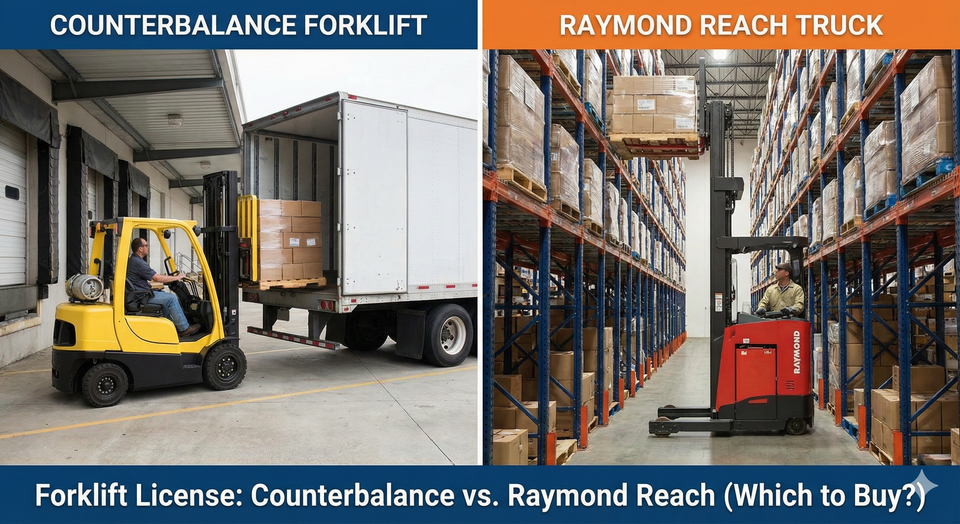
In the Canadian warehouse industry, a forklift license is the "Golden Ticket."
Unlike a university degree that takes 4 years, you can get a forklift license in 2 days and immediately start earning $22.00 to $26.00/hour.
But when you call a training school in Brampton, Mississauga, or Surrey, they will ask you a confusing question:
"Do you want Counterbalance, Raymond Reach, or the Combo?"
Most beginners choose the cheapest option (Counterbalance) and regret it later. Why? Because the highest-paying jobs in 2026—specifically in cold storage and e-commerce—require the Raymond Reach.
This guide compares the two most common machines, breaks down the costs, and reveals which license actually gets you hired.
Looking for warehouse jobs? Check out our Ultimate Canadian Job Directory or see what Amazon Canada pays their drivers.
Machine #1: The Counterbalance (Class 4/5)
This is what most people picture when they hear "forklift." It is the standard sit-down machine.
The Job Description
- Where it works: Loading docks, construction sites, and wide aisles.
- The Task: Unloading 53-foot trailers. You drive into the back of a truck, pick up a pallet, and drive it out.
- The Vibe: Fast-paced, often outdoors or near open bay doors (it gets cold in winter).
The Pros & Cons
- Pros: Easy to drive (drives like a car with a steering wheel). Can work indoors (Electric/Propane) and outdoors (Diesel).
- Cons: Lower pay ceiling. Everyone has this license, so competition is high.
Machine #2: The Raymond Reach (Class 2)
This is a "Narrow Aisle" machine. You stand up while driving it.
The Job Description
- Where it works: High-density warehouses (Amazon, Walmart Distribution, Cold Storage).
- The Task: putting pallets away into racks that are 30+ feet high. You operate in tiny aisles where a Counterbalance wouldn't fit.
- The Vibe: Precision work. You are not rushing; you are focusing on not dropping a 2,000lb pallet from the ceiling.
The Pros & Cons
- Pros: Higher Pay (usually $1–$3 more per hour). High demand in logistics hubs like Peel Region and Delta, BC.
- Cons: Harder to learn. The steering is "reverse" (you turn the wheel left to go right). It causes more neck strain because you are constantly looking up.
The Verdict: Which One Should You Buy?
If you can only afford one: Get the Counterbalance.
- It is the foundation. Most warehouses will not hire a Reach driver who can't drive a Counterbalance.
The Smart Move: Buy the Combo (Counterbalance + Reach).
- Cost Efficiency:
- Counterbalance alone: ~$180
- Reach alone: ~$200
- Combo: ~$300 (You save ~$80).
- Employability: 70% of job postings on Indeed/ZipRecruiter ask for "Valid Forklift License (CB & Reach)." If you only have one, your resume goes in the trash.
Internal Link: If you are a student looking for easier warehouse roles, check out the Student Jobs Canada guide for positions like "Order Picker."
The "Walkie Rider" Bonus
Here is a secret: Most training schools will throw in the "Walkie Rider" (Electric Pallet Jack) license for FREE if you buy the Combo package.
- Why you need it: Even if you are a forklift driver, you will use the Walkie Rider 50% of the time to move small loads.
- The Value: A standalone Walkie course costs ~$100. getting it for free is a no-brainer.
Practical Questions Answered
We scanned r/Forklift and r/Brampton to find the real advice from operators.
"Is the Reach truck really that hard?"
YES.
- The Steering: It uses "360-degree steering." If you panic and spin the wheel, you lose track of which way your wheels are facing.
- The Stance: You stand sideways. New drivers often complain of left leg and neck pain for the first 2 weeks.
"Can I get a job with no experience?"
It's tough, but possible.
- The Strategy: Apply to "High Turnover" places first (staffing agencies). They are desperate.
- The Lie: Do not lie about experience. If you crash a machine on your first day, you will be fired instantly. Tell them: "I am newly licensed, but I passed my training with high scores and I am very safety-conscious."
"Do licenses expire?"
Technically No, but Actually Yes.
- The Law: The Ontario Ministry of Labour requires "competency," usually reviewed every 3 years.
- The Employer: Almost every employer requires a certificate dated within the last 3 years. If yours is from 2021, go pay the $80 for a "Renewal/Refresher" course.
Frequently Asked Questions
Do I need a driver's license (G2/G) to drive a forklift?
No. You do not need a provincial driver's license to operate a forklift inside a warehouse on private property. However, if the job requires you to cross a public road, you need a valid driver's license.
How much do forklift drivers make in 2026?
- Entry Level: $20.00 - $22.00/hr.1
- Experienced (Reach/Clamp): $24.00 - $28.00/hr.
- Freezer Work: $26.00 - $32.00/hr (Danger pay).
Can I fail the training?
Yes. If you are unsafe (e.g., driving with the forks raised, not looking behind you when reversing), the instructor will fail you. However, most schools allow a free re-test on the same day.
Deep Dive: Specialized Licenses & Salary Hacks
Beyond the basic Counterbalance and Reach, there are "Niche" licenses that pay even more. If you want to hit the $30/hr mark, look into these.
1. The "Order Picker" (Cherry Picker)
- The Machine: You wear a harness and the entire platform goes up with you. You pick individual boxes from high shelves.
- The Pay: Similar to Reach, but easier on the neck.
- The Fear Factor: If you are afraid of heights, do not get this license. You will be 30 feet in the air on a wobbly platform.
2. The "Clamp Truck" (Paper Roll)
- The Difference: Instead of forks, it has a giant clamp to grab rolls of paper or appliances.
- The Job: Common in printing presses and appliance warehouses (Samsung/LG).
- The Pay: High. Handling fragile, expensive products requires skill.
3. Class 2 vs. Class 4 Salary Data
- Class 4 (Counterbalance): The market is flooded. Wages are stagnant at ~$21/hr.
- Class 2 (Reach): High demand in urban centers where land is expensive (warehouses grow up, not out). Wages are rising faster here.
- The "Double Deep" Reach: Some Reach trucks have pantographs that extend two pallets deep. Operators who can handle these efficiently are rarely unemployed.
4. How to Spot a "Fake" Training School
- The Scam: A guy in a van who sells you a card for $50 without making you drive a machine.
- The Risk: If you have an accident, the Ministry will investigate your training. If your "school" wasn't legitimate, you are personally liable (and your employer gets fined).
- The Check: Ensure the school issues a certificate that references CSA Standard B335-15.
Deep Dive: The "Hidden" Machines & Test Secrets
Beyond the basic "Reach vs. Counterbalance" debate, there are technical details that can make or break your job application in 2026. Here is the insider knowledge most schools don't teach you.
1. Dockstocker vs. Raymond Reach (Don't Get Confused)
Many new drivers confuse these two machines because you stand up for both.
- The Raymond Reach: Has two "legs" (outriggers) at the front that straddle the pallet. The forks extend out from the mast (using a pantograph). It is designed for Narrow Aisles and high racking.
- The Dockstocker: Does not have legs. It looks like a Reach truck but acts like a Counterbalance. It is used on Loading Docks because it can drive straight into a trailer (Reach trucks often get stuck on dock plates due to their low clearance legs).
- The Hiring Tip: If a job posting says "Dockstocker," do not apply if you only have a Reach license. The steering feels different, and the tipping risk is higher on a Dockstocker.
2. The "Automatic Fails" on the Practical Test
During your 2-day course, the practical exam is the stressful part. Here are the instant-fail mistakes to avoid:
- The "Travel High" Error: If you drive with your forks higher than 4–6 inches off the ground, you fail.
- The "No Shoulder Check" Error: Every time you reverse, you must physically turn your head to look behind you. Using the mirror is not enough.
- The "Dismount" Error: When you get off the forklift, you must have three points of contact. If you jump off, you fail.
- The "Tilt" Error: Never travel with a load tilted forward. Always tilt back to cradle the load.
3. Cold Storage: The $30/hr Secret
If you want to make $28–$32/hr immediately, look for "Cold Chain" jobs (Freezer work).
- The Job: Driving a Reach truck in a warehouse kept at -20°C.
- The Gear: You wear a "Freezer Suit" (provided by the employer).
- The Machine: You drive a special "Heated Cab" Reach truck.
- The Premium: Because nobody wants to work in the cold, these jobs pay a premium. It is physically demanding, but it is the fastest way to a high wage without years of experience.
- Internal Link: Working in these conditions requires mental toughness, similar to the night shifts described in our Amazon Fulfillment Peak Season Guide.
4. Lost License & Renewal Scams
Unlike a Driver's License, there is no government database for forklift licenses in Canada.
- If you lose your card: You must contact the specific school that trained you. If that school went out of business, your license is gone forever. You must retake the course.
- The Renewal Rule: In Ontario and BC, your license generally "expires" every 3 years. (Technically, the law says "competency must be reviewed," but every employer demands a card less than 3 years old).
- The Cost: A "Renewal/Refresher" course is cheaper (usually $80–$100) and shorter (4 hours) than the full course.
5. Can I Use My License in Another Province?
Yes and No.
- The Law: Forklift standards (CSA B335-15) are national, but safety laws are provincial.
- The Reality: A license from Ontario is usually accepted in Alberta or BC, but the new employer must technically do a "Practical Evaluation" on you anyway.
- The Tip: Bring your Ontario card. It proves you have the core skills. Most employers will just do a quick 20-minute driving test to "certify" you for their site.
6. Safety Shoes & Gear
Before you even book your training, buy your boots.
- The Requirement: CSA Approved "Green Patch" steel toes are mandatory for the training day. You cannot take the test in running shoes.
- The Recommendation: Buy high-cut boots for ankle support. You will be stepping on and off a machine 50 times a day.
- Internal Link: For tips on boot allowances, check the "Deep Dive" section in our Costco Hiring Guide.
Summary: Buy the Combo
- Don't Cheap Out: Spend the extra $100 to get the Reach + Counterbalance Combo. It doubles your job opportunities.
- Ask for the Walkie: Ensure the school includes the Walkie Rider license for free.
- Start at an Agency: Use a temp agency to get your first 3 months of experience.
- Aim for Cold Storage: Once you are confident, switch to a freezer warehouse for a $4/hr raise.
- Safety First: Speed comes with time. Safety keeps you employed.
About the author
Jeff Calixte (MC Yow-Z) is a Canadian career researcher and digital entrepreneur who studies hiring trends, labour market data, and real entry-level opportunities across Canada. He specializes in simplifying the job search for newcomers, students, and workers using practical, up-to-date information.
Sources
- CSA Group (Standard B335-15): Safety standard for lift trucks. https://www.csagroup.org/
- Ministry of Labour (Ontario): Guideline for the safe operation of powered lift trucks. https://www.ontario.ca/page/ministry-labour-immigration-training-skills-development
- WorkSafeBC: Forklift safety resources. https://www.worksafebc.com/en/health-safety/tools-machinery-equipment/cranes-mobile-equipment/types/forklifts-materials-handling-equipment
Note
Job availability, wages, and hiring conditions can vary widely by province, employer, season, and experience level. All salary ranges and job examples in this guide are estimates based on current labour market data. Always confirm details directly with the employer before applying.