
Garbage Collector Jobs: Why "Sanitation" Pays $30/Hour
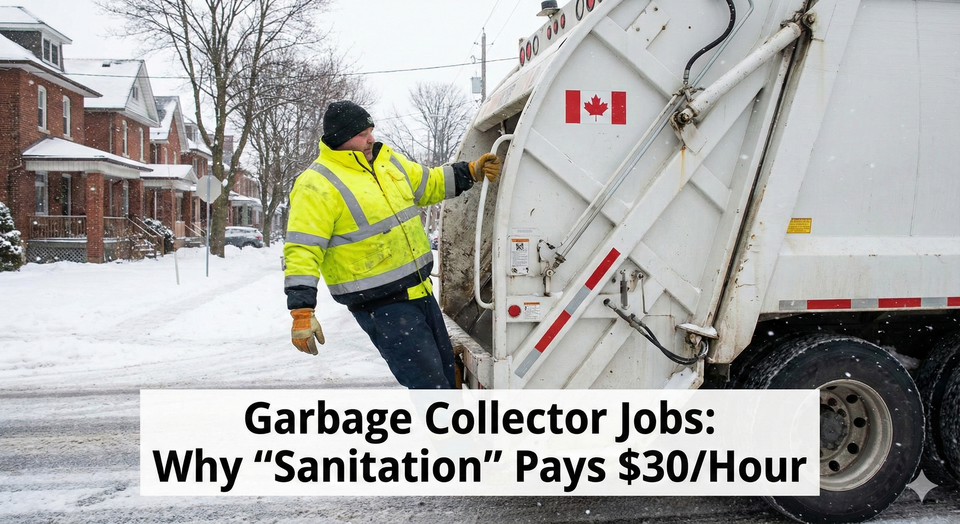
There is an old saying in the labour market: "If it smells, it pays."
While everyone else is fighting for minimum wage retail jobs, Garbage Collectors (Sanitation Workers) are quietly earning $25 to $35 per hour with full benefits.
In 2026, waste management is recession-proof. People never stop making trash. Whether it's -30°C or +30°C, the truck rolls.
But before you apply, you need to understand the hierarchy. There are two completely different worlds in this industry: the City Employee (The "Golden Ticket") and the Private Contractor (The "Grind"). One offers a pension; the other offers unlimited overtime.
If you are physically fit and don't mind getting your hands dirty, here is the ultimate guide to the best no-degree job in Canada.
1. The "Golden Ticket": City Jobs (Public Sector)
Working directly for the City of Toronto, City of Vancouver, or City of Calgary is the goal.
- The Pay: Starts around $30.00 – $34.00 per hour (2026 Union Rates).
- The Perks: defined benefit pension (OMERS in Ontario), 100% health coverage, and incredible job security.
- The Catch: It is extremely hard to get in. People hold these jobs for 25 years.
- How to Apply: You must monitor the City's official career portal constantly. They open hiring windows once a year for "Solid Waste Collection Operators."
2. The "Grind": Private Contractors (GFL / Miller)
Most cities now outsource their trash collection to private companies like GFL Environmental, Miller Waste, or Waste Management.
- The Pay: $22.00 – $28.00 per hour.
- The Hours: Long. You work until the route is done. 10–12 hour days are common.
- The Entry: Much easier to get hired. They have high turnover because the work is faster-paced than the city crews.
- Internal Link: This is similar to the pace of Lumper Jobs—hard work, fast money.
3. The "Hustle": Junk Removal (1-800-GOT-JUNK)
This is not "garbage collection" in the traditional sense. It is a service job.
- The Role: You drive a blue truck to a customer's house and remove specific items (old couches, fridges).
- The Pay: Lower base wage ($18 – $21/hr) but High Tips and Profit Share.
- The "Finds": Unlike municipal garbage, you can sometimes keep or resell items you pick up (if company policy allows). This is called "Ground Scoring."
- Best For: Students who have good customer service skills.
4. Driver vs. Loader: The License Gap
This is the single biggest factor in your paycheck.
The Loader (The "Thrower")
- Role: You ride on the back (or walk beside) and toss bags into the hopper.
- Requirement: Strong back. No education needed.
- Pay: $18 – $24/hr.
The Driver (The Operator)
- Role: You drive the truck. In modern "Side Loader" trucks, you use a joystick to pick up bins without leaving the cab.
- Requirement: DZ License (Ontario) or Class 3 (BC/Alberta).
- Pay: $28 – $38/hr.
- Verdict: Get your license. It saves your body and doubles your career length.
- Internal Link: A DZ license also qualifies you for Snow Plow Jobs.
Comparison Table: City vs. Private vs. Junk
| Feature | City Employee (Union) | Private (GFL/Miller) | 1-800-GOT-JUNK |
| Hourly Pay | $33.51+ | $26.00 | $19.00 + Tips |
| Pension | Yes (DB) | Rare (RRSP Match) | None |
| Pace | Steady | Fast / Heavy | Customer Focused |
| License | DZ Required | DZ Preferred | G License OK |
| Best For | Career Seekers | Overtime Lovers | Students |
Practical Questions Answered
"Is it gross?"
Consensus: You get used to it.
- The Reality: The smell is bad in July (maggots/heat). In winter, everything is frozen, so it doesn't smell.
- The Danger: It's not the smell; it's the needles. Never push a garbage bag down with your hands or legs. Always grab bags by the top knot. Needlestick injuries are the #1 fear.
"Can I keep stuff I find?"
Strictly NO (for City/GFL).
- The Rule: "Scavenging" is a fireable offense in municipal waste. If you find a working Xbox in a bin and put it in the cab, you can be terminated for theft of city property.
- Exception: Junk removal companies (like 1-800-GOT-JUNK) are more lenient, as they often try to donate/recycle items anyway.
"Is it physically hard?"
Yes.
Loaders walk/run about 15–20km per day and lift 5 tons of weight. It is a paid workout. The "One Arm Bandit" (automated side loader) trucks are easier, but manual throwing is still common in older neighborhoods.
Frequently Asked Questions
Do I need a high school diploma?
For Loader positions, usually no. Employers value reliability and strength over education. However, for Driver or City positions, a High School Diploma is almost always a mandatory requirement.
How much does a DZ license cost?
In Ontario, a DZ License course costs between $800 and $1,200. It takes about 3–4 days to complete. It is one of the best investments you can make, as it opens doors to garbage, snow plow, and fire truck driving jobs.
What are the hours?
Early. Most garbage trucks leave the yard between 5:00 AM and 6:00 AM. You are usually done by 2:00 PM or 3:00 PM. It is a great schedule for parents who want to be home when their kids finish school.
Is the job seasonal?
No. Garbage is collected 52 weeks a year. However, there is often a surge in hiring for Leaf & Yard Waste season (Spring/Fall) when volume doubles. This is the easiest time to get hired as a temporary "helper" to get your foot in the door.
About the author
Jeff Calixte (MC Yow-Z) is a Canadian career researcher and digital entrepreneur who studies hiring trends, labour market data, and real entry-level opportunities across Canada. He specializes in simplifying the job search for newcomers, students, and workers using practical, up-to-date information.
Sources
- City of Toronto (Solid Waste Careers): https://jobs.toronto.ca/
- GFL Environmental (Driver Jobs): https://gflenv.com/careers/
- 1-800-GOT-JUNK (Truck Team Jobs): https://jobs.1800gotjunk.com/ca_en
Note:
Job availability, wages, and hiring conditions can vary widely by province, employer, season, and experience level. All salary ranges and job examples in this guide are estimates based on current labour market data. Always confirm details directly with the employer before applying.