
H2S Alive Certification: Do You Need It Before Applying?
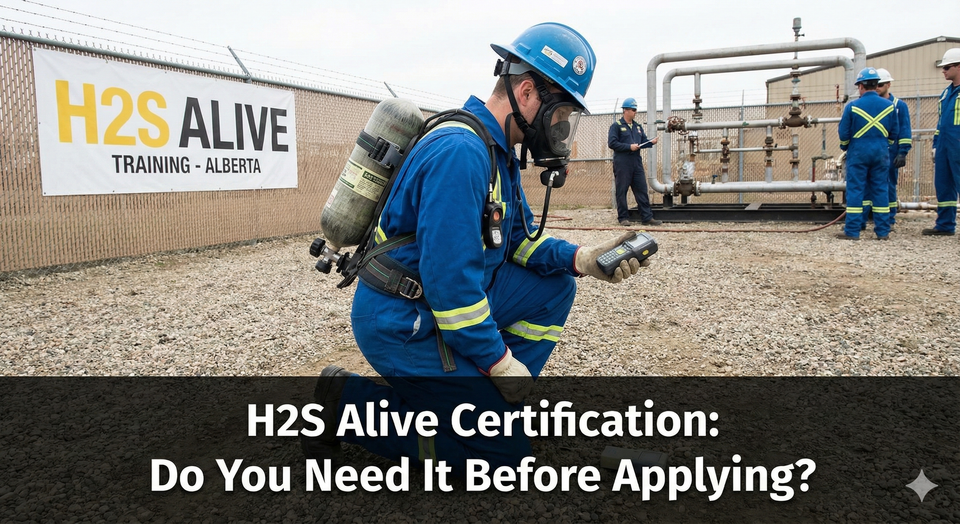
If you are looking to make big money in Canada, your eyes eventually turn to the Oil and Gas sector. Whether it is in Fort McMurray, Grande Prairie, or remote British Columbia, the "Patch" is where the six-figure salaries for entry-level labour live.
But unlike applying to Tim Hortons or a warehouse, you cannot just walk onto an oil site with a resume. You need "Tickets."
The most famous, most requested, and most misunderstood ticket is H2S Alive.
If you search for it on Google, you will see dozens of ads for "$39.95 Online H2S Training." Do not buy these. They are often useless for site access.
In 2026, the industry standard is strict. If you show up with the wrong certificate, you will be sent home on the next bus.
This guide clarifies exactly what H2S Alive is, why you (probably) need to pay for it yourself, and the difference between the legitimate Energy Safety Canada course and the cheap online knock-offs.
Looking for other high-paying entry-level work? Check out our Ultimate Canadian Job Directory or explore Student Jobs in Canada for safer alternatives.
What is H2S and Why is it "Alive"?
Hydrogen Sulfide (H2S) is a naturally occurring gas found in oil and natural gas deposits. It is:
- Colourless.
- Smells like rotten eggs (at low concentrations).
- Deadly (at high concentrations). It kills your sense of smell instantly and then shuts down your respiratory system.
"H2S Alive" is the specific brand name of the standard training course developed by Energy Safety Canada (formerly Enform). It is the only standard accepted by major players like Suncor, CNRL, and Cenovus.
The "Online Course" Scam
This is the #1 mistake new applicants make.
- The Trap: You see an ad for "H2S Awareness Online - $40." You take it from your bedroom. You get a certificate.
- The Reality: When you arrive at the security gate of a rig, they ask for your "Energy Safety Canada H2S Alive" ticket. You show them your online printout. They deny you entry.
- Why? The real H2S Alive course includes a physical component. You must prove you can put on a Self-Contained Breathing Apparatus (SCBA) mask in under 30 seconds. You cannot do this online.
Do You Need It Before Applying?
The Short Answer: YES.
In 2026, the job market in the Patch is competitive.
- For Labourers/Floorhands: Employers expect you to be "Site Ready." If they have to choose between Applicant A (who needs $500 worth of training and 2 days off) and Applicant B (who has H2S Alive and First Aid ready), they hire Applicant B.
- For Engineers/Office Staff: Usually No. The company will pay for it if you ever need to visit the field.
Cost vs. Reward:
- Cost: ~$150 – $180 CAD.
- Time: 1 Day (8 Hours).
- Validity: 3 Years.
- Return on Investment: One day of work in the oilfield pays ~$300–$400. The ticket pays for itself in 4 hours.
Internal Link: If you don't have the cash upfront, consider a "fly-in-fly-out" cleaning job. See our Forklift License Guide for a cheaper warehouse alternative.
The Course: What Actually Happens?
You cannot fail this course unless you fall asleep or refuse to shave.
1. The Classroom Theory
- You learn the properties of H2S (it is heavier than air, so it settles in low spots like trenches).
- You learn the "7-Step Initial Response Strategy."
- You learn about "Tube Detectors" and electronic monitors.
2. The Practical (The Mask)
- This is the fun part. You must physically put on a heavy SCBA pack (like a firefighter).
- The Test: You have to don the mask, tighten the straps, and get a seal in a specific time limit.
- The Drag: You might have to practice a "Rescue Drag," pulling a dummy (or a classmate) to safety while wearing the gear.
Practical Questions Answered
The unvarnished truth about H2S Alive.
"Do I really have to shave?"
YES.
- The Rule: You must be "Clean Shaven" where the mask seals to your face.
- The Reality: If you show up to class with a beard, the instructor will hand you a cheap disposable razor and tell you to dry-shave in the bathroom, or they will fail you. Do not test this. Shave that morning.
"Can I get it in Ontario?"
Yes, but it's harder to find.
- Most providers are in Alberta (Calgary/Edmonton) or BC (Fort St. John). However, major safety schools in Toronto or Sarnia (near the refineries) do offer the official Energy Safety Canada course. Look for the logo specifically.
"Is 'H2S Awareness' ever okay?"
Rarely.
- Only for drivers who drop off loads at the gate and never leave their truck cab. If you step foot on the ground, you need the full Alive ticket.
Frequently Asked Questions
Does H2S Alive expire?
Yes. It is valid for 3 years from the date of issue. There is no "grace period." If it expires on Tuesday, you cannot work on Wednesday.
Can I claim the cost on my taxes?
Yes. Keep your receipt. Since it is a certification required for your trade, it is usually deductible as a tuition/training expense or an employment expense (if your employer requires it and doesn't reimburse you).
What happens if I lose my card?
In 2026, Energy Safety Canada uses mostly Digital Certificates. You can log into their student portal and download a PDF copy for free. If you have an old-school plastic card and lose it, you don't need to re-do the course; just recover your account online.
Is the test hard?
No. It is an open-book or easy multiple-choice exam at the end of the day. The instructors want you to pass. The focus is on the physical skills.
Deep Dive: Job Hunting, "Combo" Tickets & The Drug Test
Getting the ticket is step one. Here is how to actually use it to get rich in the Patch.
1. The "Holy Trinity" of Tickets
If you want to be undeniable to employers, H2S Alive is just one of three. The "Big 3" combo for new hires is:
- H2S Alive (Energy Safety Canada).
- Standard First Aid + CPR Level C (Red Cross or St. John Ambulance).
- CSTS 2020 (Construction Safety Training System): This is often FREE online via the ACSA (Alberta Construction Safety Association).
- Pro Tip: Do the free CSTS 2020 at home tonight. Put it on your resume. It shows you know the safety culture.
2. The "Shave" Policy on Site
It's not just for the course. If you work on an H2S site, you must be clean-shaven every single day.
- The Fit Test: Employers will do a "Quantitative Fit Test" (Portacount) when you are hired. If you have stubble, the machine will fail you, and you won't be allowed on site.
- Goatees: Usually allowed if they fit inside the mask cup, but most young guys just go fully clean-shaven to avoid the hassle.
3. The "Dry" Camp Reality
Most jobs that require H2S Alive are in remote camps.
- Drug Testing: You will be drug tested (Urine) before you fly up. Cannabis is legal in Canada, but zero tolerance is the rule for safety-sensitive positions. If you test positive for THC, your H2S ticket won't save you.
- Dog Searches: Many camps have sniffer dogs at the aerodrome. Do not bring anything with you.
4. How to Spot a "Fake" Provider
- The Logo: Look for the Energy Safety Canada (ESC) logo.
- The Price: If it is under $100, it is fake. The licensing fee ESC charges the school is high, so the course generally must cost $140+.
- The "Awareness" Weasel Word: If the course title says "H2S Awareness" or "H2S Online," it is not H2S Alive.
5. Salary Expectations for H2S Holders
- Floorhand (Rigs): $35 - $42/hr (+ Loa/Camp).
- Safety Watch (Bottle Watch): $25 - $30/hr. (This is the easiest job—you literally stand there and watch the air monitor while others work).
- Labourer: $22 - $28/hr.
Summary: Is It Worth the $150?
- Yes, absolutely. It is the gatekeeper to the oil and gas industry.
- Do NOT do it online. You are wasting your money.
- Book with Energy Safety Canada (or an authorized provider).
- Shave your face.
- Get First Aid too. The combo is powerful.
About the author
Jeff Calixte (MC Yow-Z) is a Canadian career researcher and digital entrepreneur who studies hiring trends, labour market data, and real entry-level opportunities across Canada. He specializes in simplifying the job search for newcomers, students, and workers using practical, up-to-date information.
Sources
- Energy Safety Canada: Official H2S Alive course description and student portal. https://www.energysafetycanada.com/
- Alberta Construction Safety Association (ACSA): Free CSTS 2020 training. https://www.youracsa.ca/courses/csts2020/
- Government of Alberta (Occupational Health and Safety): Respiratory protective equipment guidelines. https://ohs-pubstore.labour.alberta.ca/ppe001
Note
Job availability, wages, and hiring conditions can vary widely by province, employer, season, and experience level. All salary ranges and job examples in this guide are estimates based on current labour market data. Always confirm details directly with the employer before applying.