
High Rise Window Cleaner: Rope Access Ticket Cost vs. Pay (2026 Guide)
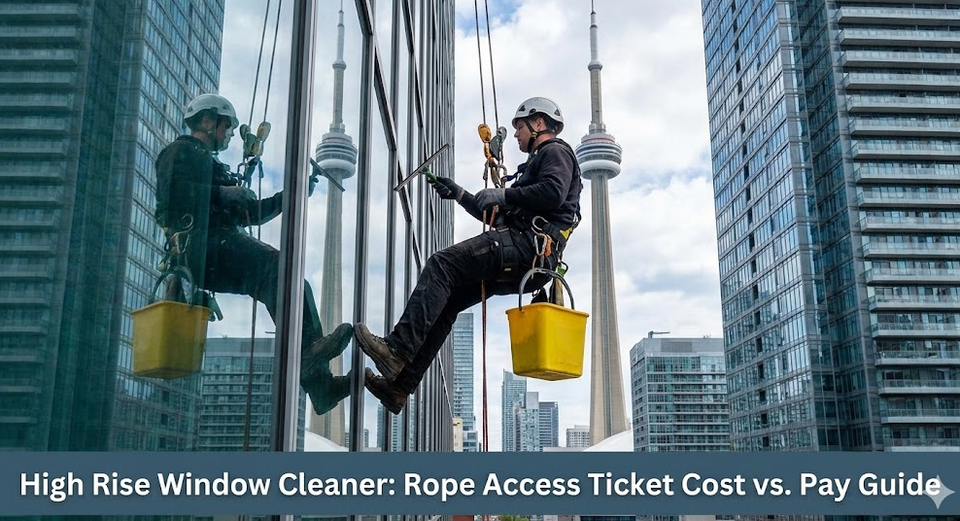
If you have ever looked up at a condo tower in Toronto or Vancouver and seen a tiny figure dangling from a rope, you probably thought one of two things:
- "You couldn't pay me a million dollars to do that."
- "I bet that guy makes a fortune."
The truth is somewhere in the middle.
In 2026, High Rise Window Cleaning (specifically Rope Access) is one of the last "Wild West" trades left. You don't need a college degree. You don't need a trade ticket like an electrician. You just need a specialized safety certification and zero fear of heights.
But the pay structure is confusing.
Some cleaners make $22/hour and struggle to pay rent.
Others (the "Piecework Cowboys") make $400 a day and take the entire winter off to go surfing in Costa Rica.
This guide breaks down the massive cost of the IRATA ticket ($2,200+), the difference between "Chair Work" and true "Rope Access," and how to avoid the "rookie tax" that leaves new cleaners making less than a Starbucks barista.
Terrified of heights? Check out Garbage Truck Runner for a ground-level workout or Night Shift Warehouse for indoor stability.
The Ticket: IRATA vs. SPRAT (The $2,200 Gatekeeper)
You cannot just buy a rope at Home Depot and rappel off a building. You need a license.
In Canada, there are two competing certifications: IRATA and SPRAT.
1. IRATA (The Gold Standard)
- Stands For: Industrial Rope Access Trade Association.
- Cost: $2,200 - $2,400 CAD (Level 1).
- Duration: 5 Days Training + 1 Day Assessment.
- Recognition: Global. You can use this ticket to work on oil rigs in the North Sea, wind turbines in Germany, or skyscrapers in Dubai.
- Difficulty: Hard. The assessment is pass/fail. If you touch the "safety line" during a maneuver, you fail instantly and lose your $2,200.
2. SPRAT (The North American Standard)
- Stands For: Society of Professional Rope Access Technicians.
- Cost: $1,800 - $2,200 CAD.
- Duration: 4 Days Training + 1 Day Assessment.
- Recognition: Mainly USA and Canada.
- The "Dual Cert" Hack: Many training centers (like Pacific Ropes or Keltic Falcon) offer a "Dual Certification" week for ~$2,600. You do 5 days of training and take both tests.
- Verdict: Pay the extra $400. getting Dual Certified opens 100% of the doors instead of 50%.
The Pay: Hourly vs. Piecework (The "Drop" Math)
This is the most critical part of the industry to understand.
Never accept an hourly job unless you are a complete beginner.
1. Hourly Pay (The Rookie Trap)
- Rate: $22.00 - $28.00/hour.
- Who pays this: Large facility management companies.
- Why it sucks: You are hanging off a building 50 stories up for only $4 more than a FedEx Jumper.
- When to take it: For your first 3 months. Learn the ropes (literally) without the pressure of speed.
2. Piecework (The "Drop" Rate)
- Rate: You are paid per "Drop" (a vertical section of windows from the roof to the ground/balcony).
- The Math:
- A typical "Drop" on a condo might be paid $100 - $150.
- An experienced tech can finish a drop in 2 - 3 hours.
- Hourly Equivalent: $150 / 3 hours = **$50.00/hour.**
- The Hustle: If you are fast, efficient, and rig your ropes quickly, you can do 3 drops a day. That is $450/day.
- The Risk: If you get your rope tangled, or the wind picks up and you get stuck, you might spend 6 hours on one drop. Your pay drops to $25/hour.
3. Commercial vs. Residential
- Commercial (Office Towers): Usually straight glass. Very fast. "The Money Run."
- Residential (Condos): Balconies. BBQs. Potted plants. Angry dogs barking at you through the glass.
- Problem: You have to pull your ropes in and out of balconies. It takes forever.
- Rule: Demand a higher drop rate for condos with "deep balconies."
The Gear: Who Pays for the Rope?
Unlike an office job, you wear your office.
Company Provided Gear
- Most legitimate companies provide the Ropes, Rigging (anchors), and Main Descent Device (ID or Rig).
- Why: Liability. If a rope snaps (unlikely), they need to prove they bought it and inspected it.
Personal Gear (You Buy)
- Harness: A comfortable rope access harness (e.g., Petzl Astro or Avao) costs $600 - $800.
- Note: Do not buy a cheap fall arrest harness. You will lose circulation in your legs in 10 minutes.
- Helmet: Petzl Vertex ($150).
- Suction Cups: For stabilizing yourself on the glass ($40).
- The "Bosun's Chair": Some window cleaners sit on a wooden bench (Chair) attached to the rope. It is more comfortable than hanging in the harness straps.
- Cost: $200 (or build your own).
Total Startup Cost (Ticket + Basic Gear): ~$3,500.
Practical Questions Answered
"What happens if you have to pee?"
The million-dollar question.
- The Reality: You are 40 stories up. You cannot just come down.
- The Fix: Go before you drop.
- The Emergency: Some guys wear a "Stadium Pal" (catheter) or simply hold it for 4 hours. If you come down to pee, you lose 45 minutes of work (re-rigging). In piecework, that pee costs you $40.
"Is it scary?"
Only the first time.
- The scariest part is the "Edge Transition" (going over the parapet wall).
- Once you are hanging, your brain adjusts.
- The Real Fear: Wind. If the wind gusts over 40km/h, you get blown off the building. You can smash into the glass or get tangled.
- Rule: If the wind meter reads 30km/h+, you call the day. Safety first.
"Can I drop my phone?"
Yes, and it is a disaster.
- The Drop Zone: If you drop a squeegee or phone from the 40th floor, it reaches terminal velocity. It can kill a pedestrian.
- The Protocol: Everything (Squeegee, Bucket, Phone) must be Lanyarded (Tethered) to your harness. If you are caught with an untethered phone, you are fired instantly.
The "Logbook" & Assessment Day Stress
Your IRATA career is governed by your Logbook.
1. The Logbook
- Every hour you spend on ropes must be signed off by a Level 3 Supervisor.
- Level 1 to Level 2: You need 1,000 hours and 1 year of experience.
- Why Level 2 Matters: Level 2 techs tackle the "Complex Rigging" (getting around corners, overhangs). They get paid $5 - $10/hour more.
2. Assessment Day (The Most Stressful Day of Your Life)
- You train for 4 days. On Day 5, an external "Assessor" comes in.
- They don't know you. They don't care about you.
- The Test: They will tell you to perform a rescue (e.g., "Rescue your unconscious partner from mid-rope").
- The Pressure: If you forget to lock a carabiner, or if you don't do a safety check, they say "Fail." You pack your bags and go home. No refund.
- Pass Rate: Approx 80%. Don't party during the training week. Study.
Winter Survival (The "Dead Season")
Window cleaning uses water. In Canada, water freezes.
So what do you do from December to March?
1. The Layoff (EI)
- Many window cleaners go on Employment Insurance for 3 months. It’s a seasonal trade.
- Link: This is similar to School Bus Drivers who get summers off.
2. The Pivot: Caulking & Building Maintenance
- You can't clean windows, but you can seal them.
- Caulking: Replacing the rubber seals between concrete panels.
- Pay: Often higher than cleaning ($35+/hour).
- Conditions: Brutal. You are hanging in -20°C wind chill. You need heated vests and Garbage Mitts.
3. Snow Removal (Roof Shoveling)
- When huge snowstorms hit, flat roofs on warehouses can collapse.
- The Gig: Companies hire rope access techs to rappel onto the roof and shovel it safely.
- Pay: $35 - $45/hour. It is emergency work, so the rates are high.
Suspension Trauma (The Hidden Killer)
Everyone worries about falling. The real killer is Hanging Still.
- What is it? If you hang in a harness without moving your legs, the straps cut off blood flow (venous return) from your legs to your heart.
- The Timeline: You can pass out in 10-15 minutes. Death can occur in 30 minutes.
- The Prevention:
- Trauma Straps: Little loops in your harness you can stand on to relieve pressure.
- Keep Moving: Never just "hang out." If you are stuck, use your foot loop to stand up periodically.
Chair Work" vs. "Rope Access
In Toronto specifically, there is a legal grey area.
Bosun's Chair (The Old School)
- System: One rope (Main) and one safety line (Backup). You sit on a wooden board.
- Regulation: Under Ontario regulations, this is "Window Cleaning," not necessarily "Rope Access."
- Ticket: You might not need a full IRATA ticket. A "Suspended Access Equipment" course (1 day) might suffice for some shady companies.
- The Pay: Lower.
IRATA Rope Access (The New School)
- System: Two ropes attached to your harness. You "ascend" and "descend" using mechanical devices.
- Regulation: Stricter. Requires a Level 3 Supervisor on site.
- The Pay: Higher. You are a technician, not just a cleaner.
- Verdict: Always get the IRATA ticket. The "Bosun's Chair" era is dying due to insurance costs.
Frequently Asked Questions
Is there a weight limit?
Yes.
- Most equipment (Petzl ID, harness) is rated for a "Total Load" of 140kg (310 lbs).
- This includes you + your bucket + your water (water is heavy! 20 liters = 20kg).
- If you weigh 280lbs, you might be too heavy for the gear once fully loaded.
Can women do this job?
Absolutely.
- Rope access is about Technique, not brute strength.
- Women often pass the IRATA assessment at higher rates than men because they listen to the leverage techniques instead of trying to "muscle" up the rope.
- Bonus: Smaller hands are better for complex rigging knots.
Do I need a car?
Yes.
- You are not going to the same office every day.
- Monday: Downtown Condo. Tuesday: Office park in Mississauga. Wednesday: Hospital in Scarborough.
- You need to carry your massive gear bag (50lbs). Taking the bus is a nightmare.
What if I drop my squeegee?
You get fined.
- Companies have strict "Drop Policies."
- First drop: Warning.
- Second drop: You pay for the replacement.
- Third drop: Fired.
- Note: If you drop something on a car, you are fired immediately.
Summary: Adrenaline for Cash
- Get Dual Certified: Pay the extra for IRATA + SPRAT. It pays for itself in one week of work.
- Start Hourly, Switch to Piecework: Don't rush into drops until you are fast.
- Respect the Cold: Plan your finances for a 3-month winter layoff or line up a caulking gig.
- Trust Your Gear: Spend the $600 on a good harness. Your back will thank you.
About the author
Jeff Calixte (MC Yow-Z) is a Canadian career researcher and digital entrepreneur who studies hiring trends, labour market data, and real entry-level opportunities across Canada. He specializes in simplifying the job search for newcomers, students, and workers using practical, up-to-date information.
Sources
- IRATA International: Training requirements and syllabus. https://irata.org/
- Pacific Ropes: Course pricing and dual certification details. https://pacificropes.com/
- WorkSafeBC: Rope access safety regulations. https://www.worksafebc.com/
Note
Job availability, wages, and hiring conditions can vary widely by province, employer, season, and experience level. All salary ranges and job examples in this guide are estimates based on current labour market data. Always confirm details directly with the employer before applying.