
Highest-Paying Jobs in Construction With No Degree (2026 List)
In 2026, the "University Myth" is dying.
For years, students were told that the only way to be wealthy was to get a degree and work in an office. Meanwhile, the people building that office are earning double the salary of the people working inside it.
Canada is in the middle of a massive construction boom. Between the government's housing targets (building 3.8 million homes) and major infrastructure projects (like the Ontario Line subway), there is a critical shortage of skilled workers.
When demand is high and supply is low, wages go up.
If you are willing to work with your hands, handle early mornings, and learn a trade, here are the highest-paying construction jobs in Canada that require zero university debt.
1. Elevator Mechanic (The "King" of Trades)
- The Job: Installing and repairing elevators and escalators.
- Why it pays: It is a highly specialized, unionized trade (IUEC). Elevators cannot break down. The safety standards are incredibly high, so the pay matches the responsibility.
- The Pay: **$50 – $70 per hour** ($100k – $140k/year).
- Barrier to Entry: It is competitive. You typically need to pass an aptitude test to get into the Union (International Union of Elevator Constructors).
- Education: No degree. You learn through a paid apprenticeship.
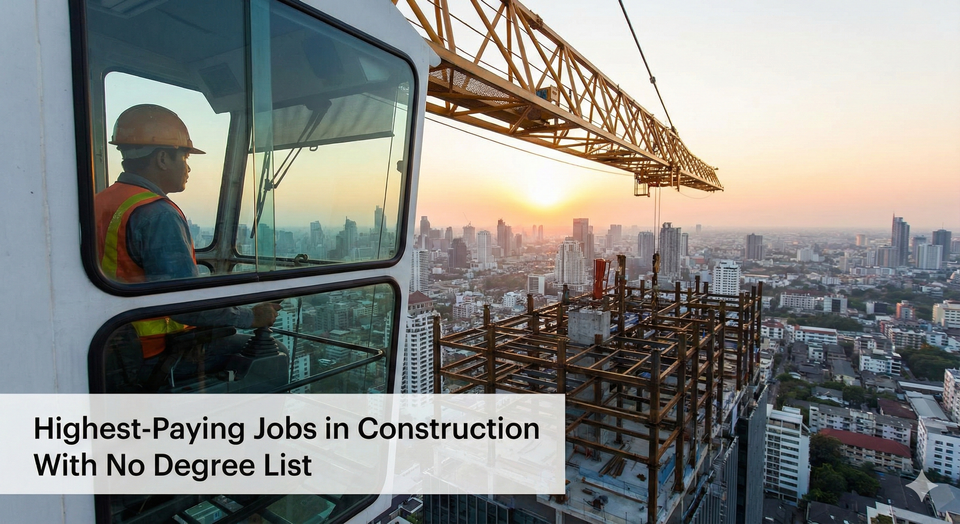
2. Tower Crane Operator
- The Job: Sitting in the cab 500 feet in the air, moving steel and concrete.
- Why it pays: It is high risk and high stress. You control the entire pace of the job site. If the crane stops, the whole site stops.
- The Pay: $45 – $60 per hour.
- How to start: You usually start on the ground as a "Rigger" or Traffic Control Person (Flagging) to learn the signals before you ever get in the seat.
3. Powerline Technician (Lineman)
- The Job: Installing and fixing high-voltage electrical lines on poles and towers.
- Why it pays: Danger and weather. You are working with lethal voltage, often during ice storms or hurricanes when the power goes out.
- The Pay: $45 – $65 per hour.
- Overtime: This is where the money is. During storm season, Linemen can make $200,000+ per year with overtime.
4. Heavy Equipment Operator
- The Job: Driving excavators, bulldozers, and graders.
- Why it pays: These machines cost $500,000+. They need a skilled operator who won't break them or hit a gas line.
- The Pay: $30 – $45 per hour.
- Why it fits: It is physically easier than other trades. You are sitting in a climate-controlled cab, not carrying lumber.
5. Concrete Finisher
- The Job: Smoothing and leveling wet concrete for high-rise floors and sidewalks.
- Why it pays: It is brutal, time-sensitive work. Concrete waits for no one. You have to work fast before it hardens.
- The Pay: $35 – $45 per hour (LiUNA Local 183 rates are very strong).
- The Entry: You can often start as a labourer and learn on the job.
6. Steamfitter / Pipefitter
- The Job: Installing the massive pipes that carry steam, gas, and chemicals in factories and oil refineries.
- Why it pays: It is industrial work. Unlike a residential plumber fixing a toilet, you are working in nuclear plants or oil sands projects.
- The Pay: $40 – $55 per hour.
- Travel: Many pipefitters work "Shutdowns" (traveling to a plant for 3 weeks of intense work) and make their entire year's salary in 6 months.
7. Site Superintendent (The Goal)
- The Job: The boss of the entire construction site.
- Why No Degree? While some large companies hire Engineering grads, most Site Supers started as Carpenters or Labourers. They know how to build because they did it for 15 years.
- The Pay: $120,000 – $180,000 per year (Salary).
- The Path: Start young. If you are 15, check our Teen Jobs Guide to find summer labour gigs. Experience beats education here.
Comparison Table: Danger vs. Dollars
| Trade | Physical Effort | Danger Level | Income Potential |
| Elevator Mechanic | Medium | Medium | Very High ($140k) |
| Crane Operator | Low (Sitting) | High (Height) | High ($120k) |
| Concrete Finisher | Very High | Low | Medium ($90k) |
| Lineman | High | Very High | Extreme ($200k+) |
| Heavy Equipment | Low | Low | Medium ($85k) |
Practical Questions Answered
"Is construction bad for your body?"
Yes, if you are stupid.
- The Reality: The "old guys" with bad backs didn't have modern safety rules. Today, we have lifting equipment, strict breaks, and safety culture.
- The Fix: Treat your body like an athlete. Stretch, wear knee pads before your knees hurt, and don't be a "hero" lifting 100lb bags alone.
"How do I get an Apprenticeship?"
You need a Sponsor.
- The Mistake: People go to college for a "Pre-Apprenticeship" and think they are hired. No. You need an employer to sign you up.
- The Strategy: Go to job sites or union halls (like LiUNA or IBEW) and ask to start as a "Helper." Prove you show up on time. After 3 months, ask them to sponsor your apprenticeship.
"Can women do these jobs?"
Yes.
- The Trend: Companies are desperate to hire women. Unions have specific programs (like "Women in Skilled Trades") that pay for your training and gear to get you started.
Frequently Asked Questions
Do I need to join a Union?
For the best pay, YES.
Unions (LiUNA, IBEW, UA, IUOE) negotiate higher wages, pensions, and benefits. Non-union ("Cash") jobs might pay well today, but they have zero security or pension for your future.
What is a "Red Seal"?
It is the "Gold Standard" certification. If you get your Red Seal, your license is valid in every province in Canada. It allows you to move where the money is (e.g., moving from Ontario to Alberta for an oil boom).
Can immigrants work in construction?
Yes.
Construction is one of the easiest sectors to get Visa Sponsorship because the shortage is so severe. If you have trade experience in your home country, you are highly valuable.
About the author
Jeff Calixte (MC Yow-Z) is a Canadian career researcher and digital entrepreneur. He tracks real-time labour market data, government hiring trends, and entry-level opportunities to help newcomers and students navigate the Canadian job market.
Sources
- Canada's Building Trades Unions: https://buildingtrades.ca/
- Red Seal Program: https://www.red-seal.ca/
- Job Bank (Construction Outlook): https://www.jobbank.gc.ca/trend-analysis
Note:
Job availability, wages, and hiring conditions can vary widely by province, employer, season, and experience level. All salary ranges and job examples in this guide are estimates based on current labour market data. Always confirm details directly with the employer before applying.