
Hospital Porter Jobs: UHN vs. Sinai (Walking 20km a Day)
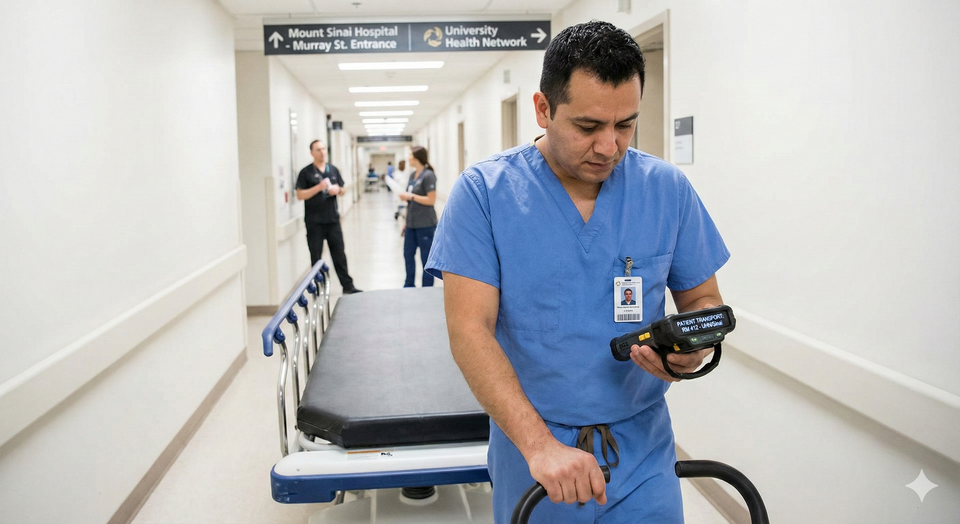
If you can walk 25,000 steps a day and have a stomach of steel, becoming a Hospital Porter (Patient Transport) is one of the most stable jobs in Toronto.
It is the heartbeat of the hospital. Nurses can't work if the patient isn't in the room. Surgeons can't cut if the patient is stuck in the ER.
The Porter makes it happen.
In 2026, the demand for porters in Toronto's "Hospital Row" (University Avenue) is massive.
But not all hospitals are the same.
UHN (University Health Network)—which includes Toronto General and Princess Margaret—is a massive city-within-a-city connected by endless tunnels.
Sinai Health (Mount Sinai) is smaller, specialized, and focuses heavily on high-risk births.
The pay is good—often starting around $24.00 - $26.00/hour due to strong union agreements—but the physical toll is real.
This guide compares the paycheques, the "Morgue Run" reality, and why you need to buy $200 shoes before your first shift.
Prefer a desk job? Check out Shopify Support Advisor for remote work, or LifeLabs Phlebotomy if you prefer clinical tasks.
The Pay: CUPE vs. SEIU (2026 Rates)
Hospital jobs in Toronto are unionized. Your pay is determined by the "Collective Agreement," not your negotiation skills.
1. UHN (Toronto General / Western)
- Union: CUPE (Canadian Union of Public Employees).
- Entry Rate: $24.50 - $26.00/hour.
- Top Rate: $28.00 - $30.00/hour.
- The Vibe: Massive workforce. Overtime is often available because the campus is so huge (General, Western, Rehab, Princess Margaret).
2. Sinai Health (Mount Sinai)
- Union: SEIU (Service Employees International Union).
- Entry Rate: $24.00 - $25.50/hour.
- Top Rate: $27.50 - $29.00/hour.
- The Shift Premium: Both unions negotiate shift premiums (approx $1.25 - $2.50/hour) for evenings and weekends. If you work the night shift, you can clear **$30/hour**.
The Work: "The 20km Shift"
This is not an exaggeration.
- The Distance: A busy porter will walk 20km - 25km in a single 8-hour shift.
- The Load: You aren't just walking; you are pushing.
- A hospital bed with a patient + IV pumps + Oxygen tank = 400+ lbs.
- UHN's Tunnel System: At Toronto General, you spend hours in the underground tunnels moving patients to Princess Margaret Cancer Centre. There are inclines. Pushing a 300lb patient up a ramp is a full-body workout.
Deep Dive: The "Morgue Run" (Code Omega)
Recruiters often gloss over this. You need to know it before you apply.
- The Duty: Porters are responsible for transporting deceased patients to the Morgue.
- The Process:
- You take a special "Concealment Trolley" (looks like a normal cart with a false top).
- You go to the ward. You assist the nurses in transferring the body.
- You take the dedicated "Service Elevator" to the basement.
- The Reality: It is quiet. It is respectful. But for some people, being alone in an elevator with a deceased person is terrifying. If you are superstitious or easily spooked, this job is not for you.
- Link: This requires the same emotional resilience as the Flight Attendant "Emergency Landing" training.
Deep Dive: "Stat" vs. "Routine" (The Dispatch App)
In 2026, you don't use a pager. You use an iPhone with an app (like TeleTracking).
- Routine Call: "Move Patient A from Room 402 to X-Ray." (You have 20 mins).
- Stat Call: "Emergency ER to OR." (Drop everything and run).
- The Metrics: The app tracks your "Response Time" and "Job Completion Time."
- The Trap: If you stop to chat with a nurse, your "Turnaround Time" (TAT) goes up. Management watches these numbers closely.
Deep Dive: The "Isolation" Clean
- The Scenario: You have to move a patient with C. Difficile or COVID-26.
- The PPE: You must "gown up" (Yellow gown, gloves, mask) before entering the room.
- The Clean: After you drop them off, you must wipe down the entire wheelchair with Virox wipes.
- The Time Sink: This takes 10 minutes. If you rush it and a supervisor sees you, you get written up for Infection Control violations.
- Link: This strict hygiene protocol matches the "Clean Room" rules at LifeLabs.
Practical Questions Answered
The real shift gossip.
"Do I need a medical background?"
No.
- You need a High School Diploma and a clean Criminal Record Check.
- Asset: A CPR/First Aid certificate helps you get hired.
"Which hospital is better?"
- UHN: Better if you like Variety. You see everything from transplants to rehab. But the walking is brutal.
- Sinai: Better if you want a Smaller environment. The elevators are faster (less waiting), and the teams are tighter.
"Is it hard to get Full-Time?"
Yes.
- Most hires start as "Casual" or "Part-Time."
- The Grind: You have to pick up shifts. If you are reliable for 6 months, you can bid on a Full-Time line.
- Link: This "Casual" start is identical to the entry path for Canada Post Sorters.
Deep Dive: The "Code Blue" Role
- When a "Code Blue" (Cardiac Arrest) is called, Porters have a specific job.
- The Task: You run to the code. Your job is to Clear the Hallways and hold the elevator.
- The Pressure: The crash team is running with the patient. If the elevator isn't there, it's on you. You are the "Traffic Controller" of the emergency.
Deep Dive: Hidden Dangers & Career Hacks
1. The "Bed Control" Wars (The Real Boss)
- You think your boss is the manager? No. Your boss is Bed Control.
- Who they are: The administrative team that decides which patient goes to which room.
- The Conflict:
- Bed Control says: "Move Patient X to 5th Floor NOW."
- The Nurse says: "We aren't ready to release them."
- Your Role: You are caught in the middle.
- The Strategy: Always listen to the Nurse (clinical safety first), but message Dispatch immediately: "Nurse Delay - Standing By." If you don't log the delay, Bed Control will blame you for the slow turnover time.
2. "Code White" (Violence & Aggression)
- Hospitals aren't always safe.
- What is Code White? Violent/Aggressive person.
- The Porter's Job: Unlike security guards who run to the fight, your job is often to Contain. You might be asked to help hold doors shut or block off a corridor so other patients don't wander into the danger zone.
- The Reality: You will be yelled at by confused patients (dementia) or intoxicated visitors. You must have "thick skin." You cannot yell back.
- Link: This de-escalation skill is exactly what Cannabis Budtenders use when refusing service to intoxicated customers.
3. The "Internal Applicant" Loophole (Nursing Students)
- 40% of Porters are actually Nursing Students or IMGs (International Medical Graduates).
- The Strategy:
- Get hired as a Porter (easier entry).
- Pass probation (6 months).
- Apply Internal: You now have access to the Internal Job Board.
- The Advantage: When a Nursing or Admin job opens up, the hospital must look at internal union applicants before hiring strangers from LinkedIn.
- Success Rate: This is the #1 way to get a prestigious job at UHN or Sinai without fighting 5,000 external applicants.
4. Ergonomics: The "Push vs. Pull" Rule
- The #1 injury for porters is Rotator Cuff (Shoulder) Tears.
- The Physics: A hospital bed weighs 400 lbs.
- The Rule: ALWAYS PUSH. Never Pull.
- When you push, you use your legs and glutes.
- When you pull, you use your shoulder and lower back.
- The Exception: Entering an elevator. You have to pull the bed in backwards so the patient faces the door. This is the "Danger Zone" for injuries.
- Link: Learning proper body mechanics is just as critical here as it is for Lumper Jobs unloading heavy freight.
5. "Helipad" Duty (The Rare Shift)
- At major trauma centers (like St. Michael's or Sunnybrook), Porters assist with Ornge Air Ambulance arrivals.
- The Job: You meet the helicopter team on the roof (or landing pad).
- The Rush: You have to run the stretcher from the Helipad to the Trauma Bay in under 3 minutes.
- The Noise: It is loud, windy, and chaotic. You need specific safety training for working near rotors.
- Link: This high-stakes environment requires the same safety awareness as Working at Heights Training in construction zones.
6. The "Oxygen Tank" Math
- You arrive to pick up a patient. They are on portable oxygen.
- The Check: You must check the PSI gauge on the tank.
- The Math:
- If the tank says 500 PSI and the patient is on 10 Liters/Minute, that tank will empty in 10-15 minutes.
- If your trip takes 20 minutes (waiting for elevators), the patient will run out of air.
- The Rule: If the tank is under 1000 PSI, Change It before you leave the floor. Never gamble with oxygen.
7. Shoe Allowance (Union Perk)
- Because you walk 20km a day, your shoes die in 3 months.
- The Benefit: Check your collective agreement (CUPE/SEIU).
- The Cash: Most contracts give you a $100 - $150 Annual Shoe Allowance.
- The Receipt: You must submit a receipt for "Non-Slip" or "Safety" footwear. Do not buy Nikes; buy nursing shoes or black work trainers to ensure you get reimbursed.
8. "Patient Watch" (The Boring Shift)
- Sometimes, they don't need you to move patients. They need you to Sit.
- The Job: "Constant Care" or "Patient Watch."
- The Scenario: A patient is a fall risk or confused. They need someone to sit in a chair at the door and make sure they don't climb out of bed.
- The Reality: You sit for 8 hours. You cannot look at your phone. You cannot read a book. You just watch. It is mentally exhausting in a different way.
- Link: This monotony is similar to the "Fire Watch" duties of a Security Guard.
9. "Elevator Etiquette" (The Unwritten Laws)
- You are pushing a patient on a stretcher. You approach the elevators.
- The Public: Visitors will try to squeeze in with you.
- The Law: You have Priority.
- The Script: "I'm sorry, folks, this is a patient transport elevator. Please wait for the next one."
- The Confidence: You must be assertive. You cannot have a sick patient squeezed against a visitor eating a bagel. You control the space.
Frequently Asked Questions
Do I get a uniform?
Yes.
- You get hospital-issued Scrubs (usually Blue or Green).
- Laundry: You usually leave them at the hospital at the end of the shift to be washed. You don't take the germs home.
Can I listen to music?
Generally No.
- You need to hear alarms and patient requests.
- Night Shift Exception: Some supervisors allow one earbud in during the quiet 3:00 AM morgue runs or mail delivery loops.
Is parking free?
No.
- Parking at University Avenue hospitals is $20+ per day even for staff.
- Advice: Take the TTC (Subway to Queen's Park or St. Patrick). Driving is a financial mistake.
Summary: The Best Workout You'll Ever Get
- Invest in Shoes: Do not wear Converse. Buy Hokas or New Balance wide-fit walking shoes. Your feet are your moneymakers.
- Respect the Morgue: It’s a part of life in a hospital. Treat it with dignity, and you’ll be respected by the nursing staff.
- Learn the Tunnels: At UHN, the tunnels are a maze. Spend your first week memorizing the shortcuts.
- Join the Union: Once you pass probation, the union (CUPE/SEIU) protects you. Read your handbook.
About the author
Jeff Calixte (MC Yow-Z) is a Canadian career researcher and digital entrepreneur who studies hiring trends, labour market data, and real entry-level opportunities across Canada. He specializes in simplifying the job search for newcomers, students, and workers using practical, up-to-date information.
Sources
- UHN Careers: Support services job postings. https://www.uhn.ca/corporate/careers
- Sinai Health Careers: Service employee opportunities. https://www.sinaihealth.ca/careers/
- CUPE Hospital Workers: Wage grids and collective agreements. https://ochu.on.ca/
Note
Job availability, wages, and hiring conditions can vary widely by province, employer, season, and experience level. All salary ranges and job examples in this guide are estimates based on current labour market data. Always confirm details directly with the employer before applying.