
Ice Road Trucking Pay 2026: Is it Still $100k for 2 Months?
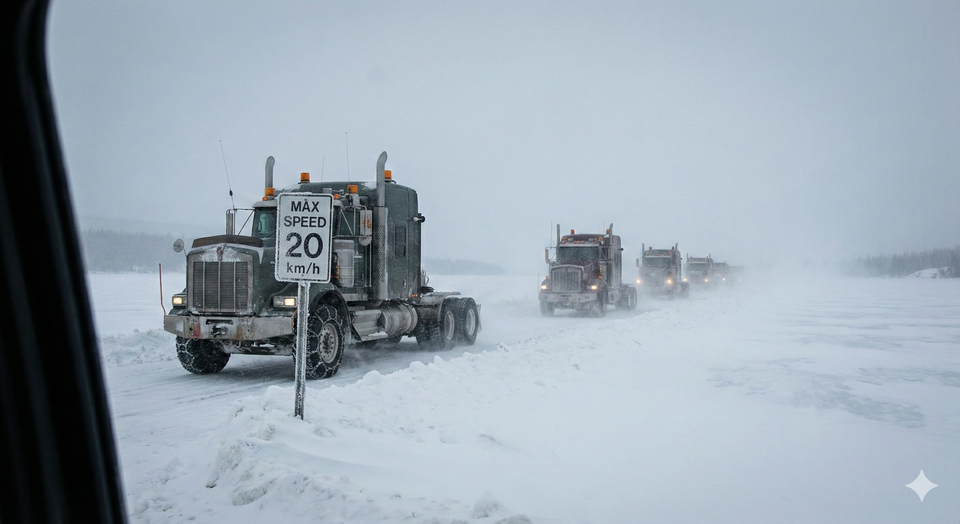
Excerpt: The Ice Road Truckers TV show lied to you. In 2026, the "Season" has shrunk to just 6 weeks. We break down the real pay math (vs. the $100k myth), the mandatory "Super B" experience you need, and why smart drivers are choosing Fluid Hauling in Grande Prairie instead.
If you watched the History Channel in 2010, you probably think Ice Road Trucking is a "Get Rich Quick" scheme.
The myth goes like this: You fly to Yellowknife, drive like a maniac for 60 days, and fly home with $100,000 cash in a duffel bag.
In 2026, that dream is dead.
Climate change has decimated the season. The Tibbitt to Contwoyto Winter Road (TCWR) used to open in January. Now? It often opens in mid-February and melts by late March.
You don't have 8 weeks to make money. You have 5 or 6.
Unless you own your own truck (Owner Operator), you are likely looking at $40,000 - $55,000 for the season. That is still great money for 6 weeks, but it isn't "retire early" money.
This guide explains the new requirements (you can't be a rookie), the "Super B" barrier, and the Alternative Job in Alberta that actually does pay $100k.
Need a license first? Check out Free Trucking School Grants to get your Class 1 paid for.
1. The Pay Reality: $100k is a Myth (For Company Drivers)
Let's do the 2026 math based on recent season data.
The "Company Driver" Pay
- Rate: You are usually paid by the Trip or by the Mile.
- The Rate: Approx $600 - $800 per round trip (Yellowknife to the Diamond Mines).
- The Speed: You drive 25 km/h on the ice. A round trip takes 24-30 hours.
- The Season: 6 weeks (42 days).
- The Math:
- If you are a machine and do 1 trip every 1.5 days = ~28 trips.
- 28 trips x $700 = **$19,600** (Net).
- Wait, that's it?
- Bonus: Most companies pay a "Completion Bonus" (e.g., $10,000) if you stay until the last day.
- Total Season Pay: $30,000 - $45,000.
The "Owner Operator" Pay
- If you bring your own truck, yes, you can gross $100,000+.
- The Risk: If your transmission blows up on a frozen lake, the tow bill is $20,000. You take all the risk.
2. The Requirement: "Super B" Experience
You cannot get hired straight out of school.
- The Load: The mines need Fuel (Diesel) more than anything else.
- The Trailer: They use "Super B" Tankers (two trailers linked together).
- The Skill: You need 2 Years of Mountain Experience (driving in the Rockies) AND Fluid Hauling experience.
- Why? A Super B tanker "sloshes." If you hit the brakes on ice, the liquid pushes you forward. If you don't know how to handle it, you jackknife and die.
- The Gatekeeper: Companies like KAG Canada (formerly Westcan) won't even look at your resume without 2 years of proven off-road experience.
3. The Better Alternative: Fluid Hauling (Grande Prairie)
If you want the "Ice Road" money without the "Short Season" risk, go to Grande Prairie, Alberta.
The Job: "Water Hauler" or "Crude Hauler"
- The Role: Driving water or oil from fracking sites to disposal wells.
- The Terrain: Off-road mud and ice (similar to ice roads, but on land).
- The Pay: $35.00 - $45.00/hour + Overtime.
- The Schedule: 21 days on, 7 days off.
- The Math:
- 12 hours/day x $40/hr = $480/day.
- 21 days = $10,000/month.
- Annual Pay: You can do this year-round (except Spring Breakup). $120,000+ is real here.
4. Deep Dive: The Lifestyle (25 km/h Madness)
Why do drivers quit after 1 trip? Boredom and Fear.
- The Speed Limit: On the ice, the speed limit is strictly 25 km/h (sometimes 10 km/h near shore).
- If you speed, you create a "Wave" under the ice that can blow out the ice in front of your truck.
- The Commute: You are driving for 14 hours straight at a crawling pace. It is mentally exhausting.
- No Bathrooms: You are peeing in a jug. There are no rest stops on a frozen ocean.
- The Cold: At -45°C, steel becomes brittle. Door handles snap off. Air lines shatter. You spend half your time fixing things with duct tape.
5. 2026 Hiring Companies (Who is actually hiring?)
Don't apply to "Ice Road Truckers Inc." (Fake). Apply to the real logistics giants.
- KAG Canada (RTL-Westcan): The biggest player. They haul the fuel.
- Nuna Logistics: They build and maintain the road.
- Tli Cho Landtran: Indigenous-owned, major contracts with the mines.
- Grimshaw Trucking: General freight (groceries/supplies).
Deep Dive: Mechanical Survival, Gear & Mine Camps
1. The "Evaluation" (The Test You Must Pass)
- You don't just get hired over the phone. You must pass a grueling 3-Day Orientation & Evaluation (usually in Edmonton or Yellowknife).
- The Yard Test: You must back up a set of Super B trailers into a tight spot on an icy yard without jackknifing. 50% of applicants fail right here.
- The Road Test: An instructor takes you on a highway run. They want to see you shift an 18-Speed Manual transmission smoothly on icy hills. If you grind gears, stall, or spin your wheels, you are sent home immediately.
2. Diesel "Gelling" (The Engine Killer)
- At -45°C, diesel fuel doesn't freeze solid; it turns into wax (gelling).
- The Consequence: The wax clogs the fuel filters, and the engine dies. If your engine dies out on the ice, you have no heat. It is a life-or-death emergency.
- Your Job: You must constantly treat your fuel with additives (like Howes) and monitor your fuel pressure gauges.
- The Golden Rule: Never shut the truck off. Many drivers keep their engines running 24/7 for the entire 6 weeks.
- Link: Managing equipment in extreme cold is a skill shared with oilfield Swamper Jobs, where frozen valves are a daily reality.
3. The $1,500 Gear List (Mandatory Costs)
- You cannot show up in jeans and sneakers. The company will provide a list of mandatory Personal Protective Equipment (PPE) you must buy before you arrive.
- The Boots: You need CSA-approved boots rated for -60°C (e.g., "Baffin" oil rig boots). Cost: ~$300.
- The Layers: Merino wool base layers, Helly Hansen thermal outer layers, balaclavas, and extreme cold weather gloves.
- Total Cost: Expect to spend $1,500+ out of pocket just to get dressed for work.
- Link: This is a much higher upfront cost than the gear required for urban Traffic Control Persons, and it eats into your first paycheck.
4. Arriving at the Mines (Ekati, Diavik, Gahcho Kué)
- What happens at the end of the 400km road? You arrive at a Diamond Mine.
- The Procedure: You park in a designated staging area to unload your fuel or freight.
- The "Camp Life": You are allowed inside the mine's main complex to eat and shower while unloading.
- Food: The cafeterias are legendary. All-you-can-eat steak, lobster, and fresh fruit, open 24 hours. It is the best food you will eat all year.
- Rules: You must wear "booties" (blue shoe covers) over your boots inside. No outdoor footwear is allowed indoors to keep the Arctic dust out.
5. The "Dry Camp" Rule (Zero Tolerance)
- The mines are strictly Drug and Alcohol-Free Zones.
- The Check: When you arrive at the Yellowknife dispatcher before heading up the road, your bags may be searched by security or drug dogs.
- The Consequence: If they find a single beer or a joint in your truck, you are fired on the spot, blacklisted from the industry, and the RCMP will escort you off the property. Do not test them.
6. The "Psychological Game" (Isolation)
- The hardest part isn't the driving; it's the silence.
- The reality: You are in a noisy cab for 14 hours a day, driving 25km/h. There is no cell service. There is no FM radio. You only have Satellite Radio (SiriusXM).
- The "Whiteout" Brain Fog: Staring at a white road against a white sky for weeks plays tricks on your mind. Rookies often quit because the isolation causes severe anxiety.
- Link: This extreme isolation is similar to what residents experience with Northern Canada Grocery Prices, where you are cut off from the rest of the world.
7. "Chaining Up" (The Physical Toll)
- When you hit the "Portages" (the land crossings between frozen lakes), there are steep, icy hills.
- The Task: You must throw heavy steel tire chains over 8 drive tires in -50°C windchill.
- The Risk: Your fingers stick to the cold metal. The chains are heavy. It is exhausting, brutal physical labour right in the middle of a driving shift. If you don't chain up perfectly, they will fly off and rip the fenders off your truck.
Frequently Asked Questions
Do I need a passport?
No.
- The Ice Roads (TCWR) are entirely within Canada (NWT and Nunavut).
- However, if you are an American driver, getting a Work Permit is very difficult unless you are a specialized Owner Operator.
Is it dangerous?
Yes, but not how you think.
- You probably won't fall through the ice (it's 40 inches thick).
- The Real Danger: Whiteouts. A blizzard hits, and visibility drops to zero. You can't see the road markers. If you drive off the plowed path into deep snow, you freeze to death waiting for help.
Can I bring a pet?
No.
- Most camps at the mines (Ekati, Diavik) strictly ban animals.
- You are sleeping in a "Bunkhouse" at the mine or in your truck. No dogs allowed.
Summary: The "Resume Builder"
- Don't go for the money: Go for the Resume. Having "2 Seasons on the Ice Road" makes you a legend. You can get a job anywhere in Canada after that.
- Check your experience: If you haven't driven Super B tankers in the mountains, don't apply.
- Look at Fluid Hauling: If you actually want to make $100k this year, go to Grande Prairie, not Yellowknife. The season is longer, and the pay is steady.
About the author
Jeff Calixte (MC Yow-Z) is a Canadian career researcher and digital entrepreneur who studies hiring trends, labour market data, and real entry-level opportunities across Canada. He specializes in simplifying the job search for newcomers, students, and workers using practical, up-to-date information.
Sources
- Joint Venture Tibbitt to Contwoyto (JVTC): Official road status and season lengths. https://jvtcwinterroad.ca/
- ZipRecruiter: Ice Road Trucker salary data 2026. https://www.ziprecruiter.com/
- KAG Canada: Seasonal driver requirements and Super B specs. https://kagcanada.ca/
Note
Job availability, wages, and hiring conditions can vary widely by province, employer, season, and experience level. All salary ranges and job examples in this guide are estimates based on current labour market data. Always confirm details directly with the employer before applying.