
Instacart vs. Uber Eats Canada: Hourly Pay Comparison 2026
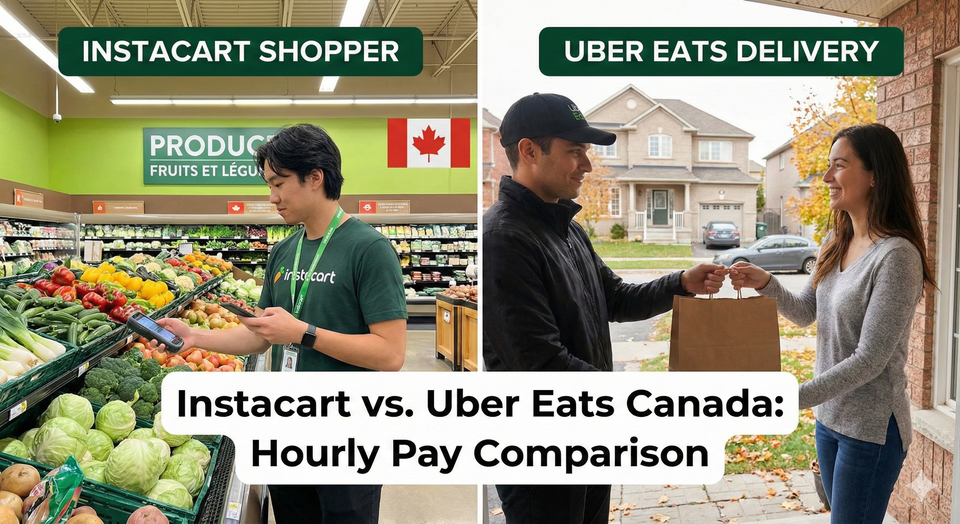
In 2026, the Canadian "Gig Economy" is no longer just for students. With the cost of living in cities like Toronto and Vancouver hitting record highs, professionals are using apps to pay their rent.
But not all apps are created equal.
New drivers often ask: "Should I shop for groceries (Instacart) or deliver takeout (Uber Eats)?"
On the surface, they look the same: You use your car, you use an app, and you get paid.
In reality, they are completely different jobs.
- Instacart is a Labour Job. You are walking 10,000 steps, lifting 40lb cases of water, and communicating constantly with picky customers.
- Uber Eats is a Driving Job. You are sitting in traffic, destroying your suspension on potholes, and dealing with parking tickets.
This guide analyzes the Net Hourly Pay (after expenses) for both platforms in 2026. We will expose the "Tip Baiting" scams, calculate the true cost of gas, and help you decide which algorithm is worth your time.
Looking for a job that doesn't ruin your car? Check out our guide on TaskRabbit Canada Earnings or consider Crime Scene Cleaning for higher pay.
The Pay Model: How You Actually Get Paid
Both apps have slashed their "Base Pay" significantly in 2026. Here is how the math works now.
Instacart (The "Batch" Model)
- Base Pay: Calculated by "Batch" (Order). Includes distance from store to customer and "Heavy Pay" (if applicable).
- Average Base: $7.00 - $10.00 per batch (even for 3 customers at once).
- Tips: 100% of your income depends on this.
- Instacart customers usually tip a percentage of the grocery bill (5% - 20%). Since grocery bills are high ($200+), tips can be significantly higher than fast food tips.
- Hourly Potential: $18.00 - $35.00/hour (Active time).
Uber Eats (The "Trip" Model)
- Base Pay: Calculated by distance and time.
- Average Base: $3.00 - $5.00 per delivery.
- Tips: Usually flat rate ($2, $3, $5).
- Since a Big Mac meal costs $15, a 20% tip is only $3. You need volume to make money.
- Hourly Potential: $15.00 - $25.00/hour (Active time).
Winner: Instacart. (Higher ceiling per hour due to larger order values).
The "Wear and Tear" Factor (The Silent Killer)
This is where Uber Eats loses.
Uber Eats Scenario:
- To make $100, you might have to do 10 deliveries.
- That’s 10 pickups, 10 drop-offs, and driving back to "Hot Zones."
- Mileage: High (100km+ per shift).
- Cost: Gas, Tires, Oil Changes, Depreciation.
Instacart Scenario:
- To make $100, you might only do 3 "Batches" (Large orders).
- You spend 45 minutes walking inside Costco or Loblaws. You are not burning gas.
- Mileage: Low (30km per shift).
- Cost: Your legs get tired, but your car stays fresh.
Winner: Instacart. If you have an older car or want to save gas, pick the shopping job.
The "Stress" Factor: Customers & Parking
Money isn't everything. Which job makes you want to scream less?
Instacart Stressors
- Out of Stock: The customer wants "Organic Strawberries." The store is out. You have to text them. They don't reply. You wait. Stress levels rise.
- Replacements: If you pick the wrong replacement, they rate you 1-Star.
- Checkout Lines: Standing in line at Walmart on a Sunday is pure misery.
Uber Eats Stressors
- "The Wait": You arrive at McDonald's. The food isn't ready. You stand there for 10 minutes (unpaid).
- Condo Delivery: The customer lives on the 45th floor. There is no visitor parking. You risk a $60 parking ticket to deliver a $12 burrito.
- Gate Codes: "Buzz code is #1234." It doesn't work. Customer doesn't answer.
Winner: Uber Eats. It is "mindless." You grab bag, drop bag. Instacart requires constant mental energy and decision making.
Related: If you prefer physical work without the customer service, consider Worm Picking (no talking required).
Practical Questions Answered
We scanned r/UberEats and r/InstacartShoppers to find the real Canadian experience.
"Is 'Tip Baiting' real?"
YES (Especially on Instacart/Uber).
- What is it? A customer offers a $20 tip to get you to accept the order fast. Once you deliver it, they edit the tip to $0.
- The Defense: Uber Eats allows customers to change the tip for 1 hour. Instacart reduced the window, but it still happens.
- Reality: It happens in maybe 1 out of 100 orders, but it ruins your day when it does.
"Can I do this with a G2 license?"
Yes.
- Both apps accept a G2 license in Ontario (or equivalent Novice license in other provinces). You do not need a full G.
- Vehicle Age: Uber Eats usually requires a car 20 years old or newer (more lenient than Uber Rideshare). Instacart doesn't care what you drive as long as it runs.
"Do I need special insurance?"
YES.
- Your personal insurance policy does not cover "Commercial Use" (Food Delivery).
- The Risk: If you crash while delivering a pizza and don't have the endorsement, your insurance will deny the claim and cancel your policy. You will be on the hook for thousands.
- The Cost: Adding a "Rideshare/Delivery" endorsement costs ~$50/month.
Costco Drop (Instacart's Secret Weapon)
The highest paying orders on Instacart are almost always from Costco.
Why?
- Order Value: People buy $500 worth of groceries. A 5% tip is $25.
- Efficiency: Once you learn the layout of your local Costco, you can shop fast.
- The "Drop": At 9:00 AM (or whenever it opens), a massive wave of orders ("Batches") hits the screen.
- Strategy: Experienced shoppers park in the Costco parking lot at 8:50 AM to grab the $60+ "Unicorn" batches before anyone else.
Internal Link: If you like the Costco environment, why not apply to work there directly? Read our Costco Hiring Guide.
Frequently Asked Questions
Can I bring someone with me?
- Uber Eats: Yes. You can have a "Navigator" or friend in the car.
- Instacart: Strictly NO. It is against the Terms of Service to have anyone else shopping with you (Co-shopping). If a store manager reports you, you get deactivated.
Which pays faster?
- Both offer "Instant Cash Out" (for a $0.50 fee). You can end your shift and have the money in your bank account in minutes.
Do I need thermal bags?
- Uber Eats: Highly recommended (keeps food warm = better tips).
- Instacart: Mandatory for "Food Safety" verification (Insulated bags for frozen items). You usually have to buy your own.
Multi-Apping, Taxes & The "Bot" Problem
1. The Art of "Multi-Apping" (Dirty Apping)
To make a living wage in 2026, you cannot rely on one app. You must "Multi-App."
- The Setup: You run Uber Eats, DoorDash, and Instacart simultaneously.
- The Strategy:
- Turn them all on.
- Wait for a good offer.
- Accept a $15 Uber Eats order. Pause the other apps immediately.
- Complete the delivery. Unpause.
- The Danger: Do NOT try to deliver an Uber order while shopping for an Instacart order. The GPS tracking will catch you going off-route, and you will be deactivated for "Delaying Orders."
- The "Stack": Advanced drivers might take an Uber Eats order that is on the way to an Instacart store. This is risky but profitable.
2. The "Bot" Grabbers (Cheating)
- If you look at the Instacart screen and see a $80 batch disappear in 0.1 seconds, you just lost to a Bot.
- What are they? Illegal third-party scripts that auto-accept high-value orders.
- The Risk: Instacart bans users caught using bots.
- The Reality: They are rampant in Brampton and Vancouver. Honest shoppers often struggle to get the "Unicorn" batches because of this. Don't buy a bot; you will lose your account.
3. Taxes: The "Self-Employed" Nightmare
- You are not an employee. You are a business.
- CPP: You must pay double CPP (Canada Pension Plan) contributions (Employer + Employee portion) when you file taxes. This is approx 11.4% of your net income.
- The Write-Offs: You must track your mileage.
- Apps: Use MileIQ or Everlance.
- Rule: You can deduct a portion of your gas, insurance, car repairs, and phone bill based on the % of business use.
- Example: If you drove 20,000km for Uber and 5,000km for personal, you can write off 80% of your car expenses. This saves you thousands in tax.
4. "Heavy Pay" Scams (Instacart)
- Instacart claims to pay extra for heavy items (cases of water, cat litter).
- The Glitch: Often, the algorithm fails to register the weight correctly. You might carry 4 cases of water and get $0 heavy pay.
- The Fix: After the delivery, contact Shopper Support. Say: "The order contained 4 cases of water (40lbs each). Heavy pay was not included." They will often add a $5 - $10 "Bump" to your pay instantly. Do this every time.
5. DoorDash vs. Uber Eats
- Where does DoorDash fit in?
- Market Share: DoorDash is often busier in the suburbs (Mississauga, Surrey, Calgary). Uber Eats dominates downtown cores (Toronto, Vancouver).
- Scheduling: DoorDash forces you to "Schedule" shifts or have "Top Dasher" status to work anytime. Uber Eats lets you go online whenever.
- Verdict: Uber Eats is more flexible; DoorDash is more stable if you can get a schedule.
6. The "Shop & Pay" (Uber Eats) vs. Instacart
- Uber Eats now has "Shop & Pay" orders (you shop for the items, then deliver).
- Difference: Uber's shopping interface is terrible compared to Instacart's. The aisle numbers are often wrong.
- Pay: However, Uber often pays higher base pay for shopping orders to entice drivers who hate shopping.
- Strategy: If you are an Instacart pro, turn on "Shop & Pay" on Uber. You will be faster than the average Uber driver and make good money.
7. Safety: The "Lobby" Rule
- Female Drivers: Safety is a major concern at night.
- The Rule: Never enter a customer's apartment unit.
- Policy: Most apps state "Door to Door," which implies the unit door. However, if you feel unsafe, you can leave it in the lobby or ask the customer to meet you.
- Apartment Buzzers: If the buzzer is broken, start the "Timer" in the app immediately. After 5-8 minutes, if they don't come down, you are allowed to leave the food in a safe place (or dispose of it) and get paid.
8. "Cornershop" (Uber) Integration
- Note: Cornershop was acquired by Uber and fully integrated. All grocery orders on Uber are now just "Uber Eats" orders. The dedicated Cornershop app is dead in Canada.
9. Rating Protection
- Instacart: Removes your lowest rating automatically.
- Uber Eats: Ratings are based on the last 100 deliveries.
- The Trap: If your rating drops below ~85%, you risk deactivation.
- How to fix it: If a restaurant messes up the order (seals the bag with missing items), text the customer before you leave: "Hi! The bag is sealed by the restaurant for safety, so I cannot check the items inside. On my way!" This shifts the blame to the restaurant.
10. The "Alcohol Delivery" Certification
- Smart Serve: You need it to deliver alcohol in Ontario.
- The Pay: Alcohol orders often tip better.
- The Hassle: You must scan the customer's ID. If they are drunk or underage, you must refuse delivery and return the alcohol to the store.
- Return Pay: The app will pay you for the return trip (usually base pay + small bump). It is a hassle, but keeps you legal.
- Related: See our Smart Serve vs. ProServe guide to get certified.
Summary: Which Should You Choose?
Choose Instacart IF:
- You have a gas-guzzling car (SUV/Van).
- You are physically fit and don't mind heavy lifting.
- You are good at communicating (texting customers).
- You want to work fewer hours for higher pay per task.
Choose Uber Eats IF:
- You have a hybrid/electric car (or a beater you don't care about).
- You have social anxiety and hate talking to people.
- You want to listen to podcasts and zone out.
- You want to work late nights (2 AM munchies rush).
About the author
Jeff Calixte (MC Yow-Z) is a Canadian career researcher and digital entrepreneur who studies hiring trends, labour market data, and real entry-level opportunities across Canada. He specializes in simplifying the job search for newcomers, students, and workers using practical, up-to-date information.
Sources
- Instacart Shopper Help: Pay and Earnings. https://shoppers.instacart.ca/
- Uber Canada: Driver Requirements. https://www.uber.com/ca/en/deliver/
- Intact Insurance: Commercial coverage for delivery drivers. https://www.intact.ca/
Note
Job availability, wages, and hiring conditions can vary widely by province, employer, season, and experience level. All salary ranges and job examples in this guide are estimates based on current labour market data. Always confirm details directly with the employer before applying.