
LifeLabs vs. Dynacare: Phlebotomy Assistant Pay Comparison (2026 Guide)
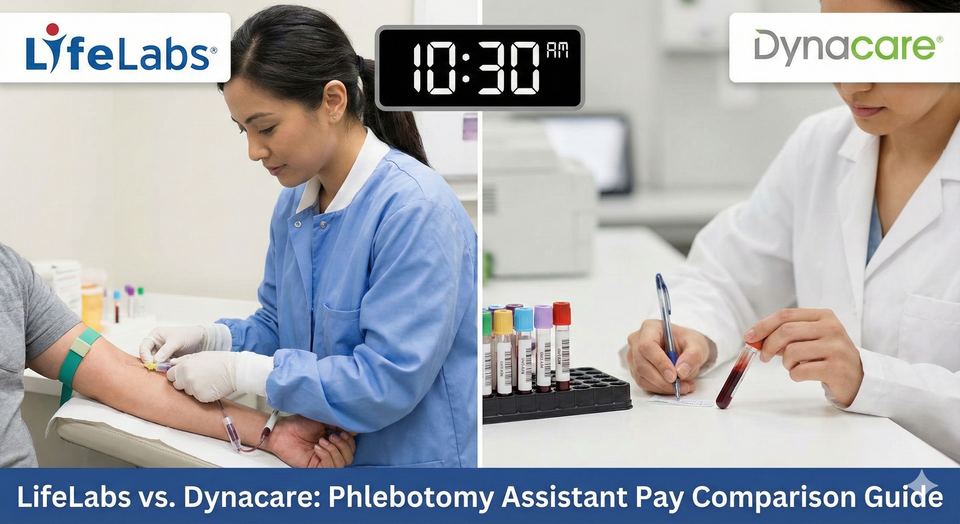
If you have steady hands and a strong stomach, becoming a Phlebotomy Assistant (Lab Technician) is one of the fastest ways to enter the Canadian healthcare system.
Unlike nurses who study for 4 years, you can get certified in Phlebotomy in a few months.
But once you graduate, you face the big choice: LifeLabs or Dynacare.
Together, they control almost the entire private blood collection market in Ontario and BC.
To the patient, they look the same. To the employee, they are very different.
In 2026, the industry is suffering from a massive shortage of staff, driving wages up slightly, but the Patient Volume quotas have become brutal.
This guide compares the paycheques, the "Pace" (how many arms you have to poke per hour), and the reality of the OSMT / CSMLS certification requirements.
Queasy around blood? Check out Shopify Support Advisor for a desk job or Cannabis Budtender for retail.
The Pay: Hourly Rates & Unions
Both companies are largely unionized (OPSEU in Ontario), which keeps wages standardized.
1. LifeLabs (The Giant)
- Entry Rate: $19.50 - $21.00/hour.
- Top Rate: $26.00 - $28.00/hour (after ~5 years).
- The Union: Most locations are unionized. Raises are guaranteed by the contract, not by your performance.
- Shift Premium: small premiums ($0.50 - $1.00) for weekends or very early mornings (starts at 6:30 AM).
2. Dynacare (The Challenger)
- Entry Rate: $20.00 - $22.00/hour. (Often slightly higher to attract talent).
- Top Rate: $27.00 - $29.00/hour.
- The Bonus: Dynacare sometimes offers "Signing Bonuses" ($500 - $1,000) in hard-to-staff rural areas, which LifeLabs rarely does.
Winner: Dynacare (Slightly higher starting wage).
The Pace: "The Factory Line"
This is the #1 complaint for both companies.
It is not a doctor's office where you chat with patients. It is a factory.
The "6-Minute" Rule
- You are expected to process a patient every 6 to 8 minutes.
- The Process: Greet $\rightarrow$ Check Requisition $\rightarrow$ Verify ID $\rightarrow$ Stick Needle $\rightarrow$ Label Tubes $\rightarrow$ Bandage $\rightarrow$ Clean Chair.
- The Volume: You might see 40 - 60 patients in a single shift.
- The Stress: If you miss a vein (a "Hard Stick") and it takes 15 minutes, the waiting room backs up, and patients get angry.
- The "Fainters": If a patient faints, it ruins your schedule. You have to manage the medical emergency while 20 people stare at you.
Deep Dive: Certification (OSMT vs. CSMLS)
Do you need a license? Yes.
- The Course: You need a Laboratory Assistant / Phlebotomy certificate from a college (e.g., Humber, Seneca, Anderson).
- The Exam:
- OSMT (Ontario Society of Medical Technologists): The provincial standard.
- CSMLS (Canadian Society for Medical Laboratory Science): The national standard.
- The Hiring Rule: Both LifeLabs and Dynacare require certification. You cannot just "learn on the job" anymore.
- Note: If you are an IMG (International Medical Graduate) or a foreign Nurse, you might be able to challenge the exam, but you cannot practice without the paper.
The "Mobile Phlebotomist" (The Hidden Gem)
Both companies have a "Home Care" division.
- The Job: You drive a company car to nursing homes or private houses to draw blood for seniors who can't travel.
- The Pace: Much slower. You might only see 12 - 15 patients a day.
- The Pay: $22.00 - $24.00/hour.
- The Vibe: You are alone. You have autonomy. You can listen to podcasts in the car.
- Link: The driving aspect makes this similar to Purolator Driver jobs, but with less heavy lifting.
Clinical Secrets & Survival Tactics
1. The "Order of Draw" Interview Test
- If you fail this question, the interview is over immediately.
- The Question: "I need to draw a CBC, a Glucose, and a Coagulation screen. Which tube do I fill first?"
- The Why: If you fill the tubes in the wrong order, the additives from one tube cross-contaminate the needle and ruin the next sample.
- The Cheat Sheet (Mnemonic): Memorize this: "Stop Light Red Stay Put Green Light Go."
- Sterile (Blood Culture)
- Light Blue (Citrate)
- Red (Serum)
- SST (Gold/Tiger)
- PST (Light Green - Lithium Heparin)
- Green (Heparin)
- Lavender (EDTA)
- Grey (Fluoride)
- Link: Passing this memory test is the medical equivalent of the "Fall Clearance Math" required for Working at Heights Training.
2. The "Three-Poke Rule" (Don't Be a Hero)
- New hires try to prove themselves by digging for veins. Don't.
- The Policy: Most labs have a strict Two-Poke or Three-Poke limit per technician.
- The Protocol:
- Miss the first time? Re-adjust slightly (do not "fish").
- Miss the second time? Stop.
- The Handoff: You must go get a senior technician. "I have a hard stick in Chair 2."
- The Ego Check: It is better to admit defeat than to turn a patient's arm into a pincushion. If a patient complains to the College of MLTs about "brutality," you lose your license.
3. The "Casual Float" Nightmare (Schedule Instability)
- 80% of new hires start as "Casual Float."
- What it means: You do not have a "Home Branch." You cover sick calls for 10-15 different locations in your district.
- The Reality:
- 6:00 AM: Phone rings. "Can you get to the Brampton location by 7:00?"
- The Commute: You put massive mileage on your car.
- The Strategy: Treat the "Float" period as a 6-month interview. Find the branch you like best, make friends with the manager, and when a permanent line opens up, you’ll be their first pick.
- Link: This "On Call" lifestyle is identical to the "Reserve" life of Flight Attendants, but with less travel glamour.
4. Pediatric Draws (The "Heel Prick" Scream)
- Drawing blood from a 6-foot bodybuilder is easy. Drawing from a 6-day-old baby is war.
- The Technique: You don't use a vein; you use a Lancet on the heel.
- The Stress: The baby will scream. The mother will cry. The waiting room will stare.
- The Tip: You need to warm the baby's foot with a Heel Warmer pack for 5 minutes first. If the foot is cold, the blood won't flow, and you have to cut them again.
- Resume Keyword: If you have "Pediatric Experience," put it at the top of your resume. Everyone is scared of babies; if you aren't, you are hired.
5. Dealing with "Fasting Fainters" (Hypoglycemia)
- Your busiest time is 7:00 AM - 9:00 AM because of "Fasting Required" tests.
- The Risk: Diabetic patients who haven't eaten in 12 hours are prone to Hypoglycemic Crashes.
- The Signs: Sweating, confusion, shaking.
- The Fix: Keep orange juice or glucose tabs at your station.
- The Protocol: If a patient hits the floor, Do Not Try to Catch Them (you will hurt your back). Guide them down, protect the head, and call 911 if they don't wake up in 10 seconds.
- Link: Recognizing these medical signs is part of the "Duty of Care" similar to Cannabis Budtenders checking for intoxication.
6. "TTT" (Turnaround Time Targets)
- LifeLabs and Dynacare are obsessed with TTT.
- The Metric: From the moment the patient checks in to the moment the blood is in the fridge.
- The Red Zone: If the waiting room wait time exceeds 20 minutes, the manager's dashboard turns red.
- The Cheat: Sometimes staff will "Check In" patients before they are actually in the chair to juke the stats. Do not do this. It messes up the timestamp for time-sensitive tests (like Cortisol or Insulin) and can ruin the diagnosis.
7. The "Butterfly" Hoarding War
- We mentioned butterflies are expensive.
- The Politics: Senior staff often hoard boxes of Butterfly needles in their personal drawers.
- The Struggle: As a new hire, you are left with the straight needles.
- The Skill: Learn to use a straight needle on a hand vein. It’s hard, but if you master it, you won't be dependent on the "good" equipment that is always locked away.
8. Career Exit Strategy (Where do Phlebs go?)
- Most people do not retire as Phlebotomists (the back pain is too real).
- Path 1: MLT (Medical Laboratory Technologist): Go back to school for 2-3 years. Run the machines. Pay jumps to $35 - $45/hour.
- Path 2: Research Coordinator: Work for hospitals managing clinical trials.
- Path 3: Insurance Examiner: Go to people's houses to do "Vitals" for life insurance policies.
- Link: Many also transition into remote admin roles like Shopify Support Advisors to save their backs.
9. "Add-On" Tests (The Paperwork Nightmare)
- Sometimes a doctor calls 2 hours after the blood is drawn and says "Add a Magnesium test to that sample."
- The Job: You have to run to the fridge, find the tube among 500 others, check if it's stable, and relabel it.
- The Skill: Organization. If your fridge is messy, you can't find the tube, and the patient has to get poked again.
Practical Questions Answered
The vein truth.
"Is it hard on your body?"
YES.
- You are bending over a chair 50 times a day.
- Back Pain: Lower back issues are the #1 injury.
- Repetitive Strain: Your "poking hand" will get sore from the repetitive motion of stabilizing the needle.
"Do I have to deal with urine?"
Yes.
- It's not just blood. You are collecting urine samples, stool samples, and swabs.
- The Smell: You get used to it, but you will be handling warm jars of bodily fluids daily.
- Link: If you have a weak stomach, you are better off as a Traffic Control Person.
"What is the 'Butterfly' needle rule?"
- The Tool: A "Butterfly" is a smaller, easier needle for difficult veins.
- The Cost: They are expensive.
- The Management Pressure: Managers will yell at you if you use too many Butterflies. They want you to use the standard (cheaper) straight needle. You have to fight for the right to use the good tools.
"Data Entry" Accuracy
- The Danger: If you label the tube with the wrong name, a patient could get the wrong diagnosis (e.g., told they have cancer when they don't).
- The Rule: You must ask the patient to Spell Their Name and State Their Date of Birth every single time.
- The Fatigue: By 2:00 PM, you will be tired of asking. But if you skip it once, you can be fired for a "Critical Error."
Frequently Asked Questions
Can I work Part-Time?
Yes.
- Most new hires start as Casual or Part-Time.
- The Hours: You will likely work the "Morning Rush" (7:00 AM - 11:00 AM) when everyone comes in fasting.
Is there a uniform?
Yes.
- Scrubs. usually provided or you get an allowance.
- Shoes: Closed-toe, non-slip medical shoes (like Danskos or Hokas).
- Link: Investing in good footwear is just as critical here as it is for Canada Post Sorters.
Do they hire nurses?
Yes.
- RPNs (Registered Practical Nurses) often work at LifeLabs, especially for performing ECGs (Heart monitoring) which pays more than just blood draws.
Summary: Speed vs. Empathy
- Practice on "Hard" Veins: In school, practice on the students with invisible veins. If you can only hit the easy ones, you will fail at LifeLabs.
- Go Mobile: If you hate the assembly line, apply for the "Mobile/Home Care" team immediately.
- Protect Your Back: Adjust the chair height for every patient. Do not stoop.
- Join the Union: Understand your collective agreement. It protects you from being forced to work through lunch.
About the author
Jeff Calixte (MC Yow-Z) is a Canadian career researcher and digital entrepreneur who studies hiring trends, labour market data, and real entry-level opportunities across Canada. He specializes in simplifying the job search for newcomers, students, and workers using practical, up-to-date information.
Sources
- CSMLS (Canadian Society for Medical Laboratory Science): Certification standards. https://www.csmls.org/
- LifeLabs Careers: Job postings and requirements. https://www.lifelabs.com/careers/
- Dynacare Careers: Technician roles and benefits. https://www.dynacare.ca/careers
Note
Job availability, wages, and hiring conditions can vary widely by province, employer, season, and experience level. All salary ranges and job examples in this guide are estimates based on current labour market data. Always confirm details directly with the employer before applying.