
Medical Courier Jobs: Delivering Blood/Organs (No Experience)
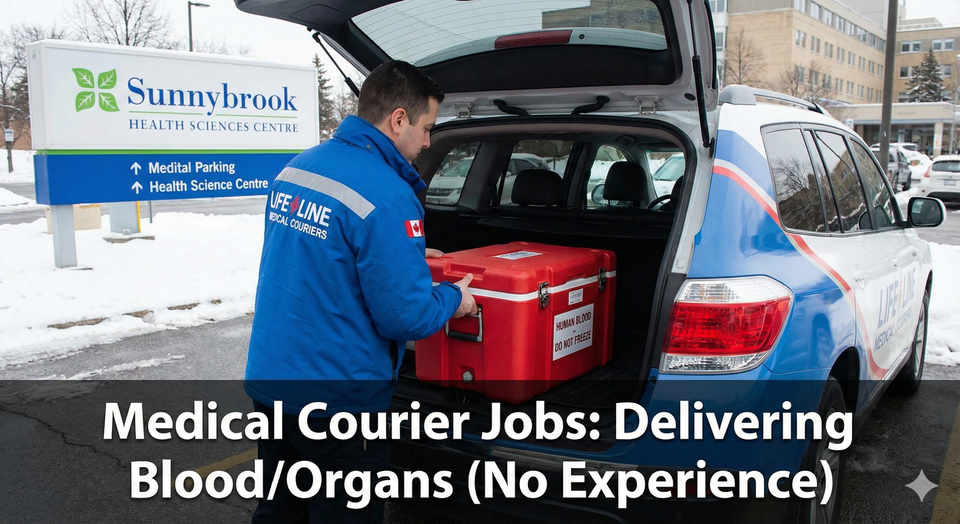
If you enjoy driving but hate the smell of fast food in your car, there is a "hidden gem" niche in the logistics world that most people ignore.
Medical Courier work.
Instead of delivering Big Macs for a $3 tip, you could be delivering life-saving blood samples, transplant organs, or urgent medical documents between hospitals and labs. It sounds intense, but for 95% of shifts, it is just driving a box from Point A to Point B safely.
The best part? You rarely need medical experience. You don't need to be a nurse or a paramedic. You just need to be a safe driver who can follow instructions.
In 2026, with Canada's aging population requiring more tests than ever, companies like LifeLabs, Dynacare, and ATS Healthcare are aggressively hiring. It offers recession-proof stability, unionized wages (in some cases), and the satisfaction of doing work that actually matters.
Here is how to break into the medical courier industry in Canada.
1. Who Hires Medical Couriers? (The Big Players)
Do not just search "courier jobs" on Indeed. You need to target the specific healthcare logistics companies.
The "Big Two" Labs (Employee Status)
These are the best jobs because they often come with benefits, a company car, and gas cards.
- LifeLabs: The largest community lab network in Canada (mostly BC and Ontario). They hire "Mobile Couriers" to pick up samples from clinics.
- Dynacare: Huge presence in Ontario and Quebec. They employ "Walking Couriers" (Downtown Toronto/Montreal) and drivers for suburbs.
- Pay: $21.00 – $26.00 per hour (Plus benefits).
The Specialized Logistics Firms (Contractor Status)
These companies handle the complex stuff (nuclear medicine, temperature-controlled vaccines).
- ATS Healthcare: The gold standard for pharmaceutical transport.
- Purolator (Healthcare Division): Yes, Purolator has a specific medical wing that requires higher clearance.
- Dropoff / Stallion Express: Newer players that handle "last-mile" pharmacy deliveries.
2. The One Certificate You NEED: TDG
You can drive for Uber with just a license. To drive blood, you need your Transportation of Dangerous Goods (TDG) certificate.
Don't panic. It sounds scary, but it is easy.
- What it is: A federally required course that teaches you how to handle "Class 6.2 Infectious Substances" (i.e., blood vials) and what to do if a cooler leaks.
- How to get it: You can take the course online in about 3–4 hours.
- Cost: $35 – $50 CAD.
- Where: Providers like Danatec or AIX Safety offer Transport Canada-approved courses.
- The Hack: Put "TDG Certified" at the very top of your resume. It instantly puts you ahead of 90% of applicants who didn't bother to get it.
3. Employee vs. Independent Contractor
This industry is split down the middle. You need to know which deal you are signing.
Option A: The Employee (LifeLabs/Dynacare)
- Vehicle: They provide the car (usually a Toyota RAV4 or Ford Transit).
- Gas: They pay for it.
- Pay: Hourly wage ($22/hr).
- Verdict: Best for stability. You don't put miles on your own car.
Option B: The Contractor (Logistics Apps)
- Vehicle: You use your own car.
- Gas: You pay.
- Pay: Per kilometer or per stop.
- Verdict: Best for "Hustlers." You can claim huge tax deductions (gas, maintenance), but one breakdown can ruin your month.
Consensus Verdict: Is It Worth It?
The "Buy" Verdict:
- Do it if: You are an introvert. You spend 90% of your day alone in a car listening to podcasts.
- Do it if: You want full-time hours. Unlike food delivery, medical routes are fixed. You work 8am–4pm or 12pm–8pm guaranteed.
The "Avoid" Verdict:
- Don't do it if: You are squeamish. While the samples are sealed, you are still carrying biohazards.
- Don't do it if: You have a bad driving record. One speeding ticket in the last 3 years can disqualify you from insurance.
Comparison Table: Medical Courier vs. Food Delivery
| Feature | Medical Courier (LifeLabs) | Food Delivery (Uber Eats) |
| Pay Stability | Guaranteed Hourly | Volatile / Tip-based |
| Vehicle Wear | None (Company Car) | High (Your Car) |
| Stress | Medium (Strict Timelines) | Low |
| Certification | TDG Required | None |
| "Smell" Factor | Sterile / Clean | Greasy Food |
Practical Questions Answered
"Is it gross? Do I touch blood?"
Consensus: No.
You are handling sealed coolers and lockboxes. You are not holding open vials of blood. The only time you might see a sample is if you are double-checking a requisition form. It is very sterile.
"Do I need a special license?"
No. A standard Class G (Ontario) or Class 5 (BC/Alberta) is all you need. However, you need a "Clean Driver's Abstract." If you have a DUI or more than 2 minor tickets, you will not get hired.
"What happens if I get stuck in traffic?"
This is the biggest stress. Medical samples often have a "viability window" (e.g., must be tested within 4 hours).
- The Protocol: Dispatchers monitor you. If there is a jam, you call them immediately. You are not expected to speed; you are expected to communicate.
Frequently Asked Questions
How much do medical couriers make in Canada?
The average salary for an employee courier (LifeLabs/Dynacare) is between $42,000 and $52,000 per year, plus benefits. Independent contractors with their own cargo vans can earn upwards of $60,000, but they must cover their own vehicle expenses.
Do I need to be vaccinated?
Generally, yes. Because you are entering hospitals, long-term care homes, and clinics to pick up samples, most medical courier employers require proof of up-to-date vaccinations, including COVID-19 and Influenza, to protect vulnerable patients.
Is the TDG certificate hard to pass?
No. The Transportation of Dangerous Goods (TDG) course is designed for general drivers. It covers basic safety marks, labeling, and emergency reporting. Most people pass the online quiz on their first try. It is open-book and takes less than an afternoon.
Can I do this part-time?
Yes. Many labs hire "casual" or part-time drivers for evening and weekend pickup loops. This is an excellent way to supplement your income if you already have a 9-to-5 job, as clinics often need samples collected after they close at 5:00 PM.
About the author
Jeff Calixte (MC Yow-Z) is a Canadian career researcher and digital entrepreneur who studies hiring trends, labour market data, and real entry-level opportunities across Canada. He specializes in simplifying the job search for newcomers, students, and workers using practical, up-to-date information.
Sources
- Transport Canada (TDG Training): https://tc.canada.ca/en/dangerous-goods/training
- LifeLabs Careers: https://www.lifelabs.com/careers/
- Dynacare Careers: https://www.dynacare.ca/careers.aspx
Note:
Job availability, wages, and hiring conditions can vary widely by province, employer, season, and experience level. All salary ranges and job examples in this guide are estimates based on current labour market data. Always confirm details directly with the employer before applying.