
Medical Receptionist Certificates: Are They a Scam? (2026 Guide)
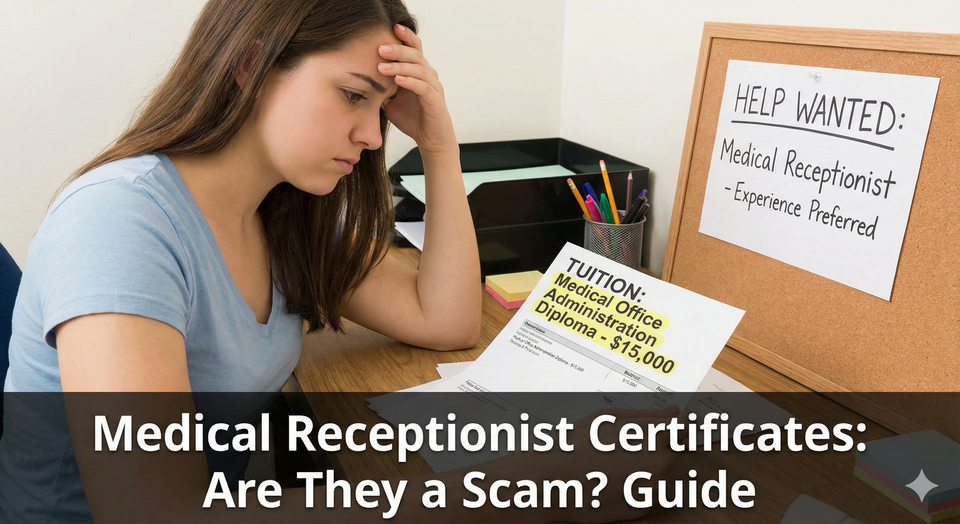
In Canada, the "Medical Office Assistant" (MOA) diploma is one of the most heavily advertised programs on daytime TV and Instagram.
Private career colleges promise you: "Train in 6 months! Start a stable career in healthcare! Earn $25/hour!"
The price tag? $10,000 to $14,000.
But if you look at job postings on Indeed for "Medical Receptionist" in Toronto or Vancouver, you will notice something shocking: Many of them do not require a diploma.
So, is the certificate a scam?
Not entirely, but for 80% of students, it is a massive waste of money.
This guide will break down the difference between a "Regulated" health professional (like a Nurse) and an "Unregulated" one (MOA), expose the "Diploma Mill" tactics, and show you how to get hired for free by learning the one skill doctors actually care about: EMR Software.
Looking for other healthcare jobs? Check out our part time job with benefits comparison or see if Hospital Security is a better fit.
The "Unregulated" Truth
Here is the secret colleges don't tell you: Medical Reception is NOT a regulated profession in Canada.
- Nurses: Must be licensed by the CNO/BCCNM. You need a degree.
- Doctors: Must be licensed.
- Medical Receptionists: Zero legal requirements.
A doctor can hire their 16-year-old niece to run the front desk if they want. There is no law saying you need a certificate to answer phones or book appointments.
Why do colleges charge $10,000?
Because they sell "Career Support" and "Practicums." But in 2026, with a massive shortage of healthcare admin staff, many clinics are hiring people with customer service experience (from Starbucks or Indigo) and training them on the job.
The "Diploma Mill" Trap: 5 Red Flags
If you are considering a school, watch out for these warning signs. If you see them, do not sign the contract.
1. "We Accept Everyone"
- The Pitch: "No high school diploma? No problem! Take our entrance test (which is 2+2=4) and you're in!"
- The Reality: Reputable public colleges (like Seneca, Humber, BCIT) have strict grade requirements. If a school is desperate to take your money, their diploma is likely worthless to employers.
2. The "Predatory" Loan
- The Pitch: "Bad credit? We have our own internal financing!"
- The Reality: These loans often have interest rates of 15% - 20%. If you drop out, you still owe the full $14,000. Public colleges cost ~$3,000 - $5,000 for similar programs.
3. The "Job Guarantee"
- The Pitch: "98% Hire Rate!"
- The Reality: Read the fine print. "Hired" often means "Graduates who found any job." If you graduate and get a job at McDonald's, they count you as "Hired."
4. Hard Sales Tactics
- The Pitch: "You must sign today to get the scholarship! The class is filling up!"
- The Reality: Real colleges don't pressure you like a used car salesman.
The One Skill You Actually Need: EMR (Electronic Medical Records)
Doctors don't care if you took a class on "Professionalism." They care if you can use their software without deleting a patient's file.
In Canada, 3 major EMR systems dominate. If you know these, you are hired.
1. OSCAR (Open Source Clinical Application Resource)
- Used By: Most Family Doctors in Ontario and BC.
- How to learn it: Don't pay $500. Watch YouTube tutorials on "OSCAR EMR Scheduling." It’s free.
- The Hack: Put "Familiar with OSCAR EMR (Scheduling & Billing)" on your resume after watching 5 hours of videos.
2. Accuro (QHR Technologies)
- Used By: Specialists and Family Teams across Canada.
- Training: Accuro offers free webinars on their website.
3. PS Suite (Telus Health)
- Used By: Large clinics.
- Complexity: Harder to learn, but similar logic.
Internal Link: If you are looking for free certifications, check out our guide on WHMIS Certification which is also required for clinics.
Public College vs. Private College
If you must get a diploma (e.g., you have zero Canadian experience and need the practicum), choose a Public College.
| Feature | Public College (e.g., George Brown, BCIT) | Private Career College (e.g., "Generic Tech") |
| Cost | ~$4,000 - $6,000 | **$12,000 - $15,000** |
| Duration | 1 - 2 Years | 6 - 9 Months |
| Reputation | High. Doctors trust the brand. | Low. Often seen as "buying a diploma." |
| Permit | PGWP Eligible (for intl students) | NOT PGWP Eligible (usually). |
Verdict: Always go Public. It takes longer, but the diploma is respected.
Practical Questions Answered
We scanned r/Torontojobs and r/MedicalAssistant to find the truth.
"I have a diploma but can't find a job. Why?"
Experience > Education.
- The Consensus: Clinics want someone who can handle stress. A diploma doesn't prove you can handle an angry patient screaming about a wait time.
- The Fix: Highlight your "Retail Survival Skills" on your resume. "Managed 200+ customer interactions per day at Tim Hortons" is more impressive than "WPM 60 typing speed."
"Is 'Medical Transcription' a good job?"
NO.
- The Reality: AI (like Dragon Dictate) has killed this industry. Doctors now speak into a mic, and the computer types it. Do not pay for a Medical Transcription course in 2026.
"What is the starting pay?"
Lower than you think.
- Range: $18.00 - $22.00/hour.
- The Ceiling: It rarely goes above $26/hr unless you become a "Clinic Manager."
- Warning: Many private colleges advertise "$30/hr." This is a lie. Only hospital admin staff (unionized) make that much, and those jobs are incredibly hard to get.
Frequently Asked Questions
Do I need to know Medical Terminology?
Yes.
This is the one valid part of the course. You need to know that "Hypertension" means High Blood Pressure.
- Free Alternative: Buy a used "Medical Terminology for Dummies" book on Amazon for $20. Read it.
Can I work in a hospital with this diploma?
Maybe.
Hospitals (like UHN or SickKids) usually require a 1-year certificate from a Public College. They rarely hire grads from strip-mall career colleges.
Is it better to be a Dental Receptionist?
Yes.
Dental offices are private businesses with higher profit margins. Dental receptionists often earn $25 - $35/hour. However, you need to learn dental coding (Odontogram), which is harder than medical billing.
Deep Dive: "Unit Clerk" vs. "MOA" & The OHIP Billing Code Cheat Sheet
1. The "Unit Clerk" Distinction (Hospital vs. Clinic)
This is where students get confused.
- Medical Office Assistant (MOA): Works in a Doctor's Office or Walk-in Clinic.
- Pay: Low ($18-$22).
- Benefits: Rare.
- Pace: Fast, but 9-5.
- Unit Clerk (or Health Ward Clerk): Works in a Hospital (ER, ICU, Cancer Ward).
- Pay: High ($26-$32).
- Benefits: Pension (HOOPP), Union Protection.
- Requirement: Hospitals often demand a specific "Unit Clerk" certificate from a Public College. A private MOA diploma usually does not qualify you for these unionized roles.
2. The "Billing Code" Interview Test
If you want to impress a doctor in an interview, mention OHIP Billing Codes (in Ontario) or MSP Codes (in BC).
- The Secret: Doctors are terrified of "Rejections" (when the government refuses to pay them because the code was wrong).
- Memorize These (Ontario Example):
- A007: Intermediate Assessment (Standard Visit).
- A001: Minor Assessment.
- A888: Emergency Department equivalent (if applicable).
- K005: Mental Health Counselling.
- The Pitch: "I am familiar with the Schedule of Benefits. I know the difference between an A007 and a K-code, and I double-check for diagnostic codes to prevent rejections." -> You are hired.
3. The "Free Practicum" Warning
- Many private colleges sell you on the "4-Week Practicum."
- The Truth: You are paying tuition to work for free.
- The Risk: Some shady clinics use students as permanent free labor. They take a student for 4 weeks, refuse to hire them, and then take the next student.
- The Question: Ask the college: "What percentage of students are hired by their practicum placement?" If they can't answer, run.
4. Resume Keywords for "No Experience" Applicants
If you are skipping school, your resume must scream "I can do the job."
- Keywords to Add: "Patient Confidentiality," "PHIPA Compliance" (Privacy Law), "Multi-line Phone Systems," "Triage," "EMR Data Entry."
- Transferable Skills: If you worked at Starbucks, write: "Managed high-volume queue prioritization in a fast-paced environment." (That is exactly what a receptionist does).
5. The "Typing Test" Lie
- Job ads say "Must type 60 WPM."
- Reality: Receptionists rarely type long paragraphs. You are clicking boxes in a dropdown menu.
- Don't Panic: If you can type at a conversational speed (40 WPM), you are fine. Focus on Accuracy (spelling patient names right) over speed.
6. Working for Specialists vs. GPs
- GP (Family Doctor): High stress, high volume, angry patients, sick kids.
- Specialist (Dermatologist/Plastic Surgeon): Lower volume, higher pay, "Elective" patients (happier).
- Pro Tip: Aim for "Cosmetic" or "Dermatology" clinics. They operate like high-end businesses and often pay bonuses for selling skincare products.
7. "Medical Terminology" Certification
- If you feel insecure about having no diploma, you can take a single "Medical Terminology" course at a local college (Continuing Education) for ~$300.
- Why? It puts a valid college name on your resume ("Seneca College - Medical Terminology Certificate") without the $10,000 price tag. It fixes the "Education" gap perfectly.
8. The "Wardrobe" Expectation
- Scrubs vs. Business Casual:
- Walk-in Clinics: Often wear Scrubs (easy, cheap, comfortable).
- Specialists: Often wear "Business Casual" (Blazers, dress pants).
- Cost: Scrubs are cheap ($30/set at Giant Tiger). Business clothes are expensive. Ask about the dress code before accepting the job.
9. Dealing with "Dr. Google" Patients
- The hardest part of the job isn't the software; it's the patients.
- Scenario: Patient demands antibiotics for a virus because Google said so. They yell at you when the doctor says no.
- Skill: "De-escalation." Doctors look for receptionists who are "Gatekeepers." Your job is to protect the doctor from chaos. If you are too shy, you will struggle.
10. Where to Find Free EMR Training (Links)
- OSCAR: Search "OSCAR McMaster User Manual" on Google. It’s a free PDF guide.
- Accuro: Search "QHR Accuro Learning Centre." They have public-facing videos.
- Youtube: Search "Medical Receptionist Roleplay." It sounds silly, but watching someone handle a "fake phone call" prepares you for the interview questions.
Summary: Save Your $10,000
- Don't Rush: Do not sign a contract with a private college just because they pressure you.
- Go Public: If you want school, apply to your local Community College (Seneca, Humber, NAIT, SAIT, BCIT).
- Self-Teach: Watch EMR tutorials on YouTube.
- Apply Anyway: Apply to "Medical Receptionist" jobs even if they ask for a certificate. Explain in your cover letter: "I have strong admin skills and I am a quick learner with software."
About the author
Jeff Calixte (MC Yow-Z) is a Canadian career researcher and digital entrepreneur who studies hiring trends, labour market data, and real entry-level opportunities across Canada. He specializes in simplifying the job search for newcomers, students, and workers using practical, up-to-date information.
Sources
- Job Bank Canada: Market report for Medical Receptionists. https://www.jobbank.gc.ca/marketreport/requirements/24401/ON
- Ontario Ministry of Colleges: Search for approved public programs. https://www.ontariocolleges.ca/en
- OSCAR EMR: Open source community resources. https://oscarcanada.org/
Note
Job availability, wages, and hiring conditions can vary widely by province, employer, season, and experience level. All salary ranges and job examples in this guide are estimates based on current labour market data. Always confirm details directly with the employer before applying.