
National Lifeguard (NL) Certification: Cost & Payback Time
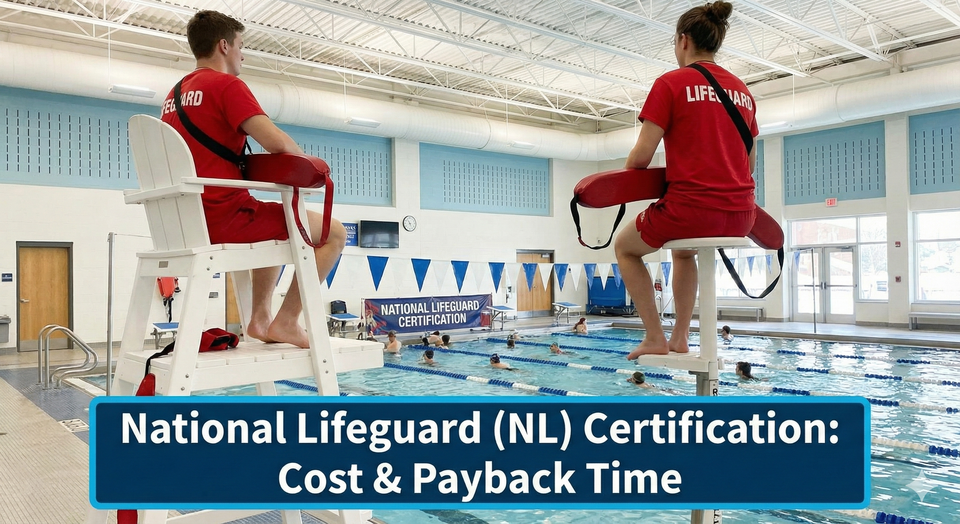
In Canada, lifeguarding is one of the highest-paying student jobs available.
While your friends are flipping burgers for minimum wage ($17.20/hr in Ontario), a City of Toronto lifeguard is earning **$21.19/hr** (plus benefits).
But unlike fast food, you cannot just walk in with a resume. You need the National Lifeguard (NL) certification.
This ticket is the gold standard. It is recognized across Canada and allows you to work at pools, waterparks, and waterfronts.
However, the path to getting it is expensive and physically demanding. Many students fail the swim test on their first try.
This guide analyzes the Return on Investment (ROI) of the NL award in 2026. We will break down the exact costs, the physical standards you must meet, and whether the high wage justifies the upfront training fees.
Looking for other student jobs? Check out our Ultimate Canadian Job Directory or compare this with the Cineplex Cast Member Review for a less physically demanding role.
The Cost Breakdown: It’s Not Just One Course
The biggest misconception is that you just take "The Lifeguard Course." In reality, it is a ladder of 4 prerequisites.
Here is the typical path and cost (estimates for Ontario 2026):
- Bronze Medallion: ~$200. (Pre-requisite: 13 years old).
- Bronze Cross: ~$200. (Pre-requisite: Bronze Medallion).
- Standard First Aid with CPR-C: ~$150. (Often bundled with Bronze Cross, but sometimes separate).
- National Lifeguard (NL) - Pool: ~$350 – $400. (Pre-requisite: 15 years old, Bronze Cross, SFA).
Total Estimated Cost: $900 – $1,000 CAD.
The "Payback Time" Calculation
Is spending $1,000 worth it?
- Average Lifeguard Wage: ~$22.00/hr.
- Minimum Wage: ~$17.20/hr.
- The Difference: +$4.80/hr.
To earn back your $1,000 investment just from the wage difference, you need to work ~208 hours. That is roughly one summer of part-time work. After that, you are profiting almost $5 more per hour than your peers forever.
The Swim Test: Can You Actually Pass?
The NL course is not a "pay to pass" class. It has a high failure rate due to the physical standards.
The Hardest Test Items (2026 Standards):
- The 400m Swim: You must swim 400 metres in 10 minutes or less. (This is 16 lengths of a standard 25m pool).
- Object Recovery: Sprint 15m, dive down 3m, pick up a 20lb brick, and carry it to the surface.
- Spinal Rollover: You must demonstrate a perfect spinal injury management rollover in deep water. This requires strong eggbeater kick legs.
Pro Tip: Do not sign up for the course if you haven't been swimming. Go to a public swim and time yourself on the 400m first. If you clock in at 12 minutes, you will fail the NL course.
Internal Link: If you aren't a strong swimmer, consider Ontario Security Guard Training instead—it pays similarly but requires zero athletic ability.
Pool vs. Waterfront vs. Waterpark
Your NL license has "Options." The most common is Pool.
- NL Pool: Allows you to work at indoor/outdoor swimming pools (YMCA, Community Centres, Condo Pools). Get this one first.
- NL Waterfront: Required for beaches (e.g., Toronto Island, Grand Bend). Includes a run-swim-tow test and open water rescue skills.
- NL Waterpark: Required for places like Canada's Wonderland or Great Wolf Lodge. Focuses on slides and spinal rescues in moving water.
Practical Questions Answered
We scanned r/Lifeguards and r/Toronto to get the real scoop from current guards.
"Is it hard to get hired?"
No, there is a shortage.
- The Reality: Post-pandemic, there is a massive lifeguard shortage across Canada. Cities are desperate. If you have your NL and can pass the screening, you will get hired.
- The Hiring Process: It usually involves a "wet interview" (skills screening) and a standard interview.
"Do I have to re-certify?"
YES.
- Your NL expires every 2 years.
- The Recert Cost: ~$100 for a 1-day exam.
- The Trap: If you let it expire, you can't work. Most employers require you to be "current" to stay on the schedule.
"Is it boring?"
Yes and No.
- The Job: 99% of the time, you are staring at water. It is mentally exhausting to stay focused.
- The 1%: When an emergency happens, it is pure adrenaline. You must be ready to save a life instantly.
Frequently Asked Questions
Can I wear glasses/contacts?
Yes. But you must be able to see the bottom of the pool clearly. If you lose your glasses during a rescue, you still need to be functional.
Does the YMCA pay less than the City?
Generally, yes.
- Municipal (City) Jobs: ~$21–$28/hr (Unionized).
- YMCA / Private Pools: ~$18–$20/hr.
- Condo Pools: Often pay the least (~$17–$19/hr) but are the easiest jobs (mostly solo guarding).
What if I fail the course?
You usually have to pay for the whole course again. Some providers offer a discount for a retake, but unlike the Smart Serve test, you cannot just pay $35 to try again. You need to be in the pool demonstrating skills.
Deep Dive: The Interview & "Wet Screening"
Getting the certification is Step 1. Getting the job is Step 2.
1. The "Wet Interview"
Before a City hires you, they will make you get in the water.
- Expectation: They will ask you to perform a rescue (e.g., "Unconscious victim in deep end").
- What they look for: Confidence, loud voice ("GUARD!"), and strong towing skills.
2. Interview Questions (2026)
- Q: "You see a child running on the deck. What do you do?"
- A: "I would blow my whistle (one short blast), get their attention, and politely but firmly tell them to walk. I would explain why (it's slippery) to ensure they understand the danger."
- Q: "How do you stay focused during a long shift?"
- A: "I use active scanning strategies, count heads, and rotate my position every 15 minutes as per protocol."
3. Uniforms & Equipment
- Whistle: You usually need your own Fox 40 whistle.
- Suit: Most employers provide a uniform (shirt/shorts), but you often need your own red or black bathing suit.
- Deck Shoes: You need waterproof sandals (Crocs or slides) to protect your feet on the deck.
Deep Dive: Hidden Costs, Tax Breaks & The "Assistant" Trap
Before you spend $1,000, you need to know the financial tricks to save money and the vision requirements that could disqualify you instantly.
1. The "Assistant Lifeguard" Trap
Many students see a course called "Bronze Cross - Assistant Lifeguard" and think they can get a job with just that.
- The Reality: In 2026, very few cities hire "Assistant Lifeguards" (who usually earn minimum wage, ~$17.20/hr).
- The Job: You are essentially a slide attendant or a cleaner. You cannot legally supervise the pool alone.
- The Pay Gap: A National Lifeguard earns ~$21.19/hr. An Assistant earns ~$17.20.
- The Advice: Do not stop at Bronze Cross. The $4/hr pay jump to NL is massive over a summer.
2. Can I Claim the $1,000 on My Taxes?
YES.
- Tuition Credit: If you take the course at a recognized institution (like a City Community Centre or YMCA) and the total cost exceeds $100, you should receive a receipt.
- Employment Expense: If you are already employed and your employer requires you to recertify but doesn't pay for it, you may be able to claim it as an employment expense (check with a tax pro).
- The "Resume" Value: Unlike a video game, this $1,000 is an investment in a "trade." It often qualifies for provincial student training credits depending on your province.
3. Vision Requirements (The 20/20 Rule)
You can be the best swimmer in the world, but if you can't see, you can't guard.
- The Standard: The Lifesaving Society requires 20/20 vision (corrected).
- Glasses/Contacts: You ARE allowed to wear them.
- The Test: You must wear your corrective lenses in the water. If you wear glasses, you need a strap. If you wear contacts, you must be comfortable opening your eyes underwater (or risk losing them during a rescue).
- Pro Tip: Keep a spare pair of cheap glasses in your locker. If your contacts fall out during a shift, you can't legally return to the deck without backup.
4. The "Recert" Reality (Every 2 Years)
Unlike a college degree, your NL expires.
- Frequency: Every 2 years.
- Cost: ~$100 – $120.
- The Exam: It is a 4-hour "challenge exam." You hop in the pool, do the physical standards (400m swim, object recovery, spinal), and go home.
- The Danger: If you let it expire by even one day, you cannot take the short Recert clinic. You must re-take the entire 40-hour course ($400). Set a calendar reminder now.
5. Instructor Status: The Real Money Glitch
If you are smart, you won't just guard. You will teach.
- The Ticket: "LSI" (Lifesaving Swim Instructor).
- The Cost: Another ~$300 course.
- The Wage: Instructors often earn $1–$3 more per hour than guards.
- The Best Part: You aren't cold. You are in the water teaching kids, time flies, and you don't have the stress of scanning for drowning victims every 10 seconds.
- The "Combo" Job: Most pools hire "Swim Instructor / Lifeguards." If you have both tickets, you get Full-Time hours (splitting your shift between teaching and guarding).
6. City of Toronto vs. Private Uniforms
- City of Toronto: Provides the classic red/yellow uniform (shirt/shorts). You must provide a red bathing suit.
- YMCA: Often requires a black bathing suit and provides a specific "Y" shirt.
- Condos: Often require a generic "Lifeguard" tank top and red shorts.
- Cost: Budget $50–$80 for a high-quality chlorineresistant swimsuit (like Speedo Endurance+). Cheap suits will disintegrate in 3 months of daily pool exposure.
Summary: A Smart Investment
- High Pay: Earning $22+/hr as a student is unbeatable.
- In Demand: You will never struggle to find a summer job.
- Transferable Skills: First Aid and leadership look great on any resume.
- The Catch: You must be a strong swimmer. Do not underestimate the physical requirements.
About the author
Jeff Calixte (MC Yow-Z) is a Canadian career researcher and digital entrepreneur who studies hiring trends, labour market data, and real entry-level opportunities across Canada. He specializes in simplifying the job search for newcomers, students, and workers using practical, up-to-date information.
Sources
- Lifesaving Society: The governing body for NL certification. https://www.lifesavingsociety.com/
- City of Toronto Jobs: Current wage rates for aquatic staff. https://www.toronto.ca/explore-enjoy/parks-recreation/program-activities/leadership-employment-readiness/aquatic-leadership/
- YMCA Canada: Aquatics certification info. https://www.ymca.ca/
Note
Job availability, wages, and hiring conditions can vary widely by province, employer, season, and experience level. All salary ranges and job examples in this guide are estimates based on current labour market data. Always confirm details directly with the employer before applying.