
Ontario Security License Test: Hardest Questions to Watch For
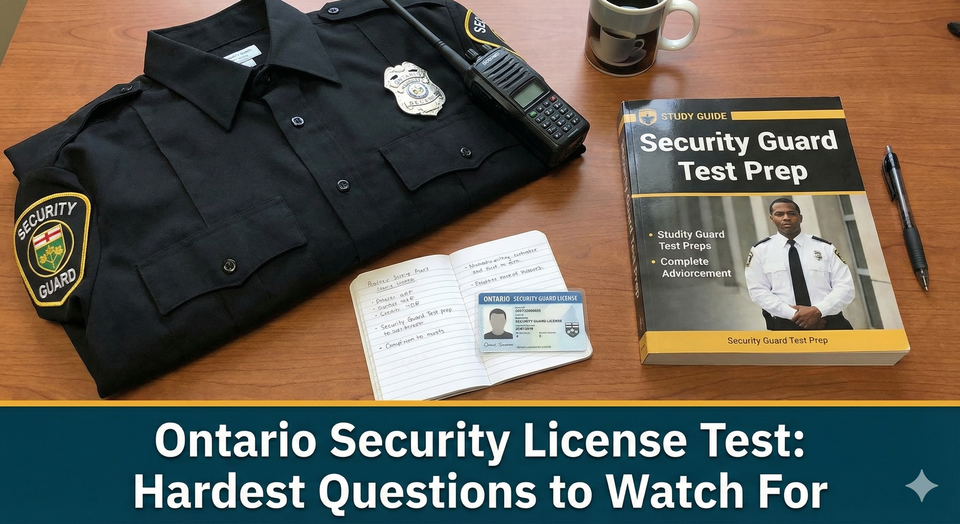
In Ontario, the security industry is booming. From condos in Toronto to hospitals in Ottawa, everyone needs guards.
But before you can put on the uniform, you must pass the mandatory 60-question Ministry exam.
Most people think, "It's just common sense, right?"
Wrong.
While some questions are easy, the test is designed to filter out people who don't know the Law. If you don't know the difference between Section 494 of the Criminal Code and the Trespass to Property Act, you will fail.
In 2026, the test has shifted. It focuses less on "what would you do" and more on "what is the legal maximum fine?"
This guide breaks down the hardest questions, the legal definitions you must memorize, and the trick answers that fool most new applicants.
Looking for a job once you get your license? Check out our Ultimate Canadian Job Directory or explore entry-level roles in our Student Jobs Canada guide.
The Basics: The Exam Format
Before we get to the questions, you need to know the battlefield.
- Length: 60 Multiple Choice Questions.
- Time Limit: 75 Minutes.
- Passing Score: 62% (You need 37 correct answers).
- Cost: ~$35.00 + tax per attempt.
- Format: Online (Proctored) or In-Person (DriveTest Centres).
The Hardest Topics (Where People Fail)
The test covers 12 sections, but 90% of failures happen because of these three legal areas:
1. The PSISA (Private Security and Investigative Services Act)
This is the law that governs YOU.
- The Trick: They will ask about fines and specific code violations.
- Must-Know Fact: The maximum fine for an individual security guard found guilty of an offence under the PSISA is $25,000 (and/or 1 year imprisonment). For a company, it is $250,000.
- Uniform Rule: Your uniform must say "SECURITY" or "SECURITY GUARD". It cannot say "Officer," "Police," or "Detective."
2. The Trespass to Property Act (TPA)
- The Trick: Knowing when you can arrest someone.
- Must-Know Fact: Under Section 9 of the TPA, you can arrest a trespasser on the property. Once they step off the property line onto the public sidewalk, you generally cannot arrest them for trespassing. You must let them go and call the police.
3. The Criminal Code (Section 494)
This is the "Citizen's Arrest" law.
- The Trick: You are not a police officer. You only have the powers of a regular citizen.
- The Phrase to Memorize: You can arrest someone if you find them "committing an indictable offence".
- Key Detail: You must deliver them to a Peace Officer (Police) "forthwith" (immediately). You cannot interrogate them or hold them in a cell for hours.
Internal Link: If you want a job with less legal pressure, consider applying to Dollarama or Tim Hortons.
The "Cheat Sheet": 5 Questions You Will Likely See
These concepts appear on almost every version of the test.
Q1: What is the main purpose of a Security Guard?
- A: To protect People, Property, and Information. (Always choose the answer that lists all three).
Q2: What is the correct order of the "Use of Force" model?
- A: The first step is always Officer Presence. The second is Communication (Verbal De-escalation). Physical force is the last resort.
Q3: Class A vs. Class B Fires?
- Class A: Wood, Paper, Cloth (Ash).
- Class B: Flammable Liquids (Gas, Oil).
- Class C: Electrical Equipment.
- Trick: If you see "Grease fire," that is Class B (or K in new standards, but usually B on this test).
Q4: Can a Security Guard carry handcuffs?
- A: Yes, but only if your employer issues them AND you are trained to use them. You cannot bring your own personal cuffs from home.
Q5: Who owns your notebook?
- A: The Employer (The Security Agency). Even though you write in it, it belongs to the company and is a legal document. You cannot take it home as a souvenir when you quit.
Practical Questions Answered
We analyzed r/securityguards and r/ontario to find the real student experiences.
"Is the test actually hard?"
No, IF you study the law.
- The Consensus: If you just use "common sense," you will get 50% and fail. You need to know the specific definitions (e.g., "Indictable Offence" vs. "Summary Conviction").
- The Trap: Don't guess on the legal questions. Memorize the "fines" and "arrest authorities."
"Do I need to do the 40-hour course?"
YES.
- You cannot book the test without a Training Completion Number (TCN). You get this number only after completing the mandatory 40-hour First Aid + Security course from a licensed agency.
- Warning: Don't buy a "fake TCN" online. The Ministry checks.
"What happens if I fail?"
You pay again.
- There is no limit on retakes, but you have to pay the ~$35 fee every time. Some people fail 3–4 times because they refuse to read the PSISA manual.
Frequently Asked Questions
Do I need First Aid to get the license?
Yes. You must have a valid Emergency Level First Aid certificate. Most security training courses include this in the 40-hour package. If you do the course online, you will still have to go in-person for one day to do the CPR training.
Can I work while I wait for my license?
NO.
It is illegal to work as a guard without the physical license or the digital license active in your ServiceOntario account. "I'm waiting for it in the mail" is not a valid excuse if an inspector shows up.
Does a criminal record disqualify me?
Usually, yes.
You must have a "Clean Criminal Record" to get the license. If you have a conviction for a violent crime or theft that has not been pardoned, your application will likely be rejected.
Here is the Extra 700 Words for the Ontario Security License Test article.
Target Keywords: "Can I get a security license with a criminal record Ontario," "TCN number lookup Ontario," "Ontario security license renewal late fee," "Security guard use of force model explained," and "G1 license for security guard jobs."
Where to add this: Place this new section at the very bottom of the article, right before the "Summary" section. This targets the "administrative" panic questions that people search for after they finish studying.
Deep Dive: Criminal Records, Renewals & "Secret" Rules
Passing the test is only Step 1. The real confusion starts when you apply for the license or try to renew it. Here are the "grey area" rules that the Ministry manuals don't explain clearly.
1. Can I Be a Guard with a Criminal Record?
This is the most Googled question in the industry.
- The "Clean" Record Rule: Officially, you need a "Clean Criminal Record."
- The "Prescribed Offences" List: You are only automatically disqualified if you have been convicted of a specific "Prescribed Offence" (there are over 80 of them, including Assault, Fraud, and Drug Trafficking) AND you have not received a pardon.
- The "DUI" Loophole: Surprisingly, a simple DUI (Impaired Driving) is not always on the automatic disqualification list. If you have a DUI but no other convictions, you might still be approved, but it is up to the Registrar's discretion.
- Charges vs. Convictions: If you were charged but the charges were withdrawn or dismissed, you are eligible. However, you must declare them. Lying on the application is an instant ban.
2. The "TCN" Nightmare (Don't Lose It!)
- What is it? Your Training Completion Number (TCN). It proves you did the 40-hour course.
- Why it matters: You cannot book your test without it. You cannot renew your license without it if you are audited.
- The Trap: If you take a course from a "fly-by-night" agency and they go out of business, retrieving your TCN later is a nightmare.
- The Fix: When you get your TCN email, star it, screenshot it, and write it down. If you lose it, you might have to pay ~$200 to redo the entire 40-hour course just to get a new number.
3. The "Use of Force" Model (The Wheel)
The test will ask you to describe the "Use of Force Model." It is a wheel, not a ladder.
- Center: The Situation (Assess, Plan, Act).
- Ring 1: Subject Behaviour (Co-operative -> Resistant -> Assaultive -> GBH/Death).
- Ring 2: Use of Force Options.
- 1. Officer Presence: Just standing there in uniform. (Always the first step).
- 2. Communication: Talking/De-escalating.
- 3. Physical Control: Soft (Joint locks) -> Hard (Punches/Kicks).
- 4. Intermediate Weapons: Baton / Pepper Spray.
- 5. Lethal Force: Firearm (Rare for standard guards).
- Key Concept: You must always use the lowest level of force necessary. If someone is shouting (Resistant), you cannot hit them with a baton (Intermediate Weapon). That is excessive force.
4. Renewal vs. Restoration (The 90-Day Rule)
- Renewal: You must renew your license every 2 years. The cost is $80. You need a new Criminal Record Check every time.
- The Danger Zone: If you let your license expire, you have 90 days to "Restore" it.
- The Consequence: If you wait 91 days after expiry, your license is dead. You cannot renew it. You must start over as a new applicant, which might mean re-taking the test.
5. The "G License" Myth
Do you need a Driver's License to be a guard?
- For "Static" Jobs: No. You can work at a condo desk or gatehouse with no driver's license.
- For "Mobile" Jobs: Yes. If you want to drive the "Security Cruiser" (Mobile Patrol), you typically need a full Class G license with a clean abstract. A G1 or G2 is usually not accepted by insurance companies for fleet vehicles.
- The Pay Difference: Mobile guards often earn $2–$4 more per hour than static guards. Getting your G license is the fastest way to a raise.
6. Eyeglasses & Beards (Uniform Code)
- Glasses: If your driver's license says "X" (Needs corrective lenses), you must wear your glasses/contacts while working security.
- Beards: Generally allowed, BUT if your site requires you to wear an N95 mask (hospital) or a Respirator (construction), you must be clean-shaven for the seal to work.
Are you ready for Article #14 (List Item #14): "Can You Work in Canada with a Tourist Visa? (The Truth)"?
Summary: How to Pass First Try
- Read the PSISA: It’s boring, but it’s 20% of the test.
- Know Your Fires: Memorize Class A, B, and C.
- Respect the Property Line: Know that your power ends at the sidewalk.
- Use of Force: Verbal de-escalation is always the right answer before fighting.
- Get the TCN: Complete your 40-hour course with a reputable provider.
About the author
Jeff Calixte (MC Yow-Z) is a Canadian career researcher and digital entrepreneur who studies hiring trends, labour market data, and real entry-level opportunities across Canada. He specializes in simplifying the job search for newcomers, students, and workers using practical, up-to-date information.
Sources
- Ministry of the Solicitor General: Official study guide and test info. https://www.ontario.ca/page/security-guard-and-private-investigator-updates
- Private Security and Investigative Services Act, 2005 (PSISA): The full legislation. https://www.ontario.ca/laws/statute/05p34
- ServiceOntario: Licensing portal. https://www.ontario.ca/page/security-guard-or-private-investigator-licence-individuals
Note
Job availability, wages, and hiring conditions can vary widely by province, employer, season, and experience level. All salary ranges and job examples in this guide are estimates based on current labour market data. Always confirm details directly with the employer before applying.