
Pipeline Labourer 2026: How to Get Hired After the "Megaproject Boom"
For the last 5 years, if you wanted to make $100,000 with no degree, the answer was simple: "Go to Coastal GasLink."
But in 2026, the game has changed.
The massive 670km pipeline is built. The "Mainline" construction crews have largely gone home. The viral TikToks of people making $5,000 a week living in camps are fading.
But here is the secret: The work didn't stop. It just changed.
In 2026, the industry has shifted from Construction to Reclamation and Integrity Maintenance.
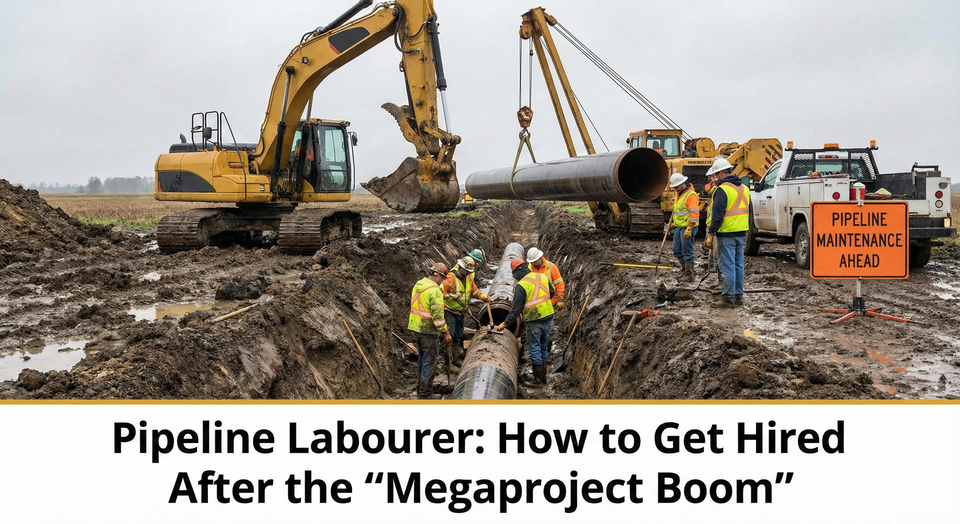
The pipe is in the ground, but now it needs to be monitored, the land needs to be restored (Reclamation), and older pipelines need to be dug up and fixed (Integrity Digs).
This guide explains how to get hired as a Pipeline Labourer in this new era. We cover the mandatory certifications (PCST vs. CSTS-20), why "swamping" is still your foot in the door, and the reality of the "12 and 2" shift rotation.
Prefer working indoors? Check out Canada Post Holiday Sorting for winter work, or Working at Heights Training if you are in Ontario construction.
The New Reality: "Mainline" vs. "Integrity Digs"
The days of laying 100km of pipe in a straight line are mostly paused.
In 2026, the money is in Integrity Digs.
1. What is an Integrity Dig?
- The Context: Canada has thousands of kilometers of old pipe (Enbridge, TC Energy).
- The Job: A "Smart Pig" (robot) scans the pipe and finds a crack or rust.
- Your Role: You go out with a small crew (maybe 6 people). You strip the topsoil, expose the pipe, sandblast the rust, recoat it, and bury it again.
- The Vibe: It is slower, more precise, and often pays higher overtime because the crews are smaller and leaner.
2. Reclamation (The CGL Cleanup)
- Even though Coastal GasLink is "done," the environmental cleanup takes years.
- The Job: Planting trees, fixing erosion on hillsides, removing temporary bridges ("Matting").
- Who Hires: Environmental companies and Indigenous partnerships (e.g., MacLems, Ledcor).
- Pay: $24.00 - $28.00/hour. Less than mainline welding, but very steady work.
The Pay: What to Expect in 2026
Wages have stabilized after the frantic inflation of 2023.
1. Entry Level Labourer
- Non-Union: $24.00 - $28.00/hour.
- Union (LiUNA/CLAC): $30.00 - $34.00/hour.
- Overtime: The magic happens after 8 hours (or 10 hours, depending on contract). You will likely work 12-hour days, meaning 2-4 hours of OT daily.
2. LOA (Live Out Allowance)
- If you aren't in a camp, they pay you LOA.
- 2026 Rate: Approx $175 - $200 per day tax-free.
- The Hack: If you share a cheap motel room with a buddy, you can pocket $100/day of your LOA. That’s an extra $3,000/month tax-free.
Deep Dive: The Mandatory Tickets (Don't Apply Without These)
You cannot walk onto a pipeline right-of-way (ROW) without these cards.
1. PCST (Pipeline Construction Safety Training)
- The Standard: This is the specific course for pipelines. It is different from general construction safety.
- Where to get it: ACSA (Alberta Construction Safety Association) online. Cost is ~$100.
- Note: Some companies accept CSTS-20 (Construction Safety Training System), which is free, but PCST is the gold standard for pipelines.
2. H2S Alive (The "Sour Gas" Killer)
- Mandatory. You cannot work in oil & gas without it.
- The Course: 1-Day In-Person. You learn how to put on a mask if a deadly gas leak happens.
- Cost: ~$150 - $180.
- Expiry: 3 Years.
3. First Aid (Standard Level C)
- Must be a 2-day in-person course (St. John Ambulance or Red Cross).
"Swamping" (The Best Entry Role)
If you have zero experience, apply to be a Swamper.
- The Job: You are the helper for a piece of heavy equipment (usually an Excavator or a Sideboom).
- The Task: You stand on the ground. You are the "eyes" for the operator. You use hand signals to tell them where to dig so they don't hit the pipe.
- The Pay: Often $28.00/hour+.
- The Career Path: If you are a good swamper, the operator will eventually teach you how to run the machine. This is how you become an Operator making $45/hour.
Deep Dive: Hidden Requirements & Camp Rules
1. Ground Disturbance Level 2 (The "Boss" Ticket)
- Everyone has H2S Alive. To stand out, you need Ground Disturbance Level 2 (often called the 201 Standard).
- The Difference:
- Level 1 (101): Basic awareness. You know not to dig without a permit.
- Level 2 (201): Supervisory. You are trained to read the "One Call" locate maps and manage the digging permit.
- Why get it? Even if you are just a labourer, having this ticket tells the foreman: "I can legally supervise the hole if you need to step away for 5 minutes." It makes you layoff-proof.
- Cost: Approx $150 - $200 (1-day course). Ensure it is ABCGA (Alberta Common Ground Alliance) endorsed.
2. The "Dispatch Board" (How Unions Actually Hire)
- If you join LiUNA Local 92 (Alberta) or Local 1611 (BC), you don't just get handed a job. You have to "Bid."
- The Process:
- Register: You go to the bottom of the "Out of Work" list.
- The Recording: You call the Job Line every morning (usually 9:00 AM - 11:00 AM).
- The Bid: The recording lists jobs: "3 Labourers needed for Surerus Murphy, Chetwynd, 14 days on." You leave a message to "Bid" on it.
- The Winner: The person with the lowest list number (longest time unemployed) gets the job.
- The Hack: Don't be picky. Bid on the short 5-day shutdown jobs. Once you are "in" with a foreman, they can "Name Request" you for the next big project, skipping the board entirely.
3. "Dry Camp" vs. "Wet Camp" (The Zero Tolerance Rule)
- Wet Camp: You can drink alcohol in your room or the camp bar after shift. (Rare in 2026).
- Dry Camp: Zero Alcohol.
- The Search: Camp security (often Paladin Security) will search your bags with dogs when you arrive.
- The Consequence: If they find a single beer can or a vape pen in a non-smoking zone, you are "Site Banned". This ban follows you to other companies.
4. Winter Gear: Dunlops vs. Baffins
- You will be standing in -40°C mud. Your Walmart boots will crack in 2 days.
- The Gold Standard: Dunlop Purofort (The "Thermo+" style).
- Pros: Indestructible, chemical resistant, easy to clean.
- Cons: Expensive (~$250).
- The Alternative: Baffin Ice Bears.
- Pros: Often warmer for standing still.
- Cons: Bulky (hard to drive in) and can crack in extreme cold.
- The Pro Tip: Buy Bama Socks (blue booties). They absorb sweat. Change them at lunch, or your feet will freeze from the inside out.
5. Top Companies to Watch in 2026
- Don't just search "Pipeline." Search these specific companies on Indeed:
- Surerus Murphy Joint Venture (SMJV): Huge player in BC reclamation.
- Michels Canada: Does a lot of the specialized HDD (Horizontal Directional Drilling) work.
- Banister Pipelines: Known for mainline integrity digs.
- Summit Earthworks: Focuses on the environmental reclamation side (planting/erosion control).
6. "Bird Dogging" (The Private Investigator Role)
- What is it? A "Bird Dog" is a scout who works for the oil company (the Client), not the construction company.
- The Job: You drive around in a pickup truck and make sure the construction crews are following the rules.
- Entry Level? Yes, for Junior Inspectors.
- The Pay: $500 - $700 Day Rate.
- Requirement: Usually requires a background in Environmental Science or extensive swamping experience.
7. "Frost Fighting" (Winter Work)
- Pipeline work doesn't stop in winter; it gets harder.
- The Job: You spend 12 hours a day dealing with Hoarding (tarps) and Herman Nelsons (massive heaters).
- The Reality: You are the "Heater Watch." You ensure the heaters don't run out of diesel. It is the easiest money you will ever make, but it is incredibly boring.
- Link: This monitoring role is similar to the "Fire Watch" duties often assigned to Security Guards.
8. The "7-Day Rule" (Union Loophole)
- In some union contracts (like Local 92), if you take a job that lasts less than 7 days, you don't lose your spot on the dispatch board.
- The Strategy: Always take the short jobs. You make quick money ($2,000 for a week) and keep your high-ranking spot for the "Big Job" when it comes up.
9. Pipeline vs. Utility (Know the Difference)
- Pipeline: Big inch pipe (24" - 48"). Middle of nowhere. Higher Pay ($35+/hr).
- Utility: Small inch pipe (2" - 6"). In the city (Fortis/ATCO). Lower Pay ($25+/hr).
- The Move: Start in Utility to get your Ground Disturbance hours, then apply to Pipeline companies with experience on your resume.
Practical Questions Answered
The 2026 reality.
"Is Camp Life still a thing?"
Yes, but less common.
- On big mainline projects, you stayed in massive camps with steak dinners and gyms.
- On Integrity Digs, you usually stay in a Hotel in the nearest town (e.g., Grande Prairie, Fort St. John, Hardisty). You live off your LOA.
"Do I need my own truck?"
It helps.
- Getting to the "Muster Point" (where the crew meets) is your responsibility.
- If you have a reliable pickup truck, you are more hireable. If you rely on the Greyhound bus, you will struggle.
"Is it seasonal?"
Yes.
- Summer/Fall: Busy season. You work 24 days on, 4 days off.
- Spring Breakup (March-April): The ground melts and turns to mud. Heavy equipment sinks. No work. You will be laid off for 6 weeks. Save your money!
Drug Testing (The "Clean" Rule)
- Pre-Employment: You will pee in a cup.
- Cannabis: Even though it is legal, most pipeline companies have a Zero Tolerance policy for safety-sensitive roles.
- The Test: They often use Urine Tests which detect use from weeks ago.
- Oral Swab: Some companies are moving to oral swabs (detects use in last 12-24 hours), but don't risk it. If you want the big pipeline money, you usually have to quit the green.
- Link: This is even stricter than the rules for Cannabis Budtenders, who ironically can't consume on the job either.
Frequently Asked Questions
Can women do this job?
Yes.
- The industry is actively recruiting women.
- Roles: Women make excellent Swampers and Traffic Control on the ROW because they are often more detail-oriented with signals than men.
Do I need a Class 1 License?
No.
- A Class 5 (Regular Driver's License) is mandatory.
- A Class 1 (AZ) is only needed if you are driving the semi-trucks.
- Link: If you do have a Class 3 or D license, check out Bin Rental Driver jobs for city-based work.
What is the "12 and 2" shift?
- 12 Days On, 2 Days Off.
- Or 24 Days On, 4 Days Off.
- You work every single day for weeks. You miss birthdays. You miss weekends. But you bring home a cheque for $6,000 every two weeks.
Summary: Chase the Maintenance, Not the Boom
- Get Your H2S Alive: It is the non-negotiable ticket.
- Look for "Integrity": Search Indeed for "Pipeline Integrity Labourer" or "Dig Crew," not just "Pipeline Construction."
- Be Ready for Mud: Buy high-quality Dunlops or Baffin rubber boots.
- Bank Your Cash: The work is seasonal. Do not buy a $90,000 truck on your first rotation.
About the author
Jeff Calixte (MC Yow-Z) is a Canadian career researcher and digital entrepreneur who studies hiring trends, labour market data, and real entry-level opportunities across Canada. He specializes in simplifying the job search for newcomers, students, and workers using practical, up-to-date information.
Sources
- CLAC (Christian Labour Association of Canada): Pipeline wage schedules and agreements. https://www.clac.ca/
- LiUNA (Labourers' International Union of North America): Pipeline sector training and benefits. https://liuna.ca/
- Energy Safety Canada: H2S Alive and PCST certification details. https://www.energysafetycanada.com/
Note
Job availability, wages, and hiring conditions can vary widely by province, employer, season, and experience level. All salary ranges and job examples in this guide are estimates based on current labour market data. Always confirm details directly with the employer before applying.