
Railway Conductor Jobs (CN/CP): $80k Start with No Degree
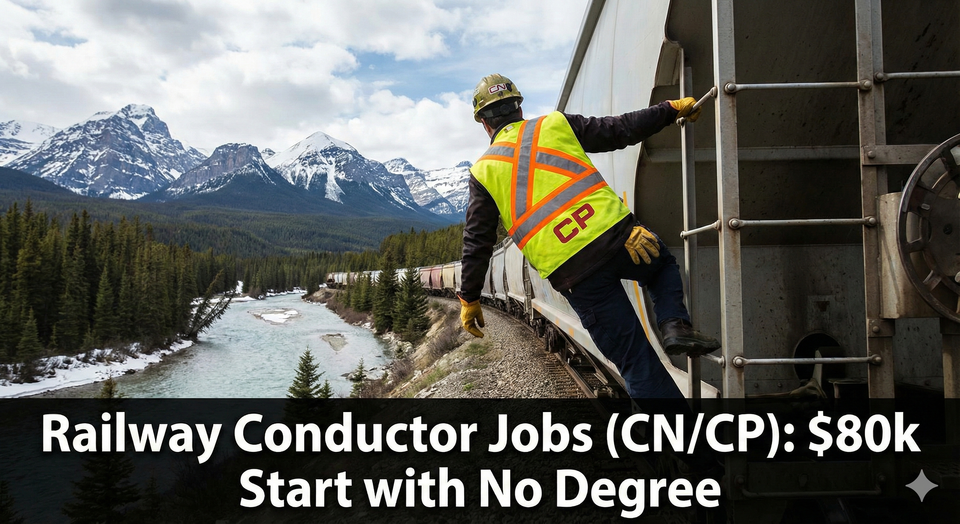
It is the highest-paying job in Canada that doesn't require a university degree. It offers a full pension, paid training, and a starting salary that beats most engineers.
The Train Conductor.
But before you apply to CN (Canadian National) or CPKC (Canadian Pacific Kansas City), you need to know the truth. This isn't just a job; it's a lifestyle. You are not driving the train (that's the Engineer). You are the ground crew—building the train, switching cars in -30°C weather, and managing the cargo.
In 2026, the railways are desperate for people. But they don't hide the fact that the schedule is brutal. If you can handle being "on call" 24/7/365, you can retire a millionaire.
If you are a newcomer looking for a career or just want big money fast, here is the definitive guide to the railway life.
1. The "Big Two" Employers (And Who Pays More)
There are two main Class 1 railways in Canada. You will likely apply to both.
CN (Canadian National)
- The Reputation: "The Money Machine." CN typically pays higher daily rates than CPKC.
- Training Pay: Approx. $180 – $236 per day during training.
- First Year Potential: $85,000 – $100,000+ (if you chase miles).
- The Vibe: Modern equipment (tablets instead of paper binders), strict rules, fast-paced.
CPKC (Formerly CP Rail)
- The Reputation: "The Pension King." While daily pay might be slightly lower, their Defined Benefit pension is legendary.
- Training Pay: Approx. $211 per day (flat rate).
- First Year Potential: $75,000 – $85,000.
- The Vibe: Traditional. Known for being harder on new hires during probation.
2. The "Campus" in Winnipeg
If you get hired by CN, you don't start at your home terminal. You go to Winnipeg.
- The Deal: CN flies you to their massive training campus in Winnipeg for 7 weeks.
- The Cost: Free. They pay for your flight, your hotel (or dorm), and give you a food allowance (approx. $40–$50/day).
- The Pay: You are paid a "Training Rate" (approx. $1,200/week) just to sit in class and learn signals.
- Street Tip: Treat this like a 7-week job interview. If you are late for class or fail a drug test at the hotel, you are on the next flight home.
3. The "Spare board" Reality (The Schedule)
This is why people quit.
When you graduate, you don't get a "Monday to Friday" schedule. You go on the Spareboard.
- How it works: You are on a list. When a train is ready, they call the top name.
- The Call: You have 2 hours to get to the station. This call can come at 2:00 AM on Christmas or 4:00 PM on your birthday.
- The Life: You live by the phone. You cannot drink a beer if you are near the top of the board. You might work 3 days in a row, then sit at home for 2 days.
Comparison Table: Conductor vs. Engineer
| Feature | Conductor (You start here) | Engineer (Promotion) |
| Role | Ground crew, switching cars | Driving the locomotive |
| Physicality | High (Walking on ballast) | Low (Sitting) |
| Pay (Avg) | $85k - $110k | $120k - $150k |
| Training | 4-6 Months | +2-3 Years Experience |
| Cold Factor | You are outside in -30°C | You are in a heated cab |
Practical Questions Answered
"Is it hard on your body?"
Yes.
Walking on "ballast" (the sharp rocks under the tracks) destroys your knees and ankles.
- The Fix: Buy high-quality boots with ankle support (Red Wing or Dunlop). Do not cheap out on footwear.
"Do I need to be good at math?"
Basic math, yes.
You need to calculate "tonnage" and train length. If your train is 10,000 feet long and you have a 6,000-foot siding, you need to know you won't fit. It's simple addition/subtraction, but you must be accurate.
"Will I get laid off?"
Likely.
Railways are seasonal. When grain or oil shipments slow down, they lay off the junior conductors.
- The Silver Lining: You collect EI (Employment Insurance) during the layoff. When traffic picks up, they call you back. Many railroaders treat layoffs as a mini-vacation.
Frequently Asked Questions
What are the requirements to be a train conductor?
You need a High School Diploma (GED), a valid Driver's License, and the ability to pass a strict medical and drug test. You must also be physically fit (able to lift 80lbs) and be willing to work outdoors in all weather conditions.
Does CN or CPKC pay for relocation?
Sometimes. If you apply for a "Hard to Fill" location (like Prince George, BC or Horne Payne, ON), they often offer a $5,000 – $10,000 signing bonus and relocation assistance. Major hubs like Toronto or Vancouver rarely offer this.
How long until I become an Engineer?
It depends on seniority and demand. In a busy terminal, you might get sent to Engineer Training in 2–3 years. In a slow terminal, you might be a Conductor for 10 years. Engineers make significantly more money but have even more responsibility.
Is it a union job?
Yes. Both CN and CPKC conductors are represented by the Teamsters Canada Rail Conference (TCRC). This means you have strong job protection, grievance procedures, and collective bargaining power for wages.
About the author
Jeff Calixte (MC Yow-Z) is a Canadian career researcher and digital entrepreneur who studies hiring trends, labour market data, and real entry-level opportunities across Canada. He specializes in simplifying the job search for newcomers, students, and workers using practical, up-to-date information.
Sources
- CN Railway Careers (Conductor): https://www.cn.ca/en/careers/
- CPKC Careers (Operations): https://careers.cpr.ca/go/ConductorsOperationsTransportation/2565717/
- Teamsters Canada Rail Conference: http://www.teamstersrail.ca/
Note:
Job availability, wages, and hiring conditions can vary widely by province, employer, season, and experience level. All salary ranges and job examples in this guide are estimates based on current labour market data. Always confirm details directly with the employer before applying.