
Security Guard "Use of Force" Certificate: Is the $300 Course Worth the Raise?
If you just got your Ontario Security Guard License, you are probably working what the industry calls a "Warm Body" site.
You sit in a condo lobby, sign for Amazon packages, look at a camera monitor, and make $17.50/hour.
t’s easy money, but it’s poverty wages. You can’t pay rent in Toronto on $17.50 an hour. If you are tired of making $17/hr standing in a lobby, you can also look into Traffic Control Tech Jobs which pay up to $35/hr for night shifts.
You want to make more money. You see ads for "Use of Force Training" (Handcuffing & Baton) for $300.
The question is: Is it worth it?
The short answer is Yes, but only if you are willing to leave your comfortable condo chair.
If you stay at the condo, that certificate is useless wallpaper. If you switch to Hospitals, Malls, or Loss Prevention, that certificate is the key to unlocking $22.00 - $32.00/hour.
This guide is not a sales pitch for a training school. It is a financial and legal breakdown of the "Use of Force" upsell. We analyze the math, the strict laws you must follow (O. Reg 463/07), and why the "Online Only" courses are a complete scam that will get you blacklisted.
Looking for other ways to boost your income? Check out our guides on Traffic Control Tech Jobs ($35/hr) or Forklift Certification.
1. The Math: Does the Raise Cover the Cost?
Before you drop $300, you need to know the Return on Investment (ROI). Let's look at the real 2026 numbers.
The Investment
- Course Cost: ~$300 (One-time fee).
- Equipment: ~$150 (Duty belt, handcuffs, baton holder).
- Total Start-up Cost: $450.
The Wage Jump
- Basic Guard (No Cuffs): $17.20 (Minimum Wage) - $18.50/hr.
- Tactical Guard (Cuffs/Baton): $22.00 - $28.00/hr.
The Break-Even Point
Let's assume you get a modest raise of $4.00/hour by switching from a Condo to a Hospital.
- $4.00 x 40 hours = **$160 extra per week.**
- $450 Cost / $160 Income = 2.8 Weeks.
The Verdict: You will pay off the entire course in less than three weeks of work. After that, the extra $6,000 - $8,000 a year is pure profit. Unlike university degrees that take 10 years to pay off, this is one of the fastest ROIs in the Canadian job market.
2. The "Online Course" Scam (Don't Get Tricked)
This is the most dangerous trap for new guards in 2026.
You will see websites offering "Use of Force Theory - 100% Online for $99."
Do NOT buy this.
In Canada, "Use of Force" is not just about knowing the law; it is about physical competency.
- The Insurance Problem: Security companies (like Paladin, Garda, Paragon) have liability insurance. Their insurance provider dictates that no guard can carry weapons (batons) unless they have been physically tested by a certified instructor.
- The "Practical Skills" Requirement: Employers need to see a "PSD" (Practical Skills Demonstration) signed off by an instructor. They need to know you can put handcuffs on a struggling person without breaking their wrist.
- The Result: If you show up to an interview at a hospital with an "Online Certificate," they will view you as uninsurable. You will not get the job. This is the same trap as the Forklift Certification scams we exposed—employers will not hire you if you haven't physically touched the equipment.
Rule of Thumb: If you don't sweat during the class, the certificate is fake.
3. The Curriculum: What Actually Happens in the Course?
"Use of Force" training is physically demanding. It is usually a 2-Day Course (16 hours). Here is exactly what you will be doing, hour by hour.
Day 1: Theory & Legal Authority
You spend the first day in a classroom learning why you shouldn't hit people.
- The National Use of Force Framework: A colour-coded wheel that helps you decide how much force to use.
- Example: If a subject is just standing there (Passive Resistant), you cannot hit them with a baton. You can only use "Soft Empty Hand" techniques.
- Positional Asphyxia: Learning how not to kill someone. You will learn why sitting on someone's chest while they are face down can stop their heart, and how to avoid it.
- Excited Delirium: Recognizing signs of drug overdose or mental health crisis where the subject feels no pain and has "superhuman" strength.
Day 2: Practical Gym Work (The Fun Part)
Wear sweatpants. You will be throwing people around.
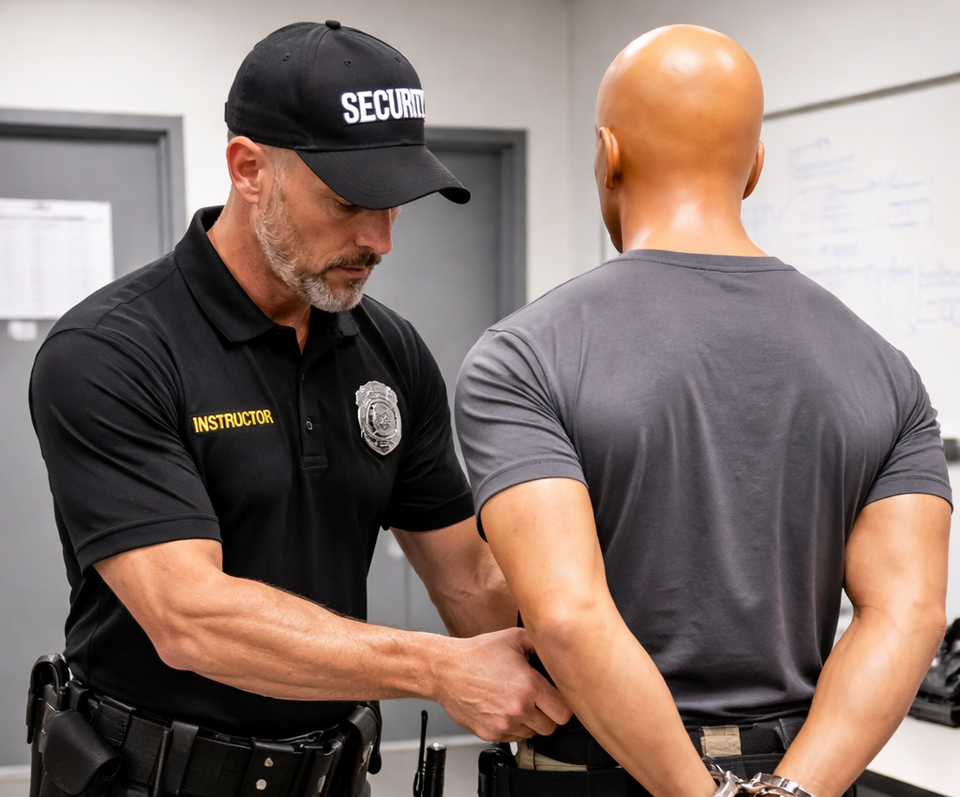
- Passive Handcuffing: How to cuff a compliant person who is listening to you.
- Active Resister Drills: Your partner will try to pull away, and you have to use leverage (joint locks) to get the cuffs on.
- Baton Strikes: You will hit pads. You learn the "Green Zones" (Arms and Legs) where you are allowed to strike to cause "Motor Dysfunction" (a charley horse).
- The "Red Zones": You are strictly taught never to hit the Head, Neck, Spine, or Groin unless it is a "Lethal Force" situation (i.e., they have a knife).
- Takedowns: Standard police-style takedowns (like the "Arm Bar") to get a standing person onto the floor safely.
4. Legal Authority: The "Heavy" Stuff (Criminal Code)
The difference between a "Guard" and a "Thug" is knowing the law.
In your interview, the manager will ask you about these sections. Memorize them.
Section 494: Citizen’s Arrest
As a security guard, you are not a police officer. You have the exact same powers as a regular citizen.
- 494(1): You can arrest anyone you find "Committing an Indictable Offence" (serious crimes like theft over $5,000, assault, breaking and entering).
- 494(2): You can arrest anyone committing a crime "On or in relation to your property" (this is your bread and butter—shoplifting, trespassing, vandalism).
- The Golden Rule: You must catch them "Finds Committing" (in the act). If someone tells you "He stole that yesterday," you cannot arrest them. Call the police.
Section 25: Protection of Persons Administering the Law
This is your shield.
- It states that if you are authorized to enforce the law (make an arrest), you are "Justified" in using as much force as is necessary for that purpose.
- Key Word: "Necessary." If you punch a shoplifter who has already surrendered, that force was not necessary, and you lose the protection of Section 25. You go to jail for assault.
Section 26: Excessive Force
- This section states that anyone who is authorized to use force is criminally responsible for any excess thereof.
- Translation: If you use too much force, you are liable. There is no immunity for security guards.
5. Where the Money Is: Top 3 "Use of Force" Jobs
Once you have the ticket, stop applying to condos. Change your search filters on Indeed to these three keywords.
1. Hospital Security (The "Gold Mine")
- The Job: This is the closest you will get to police work. You are restraining aggressive patients in the ER, protecting nurses from violent visitors, and responding to "Code Whites" (Violent Person).
- The Pay: $25.00 - $32.00/hour.
- Why it pays well: High stress, high risk of injury, and requires excellent verbal de-escalation skills.
- Top Employers: Paladin Security (dominates healthcare in Canada), Commissionaires, or "In-House" (where you work directly for the hospital union—these are the best jobs).
2. Loss Prevention Officer (LPO)
- The Job: Undercover shopper. You wear plain clothes and walk around Walmart, Sephora, or Loblaws pretending to shop. Your goal is to catch shoplifters.
- The Pay: $21.00 - $26.00/hour.
- The Reality: You need to be fast. You will be wrestling people over a stolen Xbox or specialized makeup. If you are afraid of confrontation, do not apply.
- The metric: You are often judged on your "Apprehensions" (how many people you catch).
3. Mobile Patrol (Alarm Response)
- The Job: You drive a marked car. When an alarm goes off at a warehouse at 3:00 AM, you are the first responder. You check the doors, clear the building, and call the police if you find a break-in.
- The Pay: $20.00 - $24.00/hour.
- The Perk: You are independent. No boss breathing down your neck. You listen to podcasts and drive.
- Requirement: You need a clean G License and a clean abstract (no speeding tickets).
6. The Gear Guide: What Do You Need to Buy?
Most higher-end companies will issue you a vest, but they expect you to own your "Belt Kit." Do not buy cheap Amazon toys; they will break when you need them.
| Item | Brand Recommendation | Approx Cost | Notes |
| Duty Belt | Uncle Mike's / Bianchi | $40 - $60 | Get a stiff "Inner/Outer" belt system with keepers. |
| Handcuffs | Smith & Wesson / Peerless | $40 - $60 | Must be "NIJ Certified." Do not buy "novelty" cuffs. |
| Cuff Key | Zak Tool | $10 | Get a long "swivel" key. The tiny key that comes with the cuffs is useless under stress. |
| Baton | ASP / Monadnock | $150+ | Wait! Only buy this if your employer tells you to. Many sites allow cuffs but ban batons. |
| Boots | 5.11 / Under Armour | $150+ | You will be on your feet for 12 hours. Do not cheap out on boots. |
Tax Tip: Keep every receipt. As we explain in our Gig Worker Tax Guide, these are 100% tax-deductible as "Employment Expenses" on your tax return (Form T777), provided your employer signs a T2200 form stating you were required to buy them.
7. The "One Year" Expiry Rule (The Hidden Cost)
Here is the catch nobody tells you: Use of Force expires every 12 months.
Unlike your Security License (which lasts 2 years), your authority to carry a baton is regulated by liability standards and the Private Security and Investigative Services Act.
- The Standard: Most insurers follow the "Police Standard," which mandates annual requalification.
- The Risk: If you use force on someone with an expired certificate, the insurance company will deny the claim. You will be personally sued.
- The Cost: You have to pay ~$100 - $150 every year to "Recertify" (usually a 1-day refresher course). Factor this annual cost into your budget.
8. Interview Strategy: How to Sell It
When you interview for a Tactical Guard position, the manager doesn't care if you know how to punch. They care if you know when to stop.
Common Question: "Tell me about a time you had to deal with an aggressive person."
The "Fail" Answer: "I told him to calm down, he didn't, so I took him down and cuffed him." (You just failed. Too much liability).
The "Winning" Answer (STAR Method):
"I was working at a condo and a guest was shouting at the concierge. I approached with a calm, non-threatening stance (Step and Slide). I used verbal de-escalation, asking him to explain the problem. I offered him two options: leave voluntarily or wait for the police. He chose to leave. I believe force is always the last resort, and my goal is voluntary compliance."
Why this wins: It shows you are safe, smart, and you protect the company from lawsuits.
9. Where to Get Trained (and Hired): Featured Provider
Don't just pay a random school. Pay a company that is actually hiring.
Maximum Security (Toronto & GTA)
If you are in the Greater Toronto Area, we recommend Maximum Security. Unlike generic "diploma mills," Maximum Security is a fully operational security agency that has been protecting Ontario for over 15 years.
- Why they are different: They don't just teach; they employ. They currently have a team of ~125 licensed guards and private investigators across the province.
- The "One-Stop" Shop: They offer the Ministry-approved 40-Hour Security Guard Course, First Aid/CPR, and "Use of Force" training all in one place.
- Credibility: They are a member of ASIS (American Society for Industrial Security) and fully bonded under the Private Security and Investigative Services Act, 2005.
The Strategy: Instead of getting your license at a random mall kiosk, get it here. By training directly with an active employer, you put your resume on the top of the pile before you even finish the course.
👉 Check them out here: Maximum Security Services
Frequently Asked Questions
Can I carry a baton without the course?
Absolutely not.
Carrying a baton (an "offensive weapon") without a valid certificate and specific employer authorization is a Criminal Offence (Possession of a Weapon for a Dangerous Purpose). You can be arrested, charged, and banned from the industry for life.
Can I use "Zip Ties" instead of handcuffs?
No.
Plastic "Flex Cuffs" are dangerous if you aren't trained on them. They can cut off circulation and cause nerve damage. Stick to the standard issue steel handcuffs you were trained on.
Does this help me become a Police Officer?
Yes.
Having "Use of Force" on your resume shows police recruiters that you understand the legal framework of arrest. Working as a Hospital Guard or LPO is considered "Relevant Experience" for police applications, whereas working as a condo concierge is not.
Can I carry Pepper Spray (OC Spray)?
No.
In Canada, it is illegal for security guards to carry Pepper Spray or Tasers. Only Police and Special Constables (Peace Officers) can carry these intermediate weapons. If you are caught with pepper spray on duty, you will be fired and charged.
Summary: Upgrade or Stay Broke
The security industry in 2026 is split into two worlds:
- The "Observer": Minimum wage, bored, replaceable.
- The "Professional": $25+/hr, skilled, respected.
The only difference between them is a $300 course and a pair of handcuffs.
Your Action Plan:
- Do the Math: If you plan to be a guard for more than 6 months, the course pays for itself.
- Go In-Person: Avoid the online scams. Go to a reputable school like Herbert Williams, Paragon, or GardaWorld Campus.
- Target Hospitals: That is where the real money and experience are. (If the security market is slow in your city, consider getting your DZ license to tap into Snow Plow Operator pay during the winter months).
Not sure if Security is right for you? Browse 200+ other career paths in our Ultimate Canadian Job Search Directory (2026)
About the author
Jeff Calixte (MC Yow-Z) is a Canadian career researcher and digital entrepreneur who studies hiring trends, labour market data, and real entry-level opportunities across Canada. He specializes in simplifying the job search for newcomers, students, and workers using practical, up-to-date information.
Sources
- Government of Ontario: Regulation 463/07 (Training and Testing). https://www.ontario.ca/laws/regulation/070463
- Criminal Code of Canada: Section 494 (Arrest without warrant). https://laws-lois.justice.gc.ca/
- Paladin Security: Careers & Training FAQ. https://paladinsecurity.com/
Note
Job availability, wages, and hiring conditions can vary widely by province, employer, season, and experience level. All salary ranges and job examples in this guide are estimates based on current labour market data. Always confirm details directly with the employer before applying.