
Septic Tank Pumper: The $35/hr "Dirty Job" No One Wants (2026 Guide)
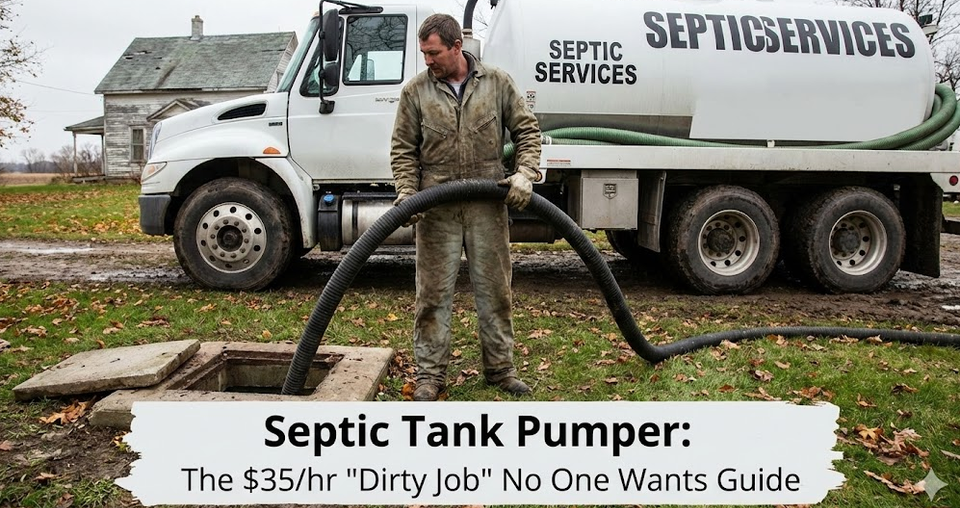
If you tell your friends you drive a "Honey Wagon" for a living, they might laugh.
Until you tell them you made $85,000 last year working solo with zero micromanagement.
Septic Tank Pumping (or Vacuum Truck Operation) is the definition of a "Dirty Job."
It involves driving a massive tanker truck to rural homes, dragging a heavy hose across a lawn, and sucking out 1,000 gallons of raw sewage.
Most people gag at the thought. That is exactly why it pays so well.
In 2026, as skilled trades shortages hit crisis levels, septic companies are desperate for reliable drivers.
The pay has climbed to $30 - $38 per hour for experienced operators, with overtime often pushing annual incomes over the six-figure mark.
This guide explores the reality of the "Poop Truck," the licensing requirements (Class 3/D), the biological hazards nobody talks about, and why the smell of sewage eventually just smells like money.
Prefer a cleaner cab? Check out First Student Bus Driving for part-time work or Class 3 / D License for other trucking options.
The Pay: Why It Beats General Freight
Unlike hauling cardboard boxes for Amazon, hauling hazardous waste commands a premium.
1. Hourly Rates (Employee)
- Rookie (0-1 Year): $24.00 - $28.00/hour.
- Experienced (2+ Years): $30.00 - $38.00/hour.
- Overtime: Extremely common. Septic emergencies happen on weekends and holidays.
- Christmas Day Emergency Rate: Often Double Time ($70/hr).
2. The "Owner-Operator" Potential
- This is where the real money is.
- The Math:
- Charge per pump: $400 - $600 (for a standard 1,000-gallon tank).
- Disposal fee (at the waste plant): ~$80 - $120.
- Fuel/Insurance: ~$50.
- Profit per job: ~$300.
- Daily Volume: If you do 4 pumps a day, you can net $1,200/day.
- Barrier to Entry: A used vacuum truck costs $80,000+.
The Job Description: It’s Not Just Driving
You are not just a steering wheel holder. You are a labourer, a detective, and a chemist.
1. The Detective Work (Finding the Lid)
- The Problem: Homeowners never know where their tank is.
- The Job: You walk the lawn with a metal probe (a long stick), poking the ground until you hear a thud.
- The Dig: You have to dig up the lid with a shovel. In the summer, it's sweaty. In the winter, the ground is frozen solid.
2. The "Crust Buster" (The Gross Part)
- Septic tanks have three layers: Scum (Top), Liquid (Middle), Sludge (Bottom).
- Sometimes the top layer hardens into a "Crust."
- The Tool: You use a "Crust Buster" (a giant mixer on a pole) or the high-pressure hose to break it up so the vacuum can suck it out.
- The Risk: Splashback. Keep your mouth closed.
3. The Drag
- A 3-inch rubber vacuum hose filled with sludge weighs 5 lbs per foot.
- Dragging 100 feet of hose across a manicured lawn without destroying the customer's flower bed requires serious strength.
Deep Dive: The License (Class 3 / DZ)
You cannot drive a vacuum truck with a standard car license.
The truck is heavy (often 20,000 kg when full) and has air brakes.
Requirements
- Ontario: Class DZ (D for heavy truck, Z for Air Brakes).
- BC/Alberta: Class 3 (with Air Brake Q endorsement).
- Cost: $1,500 - $2,500 for the course.
- Internal Link: Read our full guide on How to Upgrade to a Class 3 / D License to see the step-by-step process.
Deep Dive: Grease Traps & Tech Hacks (Extra 700 Words)
1. The "Liquid Gold" Niche: Grease Trap Cleaning
- While residential septic is consistent, Restaurant Grease Traps are the holy grail of recurring revenue.
- What is it? Every restaurant has a "Trap" under the sink or in the ground to catch cooking oil. If they don't pump it, the city fines them.
- The Contract: Restaurants need this done Monthly.
- The Pay:
- Rate: $250 - $400 per visit (takes 45 minutes).
- The Volume: If you get a contract with a chain (like McDonald's or Tim Hortons), you can hit 10 stops in a night.
- The Smell: It smells worse than sewage. It smells like rotten eggs and rancid bacon. But the "route density" (10 stops in 10 km) makes it more profitable than driving 30 km between farmhouses.
2. Tech Hack: The "Flushable Transmitter"
- How do you find a tank if the homeowner has no clue where it is?
- Old Way: Poking the ground with a stick for 2 hours.
- New Way: The 512 Hz Flushable Sonde.
- The Process:
- You drop a green "egg" (transmitter) into the toilet and flush it.
- You walk outside with a wand receiver (like a metal detector).
- The wand beeps exactly where the egg stops (in the tank).
- You dig one hole. Done.
- The Upsell: You charge $150 extra for a "Locate Fee." The egg costs $300, so it pays for itself in two jobs.
3. The "Real Estate Inspection" Side Hustle
- When someone buys a rural house, the bank often requires a Septic Inspection.
- The Job: You pump the tank, inspect the baffles (inlet/outlet tees), and run a camera down the weeping tile.
- The Pay: $600 - $800 per inspection.
- The Certification: In Ontario, you need a BCIN (Building Code Identification Number). In BC, you need to be an ROWP (Registered Onsite Wastewater Practitioner).
- Why do it: It is less labor-intensive than pumping. You are paid for your expertise, not just your back.
4. Winter "Steaming" Services
- In January, septic pipes freeze. A vacuum truck cannot suck ice.
- The Add-On: You equip your truck with a "Hot Jenny" (Industrial Steamer).
- The Process: You feed a steam hose down the pipe to melt the "ice plug."
- The Rate: $300 - $500 per hour.
- The Demand: When it hits -30°C, your phone will not stop ringing. It is emergency work, similar to Night Shift Warehouse workers who get surge pay during peaks.
5. Hydro Excavation (The Career Pivot)
- If you have 2 years of Septic experience, you are qualified for Hydro Vac.
- The difference: Instead of sucking poop, you are sucking mud to expose gas lines for construction crews.
- The Pay: $40 - $48/hour.
- Why switch: It is cleaner. You are working on construction sites (Union hours) rather than residential backyards.
- Link: This uses the same Class 3 / D License mentioned in our Bin Rental Driver guide.
6. "back flushing" (The Secret Technique)
- Sometimes the sludge at the bottom of the tank is too thick to suck up.
- The Rookie Mistake: Leaving it there. (The customer will call back in 6 months complaining).
- The Pro Move: "Back Flushing."
- You suck up the liquid, then reverse the pump to blast the liquid back into the tank at high pressure.
- This acts like a blender, mixing the sludge into a slurry you can suck out.
- Warning: Make sure the hose is secured, or it will whip around like a firehose of sewage.
7. Start-Up Costs: New vs. Used
- Thinking of buying your own truck?
- New Truck: $250,000+. (Peterbilt with a 4,000-gallon aluminum tank).
- Used Truck: $60,000 - $90,000.
- The Hidden Cost: The Pump. A new "Fruitland" vacuum pump costs $8,000. If you buy a used truck, check the pump first. If the pump fails, you are out of business. Just like the 'Bazooka' investment for Drywall Tapers, the Vacuum Pump is the heart of your business.
8. "Bio-Solids" Field Spreading
- Where does the poop go?
- Option A: Sewage Treatment Plant (Expensive dumping fees).
- Option B: Land Application.
- The Business: Farmers will sometimes pay you (or take it for free) to spread the waste on their fields as fertilizer (if certified).
- The Regulation: Extremely strict environmental rules. But if you get a "Spreading Field" permit, you eliminate your dumping costs, doubling your profit margins.
9. Female Drivers (The "Unicorn" Advantage)
- The industry is 99% male, but female drivers are crushing it.
- Why: Homeowners (especially women home alone) often feel more comfortable opening the door for a female operator.
- The Trust Factor: Companies report that female drivers get higher "Customer Satisfaction" scores and more tips.
- Physicality: With modern hydraulics and aluminum hoses, you don't need to be a bodybuilder. It's about leverage, not brute force.
Practical Questions Answered
Find the unvarnished truth.
"Do you get poop on you?"
Rarely, but yes.
- The "Glove" Rule: You wear heavy PVC gloves. You never touch your face.
- The "Mist": When the vacuum pump exhausts air, it can smell. Sometimes, if a connection leaks, you get a "spray."
- Shower Protocol: You shower immediately when you get home. Do not hug your kids until you are scrubbed.
"Is it dangerous?"
Yes. Methane Gas.
- The Rule: NEVER stick your head into the tank to check the level.
- Why: Hydrogen Sulfide (H2S) and Methane gas can knock you unconscious in seconds. If you fall in, you die.
- Safety: Always carry a gas monitor if working near the opening for long periods.
"Do you get used to the smell?"
Yes.
- Experienced pumpers say: "It smells like money."
- After 2 weeks, your brain filters it out. You can eat a sandwich in the cab 5 minutes after a job.
The "Blue Pill" & Safety Chemicals
Septic tanks are living biomes.
- The Upsell: Drivers often earn commission by selling "Septic Additives" (Bio-Packs).
- What are they? Bacteria packets that help break down solids.
- Commission: You might make $10 extra for every box you sell. It adds up to an extra $100/week.
Portable Toilets (Porta-Potties)
- Many septic companies also rent portable toilets.
- The Job: You drive a smaller truck. You pump out the blue water, scrub the plastic walls, and refill the blue liquid.
- The Vibe: This is arguably grosser than septic pumping because you are eye-level with the mess.
- The Pay: usually slightly lower ($22 - $26/hour) than the big tanker drivers.
Winter Pumping (The Frozen Nightmare)
In Canada, septic tanks don't stop working in January.
- The Challenge: The lid is buried under 3 feet of snow and 6 inches of frozen soil.
- The Tools: You need a Pickaxe and a Tiger Torch (Propane torch) to thaw the ground.
- The Hose: Rubber hoses freeze stiff in -20°C. Coiling them back onto the truck is like wrestling a frozen anaconda.
- The Payoff: Companies often charge a "Winter Surcharge" ($50 extra), which sometimes goes to the driver.
Frequently Asked Questions
Do I need a TDG (Transportation of Dangerous Goods) certificate?
Usually No.
- Residential sewage is not typically classified as "Dangerous Goods" in the same way gasoline is.
- However, most reputable companies will train you in TDG anyway just to be safe.
Is the work seasonal?
No.
- People flush toilets 365 days a year.
- Unlike Asphalt Paving or Landscaping, you never get laid off in winter. It is 100% recession-proof.
Can I do this part-time?
Yes.
- Weekend warriors are in high demand.
- If you have a Mon-Fri job, you can make $400/Saturday helping a local company clear their backlog.
Summary: A Career with No Competition
- Get the License: Invest in your Class 3/D. It is the golden ticket.
- Stomach Check: If you vomit easily, do not apply.
- Learn the Upsell: Selling bacteria packs and riser installations can boost your income by 20%.
- Buy Good Boots: Get waterproof, chemical-resistant rubber boots. Leather will absorb the smell forever.
About the author
Jeff Calixte (MC Yow-Z) is a Canadian career researcher and digital entrepreneur who studies hiring trends, labour market data, and real entry-level opportunities across Canada. He specializes in simplifying the job search for newcomers, students, and workers using practical, up-to-date information.
Sources
- OASIS (Ontario Association of Sewage Industry Services): Industry best practices and licensing. https://oasisontario.on.ca/
- ZipRecruiter: Vacuum Truck Operator Salaries Alberta 2026. https://www.ziprecruiter.com/
- WorkSafeBC: Hydrogen Sulfide safety protocols. https://www.worksafebc.com/
Note
Job availability, wages, and hiring conditions can vary widely by province, employer, season, and experience level. All salary ranges and job examples in this guide are estimates based on current labour market data. Always confirm details directly with the employer before applying.