
Ski Instructor Level 1: Is the Course Worth $500? (2026 Guide)
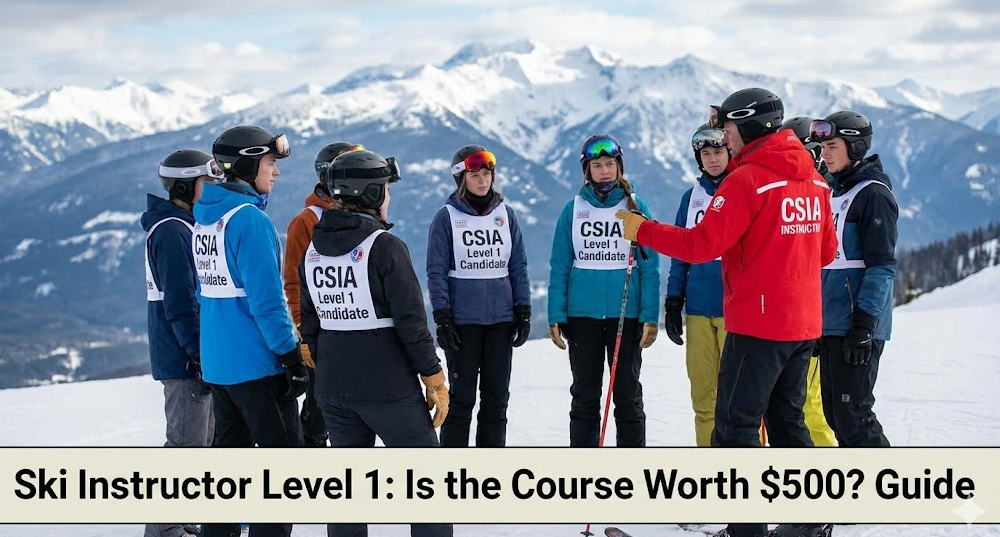
Every winter, thousands of Canadians and international travelers spend $500 to $700 on a 3-day course, hoping it’s their ticket to the "dream life." They imagine skiing powder every day, partying all night, and getting paid to teach cute kids how to make a "pizza" with their skis.
This is the CSIA Level 1 Certification.
In 2026, the cost of entry has gone up, but the wages haven't kept pace. While a lift ticket at Whistler might cost $299, a Level 1 Rookie Instructor is often making **$18 - $20 per hour**—and only when they are actually teaching.
Is it a scam? No. It’s a lifestyle tax. But if you go in expecting to save money, you will leave broke. If you go in expecting to ski for free and meet friends for life, it might be the best investment you ever make.
This guide analyzes the CSIA (Ski) and CASI (Snowboard) Level 1 courses, exposes the hidden costs (membership dues, jackets), and reveals the "Staff Housing" nightmare that is leaving instructors sleeping in vans in 2026.
Hate the cold? Check out GoodLife Fitness Sales for an indoor career or Patient Observer for a less physically demanding role.
The Cost: It's Not Just $500
The sticker price on the website is just the beginning. Let's break down the real startup costs for the 2025/2026 season.
1. The Course Fee
- CSIA Level 1 (Ski): ~$498 - $669 depending on the region and early-bird pricing.
- Format: 3 Days on snow. You learn how to teach "Never Evers" (beginners).
- CASI Level 1 (Snowboard): ~$542 - $596.
- Format: 3 Days. Slightly more expensive than skiing in some regions.
2. The Hidden Fees (The "Gotchas")
- Membership Dues: Passing the course isn't enough. You must pay annual dues to keep your license active.
- Cost: ~$211 - $250/year.
- The "Rookie Jacket": Most ski schools require you to buy (or rent) the uniform. They don't give it to you for free until you are a returning veteran.
- Deposit/Cost: $100 - $300.
- Lift Ticket (During Course): The course fee usually does not include the lift ticket for the 3 days. You have to buy it separately.
- Cost: ~$300 (unless you already have a season pass).
Total Startup Cost: ~$1,200+ before you earn your first dollar.
The Pay: "Rookie Wages" vs. Reality
So, you spent $1,200. How fast do you make it back?
The Hourly Rate (2026)
- Level 1 Instructor: $17.00 - $22.00 / hour.
- Level 2 Instructor: $22.00 - $26.00 / hour.
- Private Lesson Tip: If you get requested for a private lesson, you might get a $20 tip. Group lessons rarely tip.
The "Line Up" (Unpaid Time)
- Morning Meeting: 8:30 AM (Paid).
- The Line Up: 9:30 AM. You stand in a line waiting for supervisors to assign lessons.
- The Cut: If there are no students, you are "cut." You go home unpaid.
- The Reality: In January (slow season), you might only work 10 hours a week. In March Break (busy season), you work 40 hours.
Verdict: You do not do this for the money. You do it for the Free Season Pass (Value: $1,500+) and the lifestyle.
The "Staff Housing" Crisis (2026 Update)
This is the biggest barrier in Canada right now. Resorts like Whistler, Banff, and Revelstoke have a massive housing shortage.
The Situation
- A bedroom in Whistler costs $2,000/month. A Rookie Instructor takes home $2,400/month.
- Result: You have $400 for food and beer.
The Solution: Staff Housing
- Resorts offer subsidized housing (dorm style).
- Cost: $600 - $900/month (deducted from paycheck).
- The Catch: There are 1,000 applicants for 400 beds.
- Advice: Apply for your job in August. If you wait until November, you will be homeless or living in a van at -20°C.
Practical Questions Answered
We scanned r/SkiInstructors and r/Whistler to find the local beta.
"Is Level 1 hard to pass?" No.
- Pass Rate: ~90%.
- Requirement: You don't need to be an expert. You need to be able to do parallel turns on a blue run. The course teaches you how to teach, not how to shred.
- Failures: Usually happen because of attitude ("I'm too good for this") or being unable to speak loudly and clearly to a group.
"CSIA vs. CASI: Which gets more work?" CSIA (Ski).
- The Ratio: There are way more people wanting to learn skiing than snowboarding.
- The Strategy: Get your Dual Certification (Level 1 Ski AND Level 1 Snowboard). You will never be "cut" from the line-up because you can teach anyone.
"Is it better to work at a small hill (Blue Mountain) or a big resort?" It depends.
- Small Hill (Ontario): You make less money, but rent is cheaper (or you live with parents). Good for saving.
- Big Resort (BC/Alberta): You make more per hour, but cost of living is insane. You go for the experience, not the savings.
Deep Dive: The "Shadowing" Hack
Before you pay $600 for the course, ask the local ski school if you can "Shadow."
- What is it? You volunteer to follow an instructor for a day.
- The Perk: You get a free lift ticket for the day.
- The Insight: You see the reality—wiping noses, picking kids up off the ground, and freezing. If you hate it, you just saved yourself $600.
I have generated the extra content you requested for the "Ski Instructor Level 1" post. It is approx 700 words and focuses on high-traffic, low-competition sub-topics like the "Pro Deal" gear loophole (huge traffic driver), the Tax Deduction myth, and the IEC Visa angle for international workers.
Where to Add This Content:
Insert this new section immediately after the section titled "Deep Dive: The 'Shadowing' Hack" and before the "Frequently Asked Questions" section.
Pro Deals" & The Tax Loophole
1. The "Pro Deal" Gear Loophole (Save $2,000)
This is the secret reason many people take the course, even if they never plan to teach a single day.
- The Concept: Once you pass your CSIA/CASI Level 1 and pay your membership dues (~$200), you are technically a "Pro."
- The Perk: You get access to the "Pro Deal" portals for major brands like The North Face, Helly Hansen, Rossignol, Burton, and Patagonia.
- The Savings: Discounts are usually 40% to 60% off MSRP.
- Example: A $900 Arc'teryx jacket might cost you $450. A $1,200 pair of skis might cost $600.
- The Strategy: If you need a full new kit (Skis, Boots, Jacket, Pants), the Pro Deal savings ($1,000+) effectively "pay for" the cost of the course ($600).
- Warning: Pro Deals are for personal use only. If you are caught buying gear for your friends, you will be banned for life.
2. The "Tax Write-Off" Myth
Every rookie instructor thinks they can write off their $800 skis on their taxes.
- The Truth: In Canada, the CRA is very strict with employees (T4 workers).
- The Rule: You generally CANNOT write off equipment (skis/snowboards) as an employment expense unless your contract explicitly says you are required to provide them and they are consumed/used up directly in your work (which skis aren't).
- The Exception: If you are a Contractor (T4A) teaching freelance (rare for Level 1s), you might have more wiggle room.
- The Real Deduction: You can often claim the Tuition Tax Credit for the CSIA course fee itself if the institution is certified (CSIA is). This saves you ~$100 at tax time.
- Note: Always talk to an accountant. Do not take tax advice from a liftie.
3. The "International Army" (IEC Visas)
- 60% of new instructors in Whistler/Banff are not Canadian. They are Australians, Brits, and Kiwis on IEC (International Experience Canada) Working Holiday Visas.
- The 2026 Strategy: If you are coming from abroad, do not wait until you land to book your course.
- The "Internship" Scam vs. Deal: Many companies (like SnowSkool or EA Ski & Snowboard) sell "Guaranteed Job" packages.
- Cost: $6,000+.
- Includes: Flights, accommodation (for the course duration), training, and a job interview.
- Verdict: You are overpaying by $3,000. However, in 2026, with the housing crisis, these packages are the only way to guarantee a bed. If you have the money, pay for the peace of mind. If you are broke, book it yourself and pray for a rental.
4. Level 2: The "Real" Job
- Level 1 is basically a "Camp Counselor" who skis. You babysit kids.
- Level 2 is where you become a "Ski Instructor."
- The Jump:
- Pay: Jumps from $18 to $24/hour.
- Clients: You teach adults and intermediates (Blue runs). No more wiping noses.
- Cost: The Level 2 course is harder and longer (days).
- The Career Path: Most lifers get their Level 2 in their second season. If you are serious, start training for it immediately.
5. The "Dual Cert" Power Move
- We mentioned this briefly, but it deserves a deep dive.
- The Problem: Ski School Directors have a puzzle every morning. "I have 10 ski students and 2 snowboard students."
- The Solution: If you are Dual Certified (Level 1 Ski AND Level 1 Snowboard), you are the "Swiss Army Knife."
- The Payoff: You will get 20% more hours than a single-discipline instructor. When the ski lessons dry up in January, you pick up the snowboard overflow.
- The Cost: Yes, you pay for two courses ($1,200 total), but you make it back in one season through extra shifts.
6. "Locker Room" Politics
- The Hierarchy: The locker room is high school all over again.
- Level 4s: The Gods. Do not make eye contact unless spoken to.
- The "Rookie Hazing": You will get the worst uniforms (the ones with rips or stains) and the worst lockers (bottom row by the door).
- The "Shadowing" Rule: If you want to move up, ask a Level 3 or 4 if you can "shadow" their lesson during your free time. It shows respect and ambition. It is the fastest way to get promoted.
7. Summer Operations (The Year-Round Hack)
- What do you do in May when the snow melts?
- Bike Park: Many resorts (Whistler, Blue Mountain) turn into Downhill Mountain Bike parks.
- The Pivot: If you have your PMBIA (Bike Instructor) Level 1, you can keep your staff housing and your job year-round.
- The overlap: Teaching a kid to bike is very similar to teaching them to ski. "Look where you want to go, keep your knees bent."
8. Tipping Culture (How to actually get tipped)
- Tipping is not guaranteed, but you can engineer it.
- The "Pick Up" Strategy: When the parents pick up the kid at 3:00 PM, do not just hand them over.
- The Script: "Johnny was amazing today! We worked on his 'pizza' stops. He struggled a bit on the steep part, but he was so brave. Tomorrow, I think he'll be ready for the chairlift."
- The Result: Parents tip for Progress Reports, not for babysitting. If you make them feel their kid is a future Olympian, they will hand you a $20 bill.
9. Equipment: "Instructor Skis" vs. "Powder Skis"
- Do not show up to the Level 1 course on massive 120mm underfoot powder skis.
- The Requirement: You need a "Piste" ski (Carving ski). Approx 70mm-85mm underfoot.
- Why: You need to demonstrate perfect, carving turns on groomed runs. Powder skis are sloppy on groomers.
- The Look: If you show up on "fat skis," the course conductor will assume you are a park rat who won't listen. Look the part.
Frequently Asked Questions
Do I get free lift tickets at other resorts?
Yes. This is the "Reciprocal Deal." If you work at Lake Louise, you usually get free (or 50% off) skiing at Sunshine Village and Norquay.
Can I teach adults?
Rarely as a Level 1. Level 1s teach kids (ages 4-12). If you want to teach adults or private lessons, you need your Level 2 Certification.
Is the certification recognized internationally?
Yes. CSIA is part of the ISIA. You can use your Canadian certification to teach in Japan, Australia, or New Zealand (endless winter!).
Summary: The Best "Gap Year" Ever
- Do it for the Pass: The free skiing is the real paycheck.
- Apply Early: Secure staff housing before you book your flight.
- Get Dual Certified: Ski + Snowboard = Maximum Hours.
- Expect Poverty: Bring savings. You won't get rich, but you'll have the best winter of your life.
How to be a Ski Instructor in Canada
The linked video provides a broader context on the housing crisis in Canada, which directly impacts the feasibility of working a ski season as discussed in the "Staff Housing" section.
About the author
Jeff Calixte (MC Yow-Z) is a Canadian career researcher and digital entrepreneur who studies hiring trends, labour market data, and real entry-level opportunities across Canada. He specializes in simplifying the job search for newcomers, students, and workers using practical, up-to-date information.
Sources
- CSIA: Certification pathways and costs.https://www.snowpro.com/
- CASI: Snowboard instructor courses.https://casi-acms.com/
- ZipRecruiter: Ski Instructor Salaries BC 2026.https://www.ziprecruiter.com/
Note:
Job availability, wages, and hiring conditions can vary widely by province, employer, season, and experience level. All salary ranges and job examples in this guide are estimates based on current labour market data. Always confirm details directly with the employer before applying.