
TD Bank Teller Interview: Roleplay Scenarios Explained (2026 Guide)
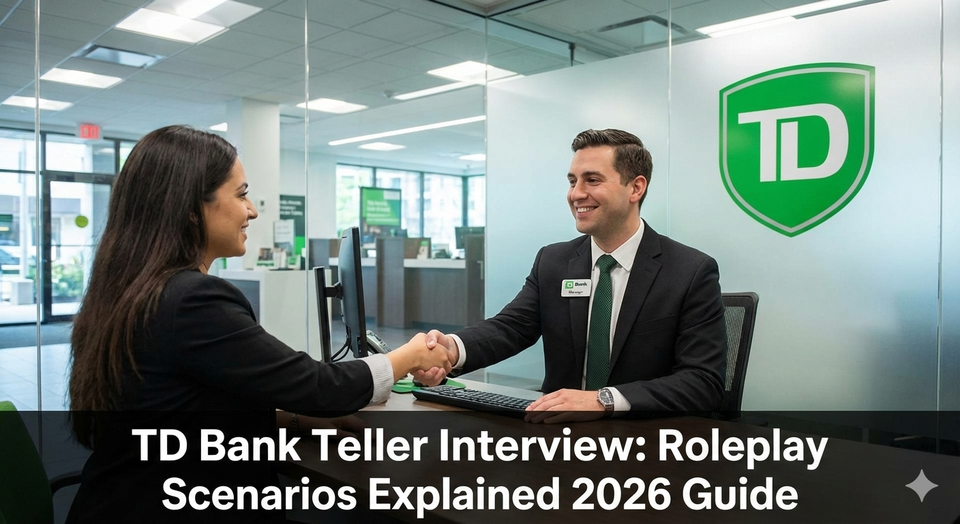
If you have an interview coming up for a Customer Experience Associate (formerly known as Teller) at TD Canada Trust, you are probably worried about one thing: The Roleplay.
Most interviews are just talking. You sit there, answer questions about your strengths, and go home.
But at TD, they put you in the hot seat.
They will act out a specific banking scenario—usually an angry customer or a confused senior—and you have to handle it "live" while the manager takes notes.
Why do they do this?
Because in 2026, being a bank teller isn't about counting cash. Machines do that.
Being a teller is about De-escalation and Sales.
This guide breaks down exactly what they are looking for, provides scripts for the three most common roleplay scenarios, and explains the "Legendary Customer Experience" framework that will get you hired.
Looking for other entry-level work? Check out Night Shift Warehouse Premiums if you hate dealing with customers, or Concentrix Remote Jobs if you prefer phone support.
The "Why": It’s Not About Math
A common myth is that you need to be good at math to work at a bank.
False. The computer tells you exactly how much change to give.
The interview is testing for Empathy and Opportunity Spotting.
TD calls this the LEI (Legendary Employee Index). It is a score customers give the branch based on how "comfortable" and "valued" they felt.
If you can make an angry person smile, you are hired. If you can turn a conversation about a vacation into a credit card sale, you are promoted.
Scenario 1: The "Angry Fee" Customer
The Situation: The interviewer acts as a client who just noticed a $48.00 NSF (Non-Sufficient Funds) fee on their account. They are furious.
The Trap: Do not just say "I'll reverse it." If you reverse every fee, the bank loses money.
The Goal: Calm them down, explain why it happened, and offer a solution to prevent it next time.
The Winning Script
Client (Interviewer): "I’ve been with this bank for 20 years! Why did you charge me $48? This is robbery! I want it back now."
You: "I can completely understand why you are frustrated. Seeing an unexpected fee like that is stressful. Let me take a look at the account to see exactly what happened." (Shows Empathy).
You: "It looks like the hydro bill came out on Tuesday, but the paycheck didn't land until Wednesday, which caused the shortfall. Because you are such a loyal client, I can make a one-time exception and reverse that fee for you today." (The Solution).
The Pivot (Critical Step): "To make sure this doesn't happen again, we can set up Overdraft Protection on your account. It costs less than $5 a month and would have saved you from this stress. Would you like me to add that for you?"
Why this works: You solved the problem, but you also sold a product (Overdraft Protection) that helps the client.
Scenario 2: The "Digital Push" (Grandma & The App)
The Situation: An elderly client comes in to pay a utility bill. The line is long. TD wants to migrate transactions to the Mobile App to free up tellers for sales.
The Trap: Do not tell them "You should just use the app, it's faster." That sounds dismissive to a senior.
The Goal: Show them the benefit and offer to teach them.
The Winning Script
Client (Interviewer): "I hate waiting in this line just to pay my Rogers bill."
You: "I agree, the line is quite long today. I can certainly process this bill for you right now." (Process the transaction first—don't refuse service).
You: "While I'm finishing this up, did you know you can actually pay this from your iPad at home? My grandmother uses the TD app and she loves that she doesn't have to walk in the snow to get here."
You: "If you have a moment, I can step out to the lobby and show you exactly how to set it up on your phone, so you have the option next time. Would that be helpful?"
Why this works: You respected their choice to come in, but you offered Education, not just a deflection.
Scenario 3: The "Sales Pivot" (The Hidden Test)
The Situation: The client is making a large withdrawal or mentioning a life event. You need to spot the "Sales Cue."
The Trap: Being a robot. "Here is your money. Have a nice day."
The Goal: Ask a probing question to uncover a need.
The Winning Script
Client (Interviewer): "I need to withdraw 500 Euros. I'm going to Italy next week."
You: "Italy! That sounds amazing. Are you going for vacation?"
Client: "Yes, just a week in Rome."
You: "That is exciting. Before you go, do you have Travel Medical Insurance arranged? I ask because our TD Aeroplan Visa Infinite card actually includes travel insurance automatically, plus you save on foreign exchange fees. It might be cheaper than buying insurance separately. Do you have a minute to chat with a financial advisor about that?"
Why this works: You didn't push the product aggressively; you framed it as saving them money.
Behavioral Questions: The STAR Method
After the roleplay, they will ask standard questions like "Tell me about a time you dealt with a difficult coworker."
You MUST use the STAR Method:
- Situation (What was happening?)
- Task (What did you need to do?)
- Action (What did YOU do specifically?)
- Result (What was the positive outcome?)
Example Answer:
"In my last job at Starbucks (Situation), a customer was screaming because his order was wrong (Task). I stayed calm, apologized, and remade the drink personally while talking to him about his day (Action). He ended up leaving a $5 tip and apologizing for his behavior (Result)."
Deep Dive: The "Hidden" Requirements
There are two things they check after the interview that disqualify 30% of people.
1. The Credit Check (Bondability)
- You are handling thousands of dollars. They need to know you aren't desperate for cash.
- The Myth: "I need a 700+ Credit Score."
- The Truth: You don't need perfect credit. You just can't have "Bad Debt" (Collections, Consumer Proposals, or Bankruptcy).
- If you have missed a few phone bill payments, you are fine. If you have $50,000 in collections, you will fail the "Bondability" check.
2. Sales Targets (The Pressure)
- Do not be fooled. A "Customer Experience Associate" is a Sales Job.
- You have quarterly goals. You need to refer a certain number of clients to the "Financial Advisors" for mortgages and investments.
- The Reality: If you hate selling, you will hate this job. If you like "gamified" goals and bonuses, you will love it.
Deep Dive: The Online Assessment (The "Gatekeeper")
Before you even get an interview, you have to pass the TD Assessment Test.
This weeds out 50% of applicants instantly.
1. The "Situational Judgment" Trap
- The Format: You get a scenario (e.g., "A coworker is stealing office supplies") and 4 options.
- The Trick: TD uses a "Most Effective / Least Effective" scale.
- The Rule: Always choose the option that involves Direct Communication or Policy.
- Wrong Answer: "Ignore it" or "Gossip to another coworker."
- Right Answer: "Privately ask the coworker if they realized they took it" or "Report to manager" (depending on severity).
- Keywords to look for: "Integrity," "Customer First," and "Ownership."
2. The Numerical Reasoning Test
- You don't need calculus, but you need Speed.
- The Question: "If a client deposits $400 USD and the exchange rate is 1.35, how much CAD do they get?"
- The Prep: Practice doing mental math with Decimals. If you pull out your phone calculator during a Zoom interview test, you fail.
3. The Personality "Consistency" Check
- They will ask the same question 3 different ways to see if you lie.
- Question 1: "I enjoy working in teams." (Strongly Agree).
- Question 50: "I prefer to work alone to get things done." (If you click 'Agree', you are flagged for inconsistency).
- Strategy: Pick a persona (e.g., "The Helpful Extrovert") and stick to it for every answer.
Deep Dive: The "Sales Targets" Reality (Quota Pressure)
This is the part recruiters don't tell you.
1. The "Referral" Game
- As a teller, you are not closing mortgages. You are a "Spotter."
- Target: You might need 2-3 Referrals per day.
- How to hit it:
- If you see a client sending a wire transfer for rent $\rightarrow$ Refer to Advisor for a Mortgage conversation.
- If you see a student with a high balance $\rightarrow$ Refer to Advisor for a TFSA/Investment.
- The Stress: If you have 0 referrals by 2:00 PM, the manager might come tap on your shoulder. It is a sales role disguised as service. If you prefer commission-heavy roles, check out GoodLife Fitness Sales.
2. The "LEI" Score (Legendary Employee Index)
- After a transaction, clients get a survey: "How likely are you to recommend TD?"
- The Scale: 1 to 10.
- The Brutal Truth:
- 9 or 10: Pass.
- 1 to 8: FAIL.
- The Impact: If you get an "8," it counts as a zero for the branch score. This is why tellers are so incredibly nice at the end of the transaction. "Is there anything else I can do to make this a 10/10 experience?"
Deep Dive: 3 Questions YOU Should Ask the Interviewer
At the end, they will say: "Do you have any questions for me?"
If you say "No," you look uninterested. Ask these to look like a pro.
1. The "Training" Question
- "I know TD has a great reputation for training. Can you tell me what the first 2 weeks look like for a new Customer Experience Associate? Is it mostly shadowing or computer modules?"
- Why it works: Shows you are eager to learn and ready to start.
2. The "Team" Question
- "How does the branch team handle peak hours? Do the Financial Advisors ever jump onto the teller line to help out?"
- Why it works: Shows you care about Teamwork and operational flow.
3. The "Success" Question
- "What is the difference between a 'Good' teller and a 'Great' one in your eyes?"
- Why it works: This forces the manager to picture you succeeding in the role.
Deep Dive: Dress Code & "The Green"
- The Look: TD is conservative.
You will be standing a lot. Make sure your dress shoes are comfortable, or you will suffer the same foot pain as Traffic Control Persons."
- Men: Dress shirt, dress pants, tie (optional but recommended for interview). No jeans.
- Women: Blouse, dress pants or skirt. Cardigans are great.
- The "Green" Rule: You do not have to wear green, but wearing a subtle green accessory (tie, scarf, or pin) to the interview is a psychological hack. It makes you look like you already work there.
Relevant Video: Bank Teller Interview Questions and Answers This video provides a visual guide to answering common bank teller interview questions, reinforcing the STAR method and roleplay tips discussed above.
Deep Dive: Benefits & "Perks" (Part-Time vs. Full-Time)
- Medical/Dental: TD is one of the few banks that offers benefits to Part-Time employees (if you average 15+ hours) unlike many retail jobs. Compare this to the Costco vs Loblaws benefits packages
- The Share Purchase Plan:
- If you contribute 3% of your paycheck to buy TD Stock, the bank matches it.
- Free Money: This is essentially a 3% raise. Always sign up for this on Day 1.
- Banking Perks:
- Free Chequing Account: You save $16/month.
- Credit Card Fee Waiver: You get the premium cards (like Aeroplan Infinite) for free ($139 value).
- Mortgage Rate Discount: Employees get a special rate, often 0.10% - 0.20% lower than the public best rate.
Deep Dive: The "Float" (Don't Lose Money)
- Your "Float" is your cash drawer.
- The Rule: You must balance to the penny every night.
- The Variance:
- If you are over/short by $10, you have to sign a logbook.
- If you are over/short by $100, it is an "Incident."
- 3 Incidents in a year = Formal Warning or Termination.
- The Tip: Count your cash 3 times before handing it to the client. Speed is good; Accuracy is mandatory. This is similar to the strict accuracy requirements for Inventory Counter Jobs.
Relevant Video: Bank Teller Interview Questions and Answers
This video provides a visual guide to answering common bank teller interview questions, reinforcing the STAR method and roleplay tips discussed above.
Practical Questions Answered
The branch gossip.
"Is there a math test?"
Usually No.
- Some managers might ask "What is 100 minus 32?" just to see if you panic. But generally, the system does the math.
"Do I have to wear a uniform?"
Yes and No.
- TD does not have a "uniform" like McDonald's.
- They have a Dress Code. You must wear "Business Professional" (Dress pants/skirt and a blouse/shirt).
- The Green Scarf: Sometimes they provide the branded green scarf or tie, but usually, you just dress like you work in an office.
"Is Part-Time actually Part-Time?"
Not really.
- They often require "Flex Availability."
- You might be hired for 15 hours, but you need to be available 7 days a week to cover sick calls.
- Warning: If you say you can't work Saturdays, you likely won't get hired. Saturdays are the busiest banking days.
Summary: It's About Confidence
- Don't Panic: In the roleplay, take a breath. Smile. The customer isn't real.
- Listen First: Let the "angry client" vent.1 Do not interrupt.
- Spot the Sale: Always listen for clues (Travel, New House, Baby, Retirement).
- Dress the Part: Wear a blazer to the interview. Look like a banker before you are one.
About the author
Jeff Calixte (MC Yow-Z) is a Canadian career researcher and digital entrepreneur who studies hiring trends, labour market data, and real entry-level opportunities across Canada. He specializes in simplifying the job search for newcomers, students, and workers using practical, up-to-date information.
Sources
- TD Bank Careers: Interview tips and "Life at TD". https://jobs.td.com/en/
- Glassdoor: TD Bank Interview Questions & Roleplay scenarios. https://www.glassdoor.ca/
- Reddit r/Banking: Discussions on sales pressure and targets. https://www.reddit.com/r/Banking/
Note
Job availability, wages, and hiring conditions can vary widely by province, employer, season, and experience level. All salary ranges and job examples in this guide are estimates based on current labour market data. Always confirm details directly with the employer before applying.