
Traffic Control Pay 2026: LiUNA Rates vs. Standing All Day for $19/hr
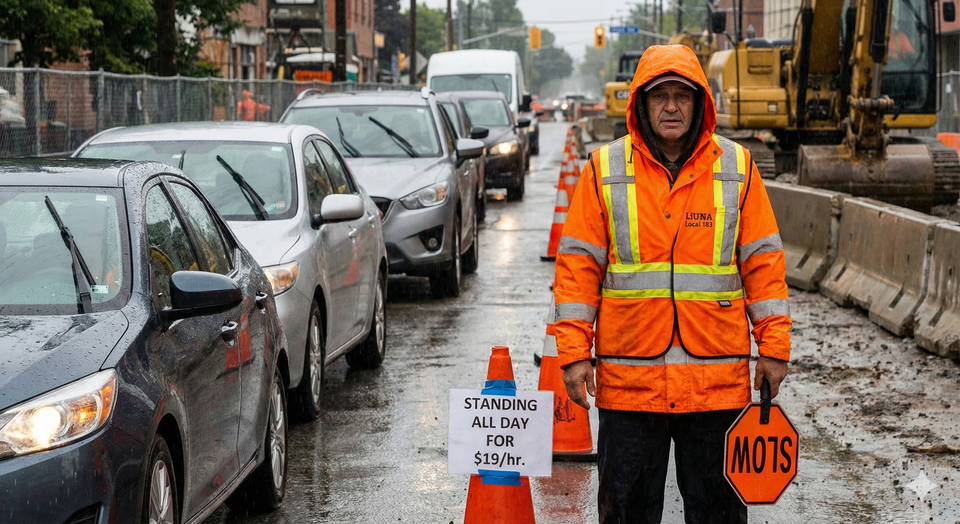
To the average driver, the Traffic Control Person (TCP)—often called a Flagger—looks like the easiest job in the world. You stand there. You hold a sign. You spin it to "Slow." You get paid.
But anyone who has actually done a 12-hour shift on the 401 highway in November knows the truth: It is a physical endurance test.
In 2026, the pay gap in this industry is massive.
If you work for a random temp agency, you might make $19.00/hour.
If you get into LiUNA Local 183 (The massive construction union in Ontario), you can make $35.00 - $45.00/hour with double-time overtime.
This guide compares the Union vs. Non-Union reality, explains why you need your "Book 7" training to stop being a "Paddle Holder," and reveals the biggest challenge of the job: finding a bathroom when you are 10km from civilization.
Prefer indoor work? Check out Hospital Porter Jobs for a walking job, or Lumper Jobs for daily cash.
The Pay: Agency vs. Union (The $15 Gap)
Do not sign up with the first agency you find on Kijiji.
1. Non-Union Agencies (The Starting Point)
- Who they are: Staffing agencies that supply flaggers to small road crews or utility companies (e.g., Rogers/Bell trucks).
- The Pay: $18.00 - $22.00/hour.
- The Conditions: You often have no guaranteed hours. If it rains, you go home unpaid.
- Benefits: Usually none.
2. LiUNA Local 183 (The Gold Standard)
- Who they are: The Labourers' International Union of North America. They control the major construction sites in the GTA.
- The Pay (2026 Est.):
- Traffic Control Person: $34.00 - $38.00/hour.
- Lane Closure Technician (Book 7): $38.00 - $44.00/hour.
- The Perks: Full benefits, pension, and overtime after 10 hours.
- How to get in: You usually need to be "sponsored" by a unionized company or apply during their intake periods.
The Training: "Stop/Slow" vs. "Book 7"
If you want the big money, you need more than just the paddle.
1. The Basic Ticket ("Stop/Slow")
- Cost: ~$150.
- What you learn: Where to stand, how to communicate with radios, and how to hold the sign.
- Job Limit: You can only control simple traffic flows (two-lane roads).
2. OTM Book 7 (The Career Maker)
- Cost: ~$300 - $500.
- What you learn: How to set up Lane Closures on highways. You learn to lay out the cones (barrels), set up the arrow boards, and create the "Buffer Zone."
- Why it pays more: Setting up a closure on a 100km/h highway is dangerous and requires technical precision. If you screw up the taper length, people die.
The "Lane Closure" Upgrade (How to Make $40/hr)
1. TCP vs. LCT (Know the Difference)
- Most people think "Flagging" is just holding a sign. That is a TCP (Traffic Control Person).
- The real money is in being an LCT (Lane Closure Technician).
- The Job: You drive the "Crash Truck" (truck with the big arrow board and crash cushion on the back). You are responsible for setting up the pylons on the 400-series highways.
- The Pay Gap:
- TCP: $19.00 - $25.00/hour.
- LCT: $35.00 - $45.00/hour (plus danger pay).
- The Requirement: You need a G License (clean abstract) and your Book 7 ticket. If you can drive the truck, you instantly become more valuable than the person standing on the road.
2. The "Night Shift" Premium (Vampire Hours)
- Construction on major highways (Gardiner Expressway, Hwy 401) only happens at night to avoid traffic jams.
- The Premium: In 2026, many union contracts (like LiUNA 183 or Local 1059) offer a Shift Premium of +$3.00 to +$4.25 per hour for work between 7:00 PM and 5:00 AM.
- The Math: A $38/hr base rate + $4.00 premium = **$42.00/hour.**
- The Lifestyle: You live like a vampire. You sleep while your family is awake. But you make $1,000 more per month than the day crew.
3. The "Pickup Truck" Rule (The Hidden Cost)
- If you apply to a non-union agency, they will ask: "Do you have a vehicle?"
- The Trap: They often expect you to use your own car to store the "Stop/Slow" signs and pylons.
- The Risk: Your Honda Civic is not designed to carry dirty, heavy rubber pylons. It will ruin your interior.
- The Union Difference: Union companies provide the truck. You drive their Ford F-250 to the site. Never use your own car for company equipment unless they pay you a Vehicle Allowance (usually $50/day).
4. "Buffer Space" Math (The Test Question)
- If you want to pass the Book 7 course, you need to know this.
- The Concept: The "Buffer Space" is the empty zone between the flagger and the workers.
- The Rule: If a car smashes through your checkpoint, the Buffer Space gives the workers 3 seconds to jump out of the way.
- The Calculation: On a 60km/h road, the buffer might be 30 meters. On a 100km/h highway, it might be 90 meters.
- Why it matters: If an inspector measures your buffer and it's too short, the entire site gets shut down and you get fired.
5. Paid Duty Officers (The "Blue" Wall)
- On dangerous intersections, you won't work alone. You will work with a Paid Duty Police Officer.
- The Dynamic: The cop sits in their cruiser with the lights on. You stand 50 feet away holding the paddle.
- The Benefit: Drivers are terrified of the cop. They obey your sign perfectly.
- The Downside: If you are on your phone or looking lazy, the cop will tell your foreman. They are always watching.
- Link: Working alongside law enforcement requires the same level of professionalism as Security Guard Jobs.
6. The "Crash Attenuator" (TMA Driver)
- This is the safest (and most boring) job in the industry.
- The Role: You drive the Truck Mounted Attenuator (TMA). It’s the truck with the accordion-style bumper on the back.
- The Job: You park behind the workers. You sit in the cab for 10 hours.
- The Purpose: If a drunk driver hits the site, they hit you. The truck absorbs the impact.
- The Pay: LCT rates ($35+/hr).
- The Requirement: Steel nerves. You are literally "Live Bait."
7. Winter "Snow Watch" (The Off-Season Hustle)
- What do Flaggers do in January?
- The Shift: Many switch to "Snow Watch" or "Hydrant Clearing."
- The Job: You drive around clearing snow from fire hydrants or monitoring plow routes.
- The Pay: usually lower ($22 - $25/hr), but it keeps you employed during the 3-month winter freeze.
8. "Double Time" Sunday (The Golden Ticket)
- In LiUNA contracts, Sunday work is often Double Time (2x).
- The Math: If your base is $35/hr, Sunday is **$70/hr**.
- The Strategy: Always volunteer for the Sunday shift. You make 2 days' pay in 1 day.
- The Caution: These shifts are rare and go to the most reliable workers first.
9. PPE: The "Class 3" Vest Rule
- You cannot wear a random orange vest from Amazon.
- The Law: Ontario requires CSA Class 2 or Class 3 apparel for night work.
- The Difference: Class 3 has "Arm and Leg Bands" (reflective stripes on your wrists and ankles).
- The Fine: If a Ministry of Labour inspector catches you at night without leg bands, it's a $195 Ticket.
- Link: Understanding PPE grades is just as important here as it is for Working at Heights Training harnesses.
Deep Dive: The Physical Toll (Standing Still)
This is the part nobody warns you about.
- Varicose Veins: Standing in one spot for 12 hours pools the blood in your legs. It is painful.
- The "Bathroom" Problem: You are often the only flagger at your end of the site. You cannot leave.
- The Solution: You have to radio for a "Relief." If the relief is 20 minutes away, you hold it.
- The Weather: You work in rain, snow, and -30°C. There is no shelter. If you dress poorly, you get hypothermia.
- Link: This exposure to the elements is similar to Pipeline Labourer Jobs, but at least they move around to stay warm.
Danger Pay & "Road Rage"
You are a human pylon.
- The Threat: Drivers hate construction. They are late for work. They see you spinning the sign to "Stop."
- The Abuse: You will be yelled at. People will throw coffee cups at you. They will try to drive around you.
- The Rule: Never jump in front of a car. If a driver runs your sign, let them go. Radio your partner: "Runner coming your way, Blue Honda." Get the plate number if you can, but prioritize your life.
- Danger Pay: Some contracts offer a premium (e.g., +$2.00/hr) for Night Work or High-Speed Highway work because the risk of being hit is higher.
Practical Questions Answered
The real stories.
"Can I wear headphones?"
NO.
- It is illegal and a firing offense. You need to hear sirens, screeching tires, and radio calls.
- Boredom: You have to stare at asphalt for 10 hours without a podcast. It requires mental discipline.
"What boots should I buy?"
Don't cheap out.
- Do not buy $60 Walmart boots. Your feet will bleed.
- Recommendation: Buy Red Wing or Timberland Pro with "Anti-Fatigue" insoles.
- Winter: You need "Baffin" boots rated for -40°C. Standing on frozen concrete sucks the heat out of your body.
"Is it seasonal?"
Mostly.
- The busy season is April to November.
- Winter: Work slows down, but emergency utility work (broken water mains, downed power lines) continues. The dedicated crews work year-round.
Frequently Asked Questions
Do I need a car?
Yes.
- Construction sites are rarely on a bus route.
- You might start at 6:00 AM in a new subdivision 40km away. If you don't have a reliable car, you won't last.
Is there a height requirement?
No.
- But you need to be Visible.
- If you are short, ensure your "Stop/Slow" paddle has a long handle (6-foot staff) so drivers can see it over the roof of an SUV.
Can I listen to the radio?
- You will have a Two-Way Radio to talk to the other flagger.
- The Chatter: This is your lifeline. Good crews joke around on the radio to keep each other awake. Bad crews stay silent for 10 hours.
Summary: It’s Mental, Not Just Physical
- Join the Union: Aim for LiUNA Local 183. The pension and benefits are worth the initiation fee.
- Get Your Book 7: Don't stay a paddle holder. Become a "Traffic Control Technician."
- Layer Up: Wear Merino wool base layers. Once you get cold, you cannot get warm again until the shift ends.
- Be Assertive: You control the road. Use clear, firm hand signals. If you look unsure, drivers will ignore you.
About the author
Jeff Calixte (MC Yow-Z) is a Canadian career researcher and digital entrepreneur who studies hiring trends, labour market data, and real entry-level opportunities across Canada. He specializes in simplifying the job search for newcomers, students, and workers using practical, up-to-date information.
Sources
- LiUNA Local 183: Wage schedules and benefits. https://liunalocal183.ca/
- IHSA (Infrastructure Health & Safety Association): Traffic Control Person training standards. https://www.ihsa.ca/
- Ontario Ministry of Transportation: OTM Book 7 guidelines. https://www.ontario.ca/page/ministry-transportation
Note
Job availability, wages, and hiring conditions can vary widely by province, employer, season, and experience level. All salary ranges and job examples in this guide are estimates based on current labour market data. Always confirm details directly with the employer before applying.