
Tree Planting Canada 2026: How Much Cash Can You Really Make?
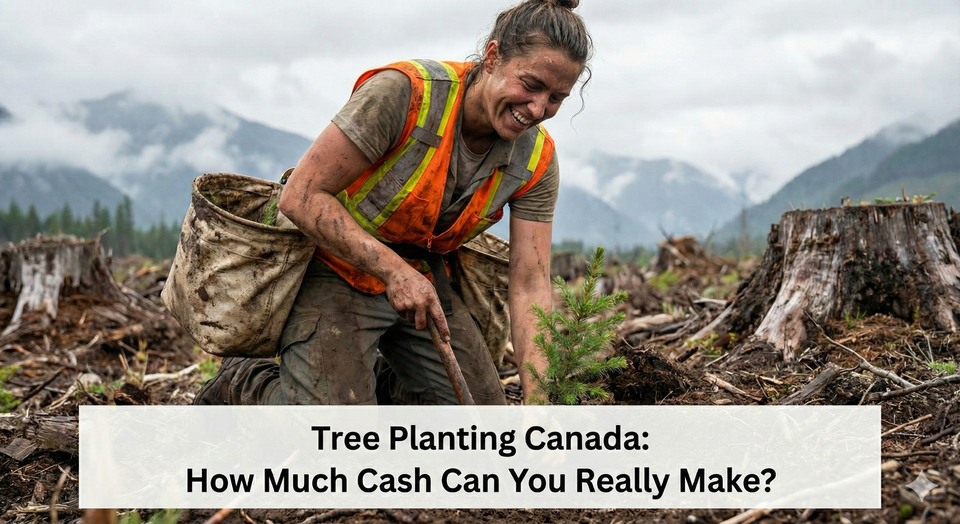
It is the ultimate Canadian "Rite of Passage." Every spring, thousands of students flock to the forests of British Columbia and Northern Ontario with dreams of making $20,000 in three months.
The stories are legendary. You hear about the "Highballer" who plants 4,000 trees a day and buys a new car with cash in August. But you rarely hear about the rookie who quits after two weeks, owing the company money for camp costs, with nothing to show for it but swollen ankles and bug bites.
Tree planting is not a normal job. It is widely considered the hardest no-degree job in Canada. You are paid strictly on Piecework. If you don't plant, you don't eat. There is no hourly wage, no overtime, and no mercy for slacking off.
However, for those with grit, it is the most efficient way to save money fast. Since you are living in a tent in the middle of nowhere, your expenses are near zero. It is the perfect student job for anyone who needs to pay off tuition in one summer.
Here is the brutal truth about the economics of tree planting in 2026.
1. The Math: How Piecework Actually Works
In a normal job, you trade time for money. In planting, you trade pain for money.
You are paid a specific price per tree planted.
- The Rate: Ranges from 12 cents to 25 cents per tree (depending on the terrain).
- Easy Ground (Flat, Sandy): Lower price (12–14 cents). You can plant fast.
- Hard Ground (Rocky, Slash piles): Higher price (18–24 cents). You plant slower.
The "Rookie" vs. "Highballer" Gap
This is where expectations meet reality.
The Rookie (First Year):
- Speed: 800 – 1,200 trees per day.
- Daily Earnings: $120 – $180.
- The Reality: For the first month, you might make less than minimum wage. You are learning the technique, dealing with blisters, and figuring out how not to cry.
The Vet / Highballer (3+ Years):
- Speed: 2,500 – 4,000+ trees per day.
- Daily Earnings: $350 – $600+ per day.
- The Reality: These people are athletes. They treat planting like a sport. They minimize every movement to maximize profit.
2. The "Camp Cost" Trap
This is the number one thing recruiters hide in the fine print. You pay to live at work.
Unlike oil sands camp jobs where housing is free, most tree planting companies charge you Camp Cost.
- The Rate: $25.00 – $30.00 per day.
- What you get: 3 meals a day (all you can eat), a shower trailer, and a spot to pitch your tent.
- The Math: If you are in the bush for 60 days, you owe the company $1,500 – $1,800 off the top of your paycheck.
The "Rookie Mill" Warning:
Some notorious companies (often called "Rookie Mills") hire hundreds of beginners, knowing 50% will quit. They profit from the camp costs and low tree prices.
- How to spot them: If they hire anyone without an interview, run. Good companies (Vet Companies) are selective.
3. Location Matters: BC vs. Ontario vs. Alberta
Where you plant determines how much you make and how miserable you will be.
British Columbia (The Big Money)
- Terrain: Steep mountains, massive logs ("Slash"), and rocky cliffs.
- Tree Price: Highest in Canada (16¢ – 26¢).
- Vibe: Hardcore. This is where the Highballers go.
- Season: Longest season (February to August if you do coastal and interior).
Northern Ontario (The Bug Hell)
- Terrain: Flat swamps (Muskeg) and Canadian Shield rock.
- Tree Price: Lower (12¢ – 15¢).
- Vibe: Fast planting ("Pounding"). You plant more trees, but they are cheaper.
- The Downside: The Black Flies. In June, the bugs in Ontario are psychologically damaging. You will wear a bug net 24/7.
Alberta (The Middle Ground)
- Terrain: Often "cleaner" trenches (prepped by machines).
- Tree Price: Medium (14¢ – 18¢).
- Vibe: Efficient. Many newcomers find success here because the ground is more forgiving than BC.
4. The Physical Toll: "The Creamer"
You need to understand the injuries. Planting is repetitive strain injury waiting to happen.
- The Creamer: This is tendonitis in your wrist or forearm. It feels like your tendons are "creaking" like a rusty door hinge. If you get this, you are out for weeks.
- The Shovel Hand: You lose feeling in your fingers from gripping the shovel 3,000 times a day.
- The "Bush Rot": Because you are wet every day, cuts on your hands and feet rarely heal. They get infected.
Street Advice: Start doing pushups and wrist curls now. If you show up to camp out of shape, you will injure yourself in Week 1.
5. How to Get Hired (The Timeline)
You cannot apply in May. The season is already over by then.
- January - February: Hiring begins. This is when you email companies.
- March: Crews are finalized.
- May 1st: You are in the bush.
Top Companies to Target:
- Summit Reforestation: Huge, safe for rookies, operates in BC/Alberta.
- Brinkman & Associates: The oldest company. Very reliable.
- Folklore Contracting: Good reputation in the BC Interior.
- Blue Collar: Often hires veterans.
Comparison Table: Rookie vs. Highballer Earnings
| Metric | Rookie Planter | Veteran Highballer |
| Trees Per Day | 1,000 | 3,500 |
| Price Per Tree | $0.14 | $0.18 (Better Land) |
| Gross Daily Pay | $140 | $630 |
| Camp Cost | -$25 | -$25 |
| Net Daily Pay | **$115** | $605 |
| Total Season (50 Days) | $5,750 | $30,250 |
The "Reddit Defense": Practical Questions Answered
"Do I have to bring my own tent?"
Yes.
Unless you are lucky enough to be in a luxury camp with dorms (rare), you live in a tent.
- The Gear: Do not bring a $40 Walmart tent. It will leak. You need a North Face or MSR 3-season tent. If your sleeping bag gets wet, you don't sleep. If you don't sleep, you can't plant.
"Is it worth it for the money?"
Consensus: Only if you stay the whole season.
The first 3 weeks are slow. The last 4 weeks are where you make 70% of your money because your muscles have adapted. If you quit in week 3, you actually lost money on gear and travel.
- Internal Link: If you want guaranteed money without the gamble, look at hourly warehouse jobs instead.
"What about bears?"
You will see them.
Black bears are common. Grizzlies are rare but present in BC.
- The Safety: You never keep food in your tent. You carry bear spray. Most interactions are harmless; the bears just want to eat berries. The bugs are a much bigger threat to your sanity than the bears.
Frequently Asked Questions
How much do tree planters make in a season?
An average first-year planter can expect to net between $8,000 and $12,000 in a 2-3 month season after expenses. An experienced planter (3+ years) can earn upwards of $25,000 to $30,000 in the same timeframe. The top 1% of "Highballers" can break $40,000.
What equipment do I need to buy?
You must provide your own personal camping gear (tent, sleeping bag rated to -10°C) and planting clothing. The most crucial item is boots. Caulked boots ("Caulks")—boots with metal spikes on the soles—are mandatory for walking on slippery logs in BC. You also need to buy your own shovel and planting bags (approx. $150 total).
Is tree planting harder than construction?
Yes, in terms of endurance.
Construction is heavy lifting in bursts. Tree planting is an ultra-marathon. You are walking 15-20km a day over rough terrain while bending over 2,000 times carrying 40lbs of trees. It burns approx. 5,000 calories a day.
Do I get paid for days off?
No.
Days off (usually every 4th or 5th day) are unpaid. In fact, you still get charged "Camp Cost" on your day off at many companies. You usually go into town to do laundry, eat pizza, and sleep in a real bed (hotel) if you can afford it.
About the author
Jeff Calixte (MC Yow-Z) is a Canadian career researcher and digital entrepreneur who studies hiring trends, labour market data, and real entry-level opportunities across Canada. He specializes in simplifying the job search for newcomers, students, and workers using practical, up-to-date information.
Sources
- Tree-Planter.com (Industry Hub): https://tree-planter.com/
- Replant.ca (Job Board & Forums): https://www.replant.ca/
- Summit Reforestation (Careers): https://www.summitreforestation.com/
Note:
Job availability, wages, and hiring conditions can vary widely by province, employer, season, and experience level. All salary ranges and job examples in this guide are estimates based on current labour market data. Always confirm details directly with the employer before applying.