
Underground Mining for Beginners: The "Entry Level" Roles
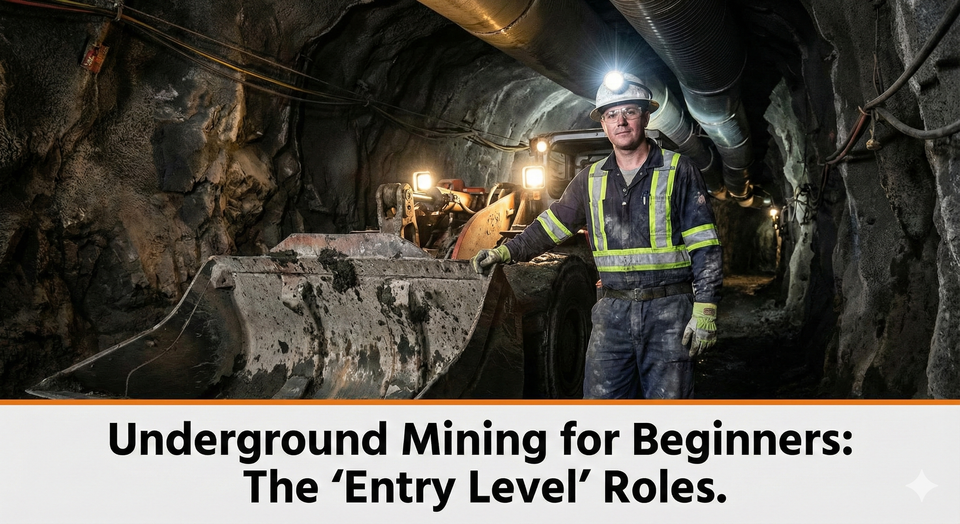
The mining industry in Canada is booming, and it is one of the few places where you can still earn $100,000 a year without a university degree.
But breaking in is tough. You can't just apply to be a "Miner." That is a skilled trade that takes years to master.
To get your foot in the door, you need to target the "Helper" and "Support" roles. These are the jobs that do the grunt work—moving hoses, fetching tools, and cleaning up. It is hot, dirty, and physically exhausting, but it is the golden ticket to a high-paying career.
If you are looking for fly-in fly-out work or a way to fast-track your savings, here is your guide to the entry-level underground world.
1. The Best Entry-Level Job: Diamond Driller Helper
This is the #1 way for a rookie to get underground.
- The Job: You are the assistant to the Driller. You move heavy rods, mix drilling mud, and pull core samples.
- The Pay: $28 – $35 per hour (plus a "meter bonus" based on how deep you drill).
- The Schedule: Often 2 weeks on, 1 week off (or 2 weeks on, 2 weeks off).
- Who Hires: Specialized drilling companies like Major Drilling, Boart Longyear, or Foraco.
- Verdict: Brutal but Lucrative. If you survive the first year, you can become a Driller earning $120k+.
2. The "Nipper" (The Gopher)
"Nipper" is old mining slang for the person who "nips" around getting things.
- The Job: You are the supply guy. You deliver drill bits, explosives, and ventilation fans to the active mining crews.
- The Pay: $30 – $40 per hour.
- Why it’s great: You get to see the whole mine. It is the best way to learn the layout and network with different crews.
- Barrier: You usually need your Underground Common Core (see below) to get this role.
3. Underground Labourer / Construction
Mines are like underground cities; they constantly need repair.
- The Job: Pouring concrete pads, hanging ventilation tubes, and cleaning ditches.
- The Pay: $25 – $32 per hour.
- Who Hires: Contractors like Redpath, Cementation, or Dumas. These companies build the mine for the owner (like Vale or Glencore).
- Internal Link: This is similar to construction labour but with a massive "underground premium."
4. The Golden Ticket: "Common Core" (Ontario)
If you want to work underground in Ontario, you legally need your Basic Underground Hard Rock Miner Common Core (Module U0000-U0002, U0012).
- What it is: A mandatory government certification that proves you know how to be safe underground.
- Cost: $8,000 – $12,000.
- Where to get it: NORCAT (Sudbury) or Northern College (Timmins).
- The Catch: It is expensive.
- The Hack: Some contracting companies (like Redpath) will pay for your training if you sign a contract to work for them for 2 years. Look for "Entry Level Training Program" job postings.
Comparison Table: Surface vs. Underground Pay
| Role | Surface Pay | Underground Pay |
| Labourer | $22/hr | **$30/hr** |
| Heavy Duty Mechanic | $38/hr | **$55/hr** |
| Electrician | $35/hr | **$50/hr** |
| Truck Driver | $25/hr | **$35/hr** |
Note: Underground always pays more due to the "danger pay" and working conditions.
Practical Questions Answered
"Is it scary underground?"
Consensus: At first, yes.
It is dark, hot, and loud. You are 1km below the earth.
- The Reality: Modern Canadian mines are incredibly safe. They are well-ventilated and have strict safety protocols. After a week, you forget you are underground.
"Do I need to be strong?"
Yes.
As a Helper, you are lifting 50lb drill rods hundreds of times a shift. It is a gym workout for 12 hours straight. If you have a bad back, do not apply.
"Can women work underground?"
Absolutely.
The industry is aggressively hiring women. Companies like Vale and Nutrien have diversity targets. Women often excel as "Haul Truck Drivers" or specialized equipment operators because they are statistically gentler on the machinery.
Frequently Asked Questions
What is the schedule like?
Most remote mines operate on a Fly-In Fly-Out (FIFO) rotation. Common schedules are 14 days on, 14 days off or 7 days on, 7 days off. You work 12-hour shifts (days and nights flip). This means you only work half the year.
Do I need a driver's license?
Yes. A valid driver's license (Class G or Class 5) is almost always mandatory because you may need to drive a pickup truck (mantrip) underground to get to your work area.
Where are the jobs?
The hotspots for 2026 are:
- Sudbury / Timmins, ON: Gold and Nickel.
- Saskatoon, SK: Potash (often safer, soft rock mining).
- Kitimat / Stewart, BC: Gold ("The Golden Triangle").
- Yellowknife, NWT: Diamonds (Remote camps).
What if I can't afford the Common Core?
Look for jobs in Saskatchewan or British Columbia. They do not require the "Ontario Common Core" certificate upfront. They typically do on-the-job training. Once you have experience there, you can challenge the Ontario exam later.
About the author
Jeff Calixte (MC Yow-Z) is a Canadian career researcher and digital entrepreneur who studies hiring trends, labour market data, and real entry-level opportunities across Canada. He specializes in simplifying the job search for newcomers, students, and workers using practical, up-to-date information.
Sources
- NORCAT (Underground Training): https://www.norcat.org/training/
- Redpath Mining (Careers): https://redpathmining.com/careers/
- Careermine (Mining Job Board): https://www.careermine.com/
Note:
Job availability, wages, and hiring conditions can vary widely by province, employer, season, and experience level. All salary ranges and job examples in this guide are estimates based on current labour market data. Always confirm details directly with the employer before applying.