
Working at Heights Training Ontario: Can You Fail the Test? (2026 Guide)
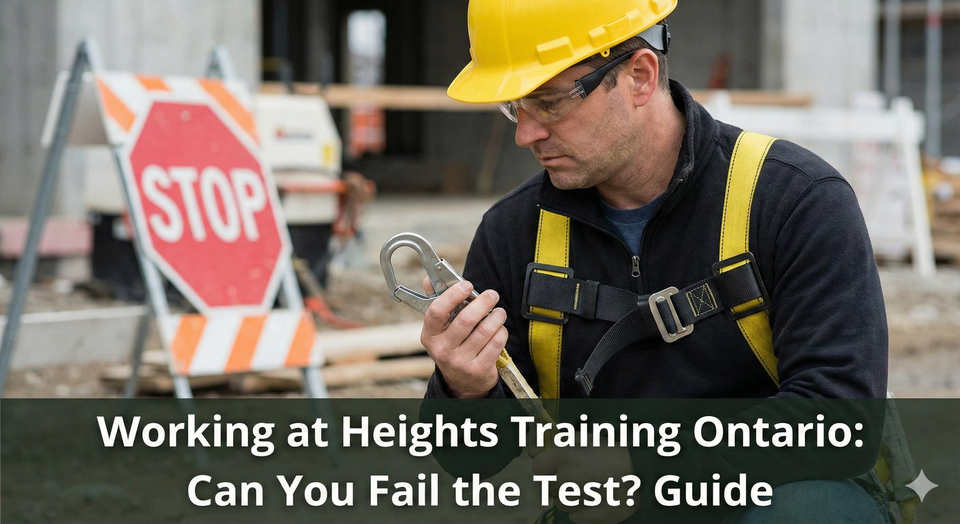
In Ontario construction, you are useless without your Working at Heights (WAH) ticket.
It is the "Green Card" of the job site. Whether you are a general labourer, a roofer, or even a Traffic Control Person who occasionally hops on a truck, you need this CPO-approved certification.
But unlike the simple WHMIS online quiz you can click through in 20 minutes, Working at Heights is an 8-hour, in-person gauntlet.
And yes, people do fail.
In 2026, the cost has risen to roughly $150 - $200 for the day, and inspectors are cracking down on "Certificate Mills."
This guide breaks down exactly how the day works, the math question that trips everyone up (Fall Clearance Calculation), and the truth about the practical "Harness Test."
Need a job that keeps your feet on the ground? Check out Shopify Support Advisor for a remote role or Cannabis Budtender for retail.
The "Hang Test" Myth: What Actually Happens?
A common fear is that they will hoist you up to the ceiling and leave you dangling to see if you panic.
The Truth: You do not hang from the ceiling.
However, the practical exam is strict.
The "100% Tie-Off" Rule
- The Test: You will stand on a simulator (usually 2 feet off the ground).
- The Task: You must demonstrate how to move from Point A to Point B using a Double Lanyard (Y-Lanyard).
- The Fail: If you unhook both clips at the same time, even for one second, you Fail Immediately.
- Why: In real life, that one second is when you fall and die. The instructor cannot pass you if you break the "100% Tie-Off" rule.
The Harness Inspection (Don & Doff)
- You have to put the harness on correctly.
- The "Two Finger" Rule: Once the leg straps are tight, the instructor will try to slide their flat hand under your strap. If they can make a fist, it's too loose. Fail.
- The "Dorsal D-Ring": It must be in the middle of your shoulder blades. If it's too high (hitting your head) or too low (mid-back), you fail.
The Written Test: The Math Problem
The written test is multiple choice, and you need 75% to pass.
Most questions are common sense ("Should you drink beer before climbing a ladder? No.").
But there is one section that fails people: Fall Clearance Math.
The Formula You Must Memorize
You need to calculate if your lanyard is short enough to stop you from hitting the ground.
Formula:
Lanyard Length + Deceleration Distance (Shock Absorber) + Height of Worker + Safety Factor = Required Clearance
Example Question:
- You are working on a platform 15 feet high.
- You have a 6-foot lanyard.
- The shock absorber opens 3.5 feet.
- You are 6 feet tall.
- The Safety Factor is 3 feet.
The Math:
6 + 3.5 + 6 + 3 = 18.5 Feet Required.
The Result: Since you only have 15 feet of height, you will hit the ground.
If you answer "Safe to Work," you fail.
Deep Dive: "Refresher" vs. "Full Course"
Your ticket is valid for 3 Years.
- Full Course (8 Hours): For first-timers or if your ticket expired more than 3 years ago. ($150 - $200).
- Refresher (4 Hours): For renewals before the expiry date. ($95 - $115).
- The Trap: If you let your ticket expire by even one day, you cannot take the Refresher. You must pay full price and sit through the full 8-hour day again. Check your wallet card now!
Bringing Your Own Gear
Some workers try to bring their own dirty, used harness to the class.
Do NOT do this.
- The Inspection: The instructor will inspect your gear. If they find a single cut, paint spill, or if the "Fall Indicator" stitching is popped, they will Confiscate/Tag Out your harness.
- The Risk: You might walk in with a harness and walk out with a piece of garbage because they legally marked it as "Unsafe." Use the training center's gear.
Lost Cards, Scams & Fines (Extra
1. The "SkillsPass" Database (Lost Card Solution)
- If you lose your wallet, do you have to retake the course? No.
- The Old Way: You had to call the training provider and beg for a reprint.
- The New Way (2026): Ontario uses a centralized digital system called SkillsPass.
- The Hack: Log in to the Ministry of Labour (CPO) website with your email. You can download a digital PDF of your ticket instantly.
- Job Site Rule: Most foremen now accept a screenshot of your SkillsPass QR code on your phone. You don't need the physical plastic card anymore.
2. The "Zoom Course" Scam (Don't Get Tricked)
- If you search "Working at Heights Online," you will see ads for "$49.99 - 100% Online."
- This is a SCAM.
- The Law: The Ontario Chief Prevention Officer (CPO) requires In-Person Practical Training.
- Hybrid: You can do the "Theory" (morning classroom stuff) online via Zoom.
- Practical: You MUST go to a physical facility to put on the harness.
- The Consequence: If you buy a "100% Online" ticket from a US-based website, the Ministry of Labour inspector will tear it up, and you will be sent home without pay.
3. The $750 Ticket (MOL Inspector Fines)
- Inspectors don't just fine the company; they fine You.
- The Scenario: An inspector walks onto the roof. You are wearing your harness, but you aren't clipped in.
- The Cost:
- Failure to Use Fall Protection: $750.00 (Ticket issued to the worker directly).
- Failure to Carry Proof of Training: $195.00.
- The "Zero Tolerance" Policy: In 2026, inspectors are no longer giving "warnings" for fall protection violations. It is an instant ticket.
4. "Pendulum Effect" (The Concept That Kills)
- This is the #1 theory question people get wrong.
- The Question: "Is it safe to anchor yourself at the corner of the roof and walk to the center?"
- The Answer: NO.
- The Reason: If you fall while working at a 45-degree angle from your anchor, you won't just fall down. You will swing sideways (like a pendulum) and smash into the wall or structure.
- The Rule: Your anchor point must be Directly Above or Behind you. You must move the anchor as you move across the roof.
5. IHSA vs. Private Colleges (Who is Better?)
- IHSA (Infrastructure Health & Safety Association):
- Pros: They write the rules. If you have an IHSA ticket, no foreman will ever question it.
- Cons: Usually more expensive and stricter.
- Private Providers (e.g., "Bob's Safety Training"):
- Pros: Often cheaper, run on weekends, and "easier" atmosphere.
- Cons: Ensure they are CPO-Approved. Check the Ministry website list. If Bob loses his accreditation, your card becomes void.
6. The "Rescue Plan" Trick Question
- The instructor will ask: "If your buddy falls and is hanging in his harness, what do you do?"
- The Trap Answer: "I call 911 and wait." WRONG.
- The Real Danger: Suspension Trauma. If someone hangs for more than 15-20 minutes, blood pools in their legs. If you cut them down suddenly, the deoxygenated blood rushes to their heart and kills them (Reflow Syndrome).
- The Right Answer: "We activate the site-specific Rescue Plan immediately (e.g., use a ladder or scissor lift) to get weight off their legs within 10 minutes."
7. Language Barriers (Punjabi/Spanish Classes)
- Do not take the course in English if you aren't 100% fluent.
- The Terms: Words like "Lanyard," "Deceleration," and "Anchorage" are technical.
- The Fix: Search for "Working at Heights Brampton Punjabi" or "Spanish Safety Training Toronto."
- The Rule: The instructor is allowed to use a translator, but you must answer the test questions yourself. Many providers now offer the written test in 12+ languages.
8. "Relief Straps" (The $20 Life Saver)
- Most cheap harnesses provided by companies don't have Trauma Straps.
- What are they? Two small pouches on the side of the harness. If you fall, you unzip them, deploy a loop, and stand in it.
- Why buy them? They cost $20. If you fall, standing in the loops takes the pressure off your arteries and buys you 30 minutes of survival time instead of 10.
- Career Tip: Buying your own trauma straps impresses the foreman. It shows you actually understand safety.
9. Union Training (LiUNA / CLAC)
- If you join a union, the training is often Free.
- LiUNA Local 183: Runs a massive training center in Vaughan. Their WAH course is considered the "Gold Standard."
- The Perk: They also feed you lunch.
- Link: If you are deciding between unions, check our guide on LiUNA vs. CLAC to see which offers better training benefits.
Practical Questions Answered
The classroom secrets.
"Is it hard for non-native English speakers?"
Yes.
- The test language can be technical ("Deceleration," "Pendulum Effect").
- The Fix: Most training providers (like IHSA or private colleges) offer tests in Spanish, Portuguese, Punjabi, and Chinese. Ask before you book.
"Can I fail for having a beard?"
No, but...
- You won't fail Working at Heights for a beard.
- However: If you are taking Fit Testing (for masks/respirators) on the same day, you will fail with a beard. Working at Heights focuses on the harness, not the face.
"What happens if I fail?"
- Written: Most instructors allow one immediate re-write. If you fail twice, you must pay and take the course again.
- Practical: If you drop a tool or unhook unsafely, they might let you try again. If you are reckless, you go home.
"Fall Restraint" vs. "Fall Arrest"
This is the concept 50% of people mix up.
- Fall Restraint: A leash that stops you from reaching the edge. (Like a dog tied to a porch). Safer.
- Fall Arrest: A system that catches you after you fall. (Like a bungee jump). More dangerous.
- The Test: If the question asks "What is the preferred method?", the answer is always Restraint. Arrest is the last resort.
Frequently Asked Questions
Is this the same as "Fall Protection"?
Yes and No.
- "Working at Heights" is the official Ontario CPO standard name.
- "Fall Protection" is the general term used in other provinces or the USA (OSHA).
- The Law: If you work in Ontario construction, your card must say "Working at Heights CPO Approved." An American OSHA card is invalid here.
Can I do it online?
Absolutely Not.
- There is a "Theory" portion you can do online, but you MUST go in-person for the practical portion.
- If a website offers you a "100% Online Working at Heights Ticket," it is a Scam.
Does it cover ladders?
Yes.
- You will learn the 4-to-1 Rule: For every 4 feet up, the ladder base goes 1 foot out.
- You will learn 3-Point Contact: Two hands, one foot (or two feet, one hand) at all times.
Summary: Respect the Gravity
- Don't Unhook: The #1 way to fail the practical is unhooking both lanyards at once.
- Memorize the Math: Practice adding Lanyard + Shock + Height + Safety Factor.
- Check Expiry: Save $100 by booking your Refresher before your 3-year mark.
- Wear Work Boots: You cannot take the course in running shoes. You will be sent home.
About the author
Jeff Calixte (MC Yow-Z) is a Canadian career researcher and digital entrepreneur who studies hiring trends, labour market data, and real entry-level opportunities across Canada. He specializes in simplifying the job search for newcomers, students, and workers using practical, up-to-date information.
Sources
- Ontario Ministry of Labour (CPO): Approved Working at Heights training standards. https://www.ontario.ca/page/program-standard-working-heights-training
- IHSA (Infrastructure Health & Safety Association): Training requirements and formulas. https://www.ihsa.ca/
- Workplace Safety & Prevention Services (WSPS): Fall clearance calculation guides. https://www.wsps.ca/
Note
Job availability, wages, and hiring conditions can vary widely by province, employer, season, and experience level. All salary ranges and job examples in this guide are estimates based on current labour market data. Always confirm details directly with the employer before applying.