
Best $30–$40/hr Jobs in Canada High-Income Trades & Tech
In the Canadian job market, $35.00 per hour is the "Golden Number."
Earning $35/hr puts you at roughly **$73,000 per year**. If you work just a little bit of overtime, you easily cross the $100,000 threshold. This is the salary level where you stop renting a basement apartment and start saving for a down payment on a house.
But here is the catch: You rarely get to this level with "General Skills."
To command $30–$40/hr, you need to be responsible for something expensive (like a $5 million crane), something dangerous (like a nuclear reactor), or something essential (like the power grid). Employers pay this premium for Accountability, not just effort.
If you are ready to take on real responsibility in exchange for a top-tier salary, here are the best jobs in Canada paying $30–$40/hr in 2026.
1. Power Engineer (4th Class)
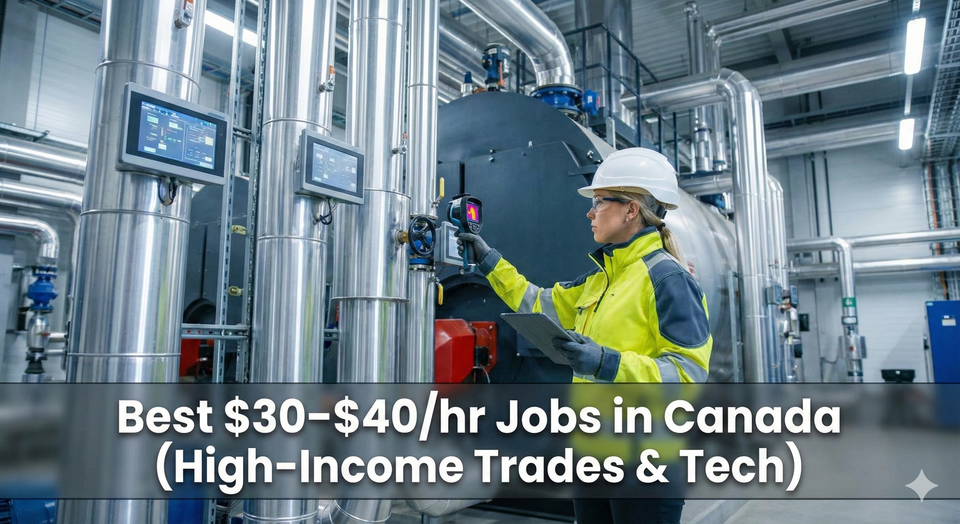
- The Job: You are the "Pilot" of a massive building. You operate the boilers, chillers, and pressurized equipment that keep hospitals, universities, and factories running.
- The Pay: $32.00 – $42.00 per hour.
- Why it wins:
- It’s "Stationary": Unlike other trades where you are crawling in mud, Power Engineers (also called Stationary Engineers) work in clean, climate-controlled control rooms.
- The Barrier: You need to pass the 4th Class Power Engineering exam (Technical Safety BC / TSSA). It requires a 1-year college course, but the payoff is immediate.
- Career Path: If you upgrade to "3rd Class" or "2nd Class," your pay jumps to $50+/hr.
2. Locomotive Engineer (Rail)
- The Job: Driving the massive freight trains that move goods across Canada. You are in control of the engine.
- The Pay: $35.00 – $45.00 per hour.
- The Promotion: Most people start as a Conductor (which we covered in our $25-$35 Guide), and after 2-3 years, they get promoted to Engineer.
- The Lifestyle: It is demanding. You are "on call" and away from home frequently. But for those who can handle the schedule, it is one of the highest-paid jobs in the country without a degree.
3. Nuclear Security Officer
- The Job: Guarding Canada's nuclear power plants (like Bruce Power or Darlington). This is not mall security. You carry a rifle and have paramilitary training.
- The Pay: $35.00 – $45.00 per hour.
- Why it fits:
- Union Protection: Unlike private security, these officers are often unionized (e.g., PWU) and have incredible benefits.
- Requirements: You need a spotless criminal record, high fitness levels, and usually a G license. They provide the specialized tactical training.
- Related: If you are just starting out, check our Security Guard License Guide to get your basic credentials first.
4. Underground Miner (Production)
- The Job: Drilling and blasting rock deep underground to extract gold, nickel, or copper.
- The Pay: $32.00 – $40.00 per hour (Base Rate).
- The "Bonus" Factor: The real money is in the "Production Bonus." If your team drills more meters than the target, you get paid extra. Many miners average $50-$60/hr when the bonus is included.
- Location: You go where the rocks are—usually Northern Ontario (Sudbury/Timmins) or Northern Quebec.
- Related: This is a key part of the "Dirty Jobs" sector we discussed in our Best Jobs for Men article.
5. Tower Crane Operator
- The Job: Sitting in the cab 50 stories above the city, moving steel and concrete for high-rise condos.
- The Pay: $38.00 – $48.00 per hour (Union Rate).
- Why it wins:
- The View: You have the best office in the city.
- The Stress: It is mentally exhausting because one mistake can be fatal. You are paid for your focus.
- Entry: You usually start as a "Rigger" on the ground to learn the hand signals before you are allowed in the seat.
6. Probationary Firefighter
- The Job: Responding to fires, car accidents, and medical emergencies.
- The Pay: $32.00 – $38.00 per hour (Starting Rate).
- The Progression: Firefighters have a locked-in pay grid. You might start at $35/hr, but within 4 years (1st Class Firefighter), you are guaranteed to make **$110,000+ ($50/hr)**.
- The Competition: It is incredibly hard to get in. Thousands apply for 10 spots. Having a trade certificate (like Electrician or Paramedic) gives you a massive advantage over other applicants.
7. elevator Mechanic Apprentice (Year 3-4)
- The Job: Fixing elevators and escalators.
- The Pay: $35.00 – $42.00 per hour.
- The "Apprentice" Reality: Even as a student (Apprentice), you earn more than most managers. By your 3rd year, you are making 70-80% of the Journeyman rate.
- The Goal: Once fully licensed, you hit the $60/hr range. It is the highest-paid construction trade in Canada.
- Related: Learn more about getting into this trade in our Highest-Paying Construction Jobs guide.
Comparison Table: The "Responsibility Premium"
Why do these jobs pay $40/hr while others pay $20/hr? It comes down to Risk and Asset Value.
| Job Title | What You Are Responsible For | Risk Factor | Hourly Pay |
| Nuclear Security | National Safety | High (Armed) | $40.00 |
| Crane Operator | Lives & $5M Machine | High (Fatal) | $42.00 |
| Power Engineer | Hospital Heating/Cooling | Medium (Pressure) | $38.00 |
| Miner | Production Targets | High (Physical) | $36.00 + Bonus |
| Firefighter | Public Safety | High (Health) | $35.00 (Start) |
Practical Questions Answered
"Is Power Engineering dying?"
No, it is evolving.
- The Myth: People think "Boilers = Coal."
- The Reality: Every hospital, university, and large condo complex needs Power Engineers to run their HVAC and steam sterilization systems. Green energy buildings need more complex management, not less.
"Can women be miners?"
Absolutely.
- The Shift: Modern mining is about operating joysticks and remote-controlled machinery, not swinging a pickaxe. Companies like Vale and Glencore are aggressively hiring women to improve safety culture. See our Jobs for Women Guide for more details on grants.
"Do I need to be good at math for these jobs?"
Practical Math, yes.
- The Test: Crane Operators need to calculate load weights. Power Engineers need to calculate pressure. You don't need Calculus, but you need strong Grade 12 Math skills.
Frequently Asked Questions
What is the fastest way to get a $35/hr job?
The Oil Sands.
If you are willing to fly to Fort McMurray and work 12-hour shifts for 21 days straight, you can earn this rate immediately as a specialized labourer or equipment operator. Check our Jobs Hiring Fast guide for agencies that recruit for these roles.
Is Firefighting a realistic career goal?
It is a long-term goal.
Do not count on getting hired tomorrow. It often takes 3-5 years of volunteering and testing to get a full-time spot. You need a "survival job" (like Construction or Paramedic) while you apply.
Do these jobs have pensions?
Yes, almost all of them.
Firefighters, Nuclear Security, Power Engineers (Public Sector), and Rail Engineers all typically have "Defined Benefit" pensions. This is worth an extra $10,000/year in deferred income.
About the author
Jeff Calixte (MC Yow-Z) is a Canadian career researcher and digital entrepreneur. He tracks real-time labour market data, government hiring trends, and entry-level opportunities to help newcomers and students navigate the Canadian job market.
Sources
- Technical Safety BC (Power Engineering): https://www.technicalsafetybc.ca/
- Canadian Nuclear Safety Commission (Security): https://www.cnsc-ccsn.gc.ca/
- Teamsters Canada (Rail Careers): https://teamsters.ca/
Note:
Job availability, wages, and hiring conditions can vary widely by province, employer, season, and experience level. All salary ranges and job examples in this guide are estimates based on current labour market data. Always confirm details directly with the employer before applying.